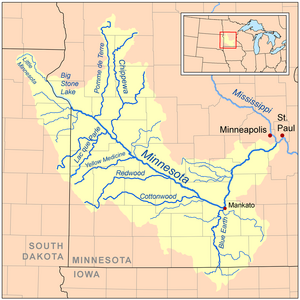
Minnesota River
Tributary in MinnesotaWikipedia
15
MENTIONS
13
EPISODES
13
PODCASTS
Search complete. 15 mentions across 13 episodes found for "Minnesota River".
Sep 9, 2026

Sabrina Deana-RogaGUEST
Like, the dogs stop at the water and are picking up his scent.
Sabrina Deana-RogaGUEST
And now, the Yellow Medicine is a small river that flows into the Minnesota River.
Sabrina Deana-RogaGUEST
It's not huge.
Sabrina Deana-RogaGUEST
In places it's knee-deep, but in other spots it does drop to 10 or even 15 feet.

John BatchelorHOST
What is most moving about the lynches is the professor takes us to a graveyard near at hand.
John BatchelorHOST
This is in a bend in the Minnesota River.
John BatchelorHOST
Carney and Kavanaugh, Donovan and Duffy, Fahey and Fitzgerald, McCarthy and...
John BatchelorHOST
This is like a song, Professor.

Mr BallenHOST
And he was terrified that the thing that he and really everybody else in his town had been scared of for days was now finally happening.
Mr BallenHOST
So right on the other side of the woods that surrounded the farm was the Minnesota River.
Mr BallenHOST
And over the last decade, lots of people had settled along this river.
Mr BallenHOST
And there'd been a town established right nearby and new homes were being built constantly.
Mr BallenHOST
They just hadn't heard the real story yet.
Mr BallenHOST
They were sort of operating like there was an attack coming.
Mr BallenHOST
So apparently, a group of American soldiers had been riding on a boat up the Minnesota River, and for some reason, they'd just gotten overly excited and began firing their guns repeatedly.
Mr BallenHOST
So those were gunshots.

Jay LeemingHOST
In 1862, the Homestead Act made it legally possible for people to claim land all around this area.
Jay LeemingHOST
Partly in response to that and in response to many other things, the Santee Sioux, in a desperate act, attacked settlements all along the Minnesota River, killed hundreds of settlers.
Jay LeemingHOST
Five weeks later, the U.S. government hung 38 Santee Sioux Indians, Little Crow being the leader, and 37 others.
Jay LeemingHOST
The largest mass execution in U.S. history.

Cal NessHOST
You ever heard of that, Joey? Mm-hmm.
Cal NessHOST
was established in 1883 in the Minnesota River Valley and had a caretaker, chef, and other employees that waited on groups of hunters showing up by train.
Cal NessHOST
Other clubs formed around Huron Lake, Lake Christina, Swan Lake, and countless other smaller waters.
Cal NessHOST
And the railroad had essentially, basically boomed the duck hunting in Minnesota.

Devin Ashley BrownGUEST
There's still so much more work to be done.
Devin Ashley BrownGUEST
There's, you know, where the Minnesota, back to tributaries, where the Minnesota River enters the Mississippi River, there's like a harsh line where you can see the agricultural runoff come into the river.
Devin Ashley BrownGUEST
And as you travel down the river, like not to call it Iowa, but also agricultural runoff from Iowa.
Devin Ashley BrownGUEST
So that changes the health of the river a lot.
8 MINS LATER
John AnfinsonGUEST
And the purpose is? Is to lift towboats and barges up.
John AnfinsonGUEST
They go through a lock and it raises them up to that next level.
John AnfinsonGUEST
But they had to do that because that river through that eight-and-a-half-mile gorge between St. Steve Falls and the Minnesota River Confluence was a phenomenal rapids with braided channels and islands.
John AnfinsonGUEST
And it was... phenomenally productive environmentally.

John BrandonNARRATOR
My maternal grandfather, Captain Duncan Graham, a Scotchman by birth, who had seen service in the British Army, was one of a party of Scotch Highlanders, who in eighteen eleven arrived in the British Northwest by way of York Factory, Hudson Bay, to found what was known as the Selkirk Colony near Lake Winnipeg, now within the province of Manitoba, Canada.
John BrandonNARRATOR
Soon after his arrival at Lake Winnipeg, he proceeded up the Red River of the North and the western fork thereof to its source, and thence down the Minnesota River to Mendota, the confluence of the Minnesota and Mississippi Rivers, where he located.
John BrandonNARRATOR
My grandmother, Hazahotawin, was a full-blood of the Mdewakanton band of the Sioux tribe of Indians.
John BrandonNARRATOR
My father, Joseph Boisen, born near Montreal, Canada, was connected with the American Fur Company, with headquarters at Mendota, Minnesota, which point was for many years the chief distributing depot of the American Fur Company, from which the Indian trade conducted by that company on the upper Mississippi was directed.

John BrandonNARRATOR
My maternal grandfather, Captain Duncan Graham, a Scotchman by birth, who had seen service in the British Army, was one of a party of Scotch Highlanders who in eighteen eleven arrived in the British Northwest by way of York Factory, Hudson Bay, to found what was known as the Selkirk Colony near Lake Winnipeg, now within the province of Manitoba, Canada.
John BrandonNARRATOR
Soon after his arrival at Lake Winnipeg, he proceeded up the Red River of the North and the western fork thereof to its source, and thence down the Minnesota River to Mendota, the confluence of the Minnesota and Mississippi Rivers, where he located.
John BrandonNARRATOR
My grandmother, Hazahotawin, was a full-blood of the Mendowakinton band of the Sioux tribe of Indians.
John BrandonNARRATOR
My father, Joseph Boysen, born near Montreal, Canada, was connected with the American Fur Company, with headquarters at Mendota, Minnesota, which point was for many years the chief distributing depot of the American Fur Company, from which the Indian trade conducted by that company on the Upper Mississippi was directed.

John BrandonNARRATOR
My maternal grandfather, Captain Duncan Graham, a Scotchman by birth, who had seen service in the British Army, was one of a party of Scotch Highlanders, who in eighteen eleven arrived in the British Northwest by way of York Factory, Hudson Bay, to found what was known as the Selkirk Colony near Lake Winnipeg, now within the province of Manitoba, Canada.
John BrandonNARRATOR
Soon after his arrival at Lake Winnipeg, he proceeded up the Red River of the North and the western fork thereof to its source, and thence down the Minnesota River to Mendota, the confluence of the Minnesota and Mississippi Rivers, where he located.
John BrandonNARRATOR
My grandmother, Hazahotawin, was a full-blood of the Mdewakanton band of the Sioux tribe of Indians.
John BrandonNARRATOR
My father, Joseph Boison, born near Montreal, Canada, was connected with the American Fur Company, with headquarters at Mendota, Minnesota, which point was for many years the chief distributing depot of the American Fur Company, from which the Indian trade conducted by that company on the upper Mississippi was directed.

John BrandonNARRATOR
My maternal grandfather, Captain Duncan Graham, a Scotchman by birth, who had seen service in the British army, was one of a party of Scotch Highlanders who in eighteen eleven arrived in the British Northwest by way of York Factory, Hudson Bay, to found what was known as the Selkirk Colony near Lake Winnipeg, now within the province of Manitoba, Canada.
John BrandonNARRATOR
Soon after his arrival at Lake Winnipeg, he proceeded up the Red River of the North and the western fork thereof to its source, and thence down the Minnesota River to Mendota, the confluence of the Minnesota and Mississippi Rivers, where he located.
John BrandonNARRATOR
My grandmother, Hazahotawin, was a full-blood of the Mendowakinton band of the Sioux tribe of Indians.
John BrandonNARRATOR
My father, Joseph Boysen, born near Montreal, Canada, was connected with the American Fur Company, with headquarters at Mendota, Minnesota, which point was for many years the chief distributing depot of the American Fur Company, from which the Indian trade conducted by that company on the upper Mississippi was directed.
3 more episodes mention Minnesota River.
Create an account to see the whole feed, search across every transcript, and follow the entities you care about.