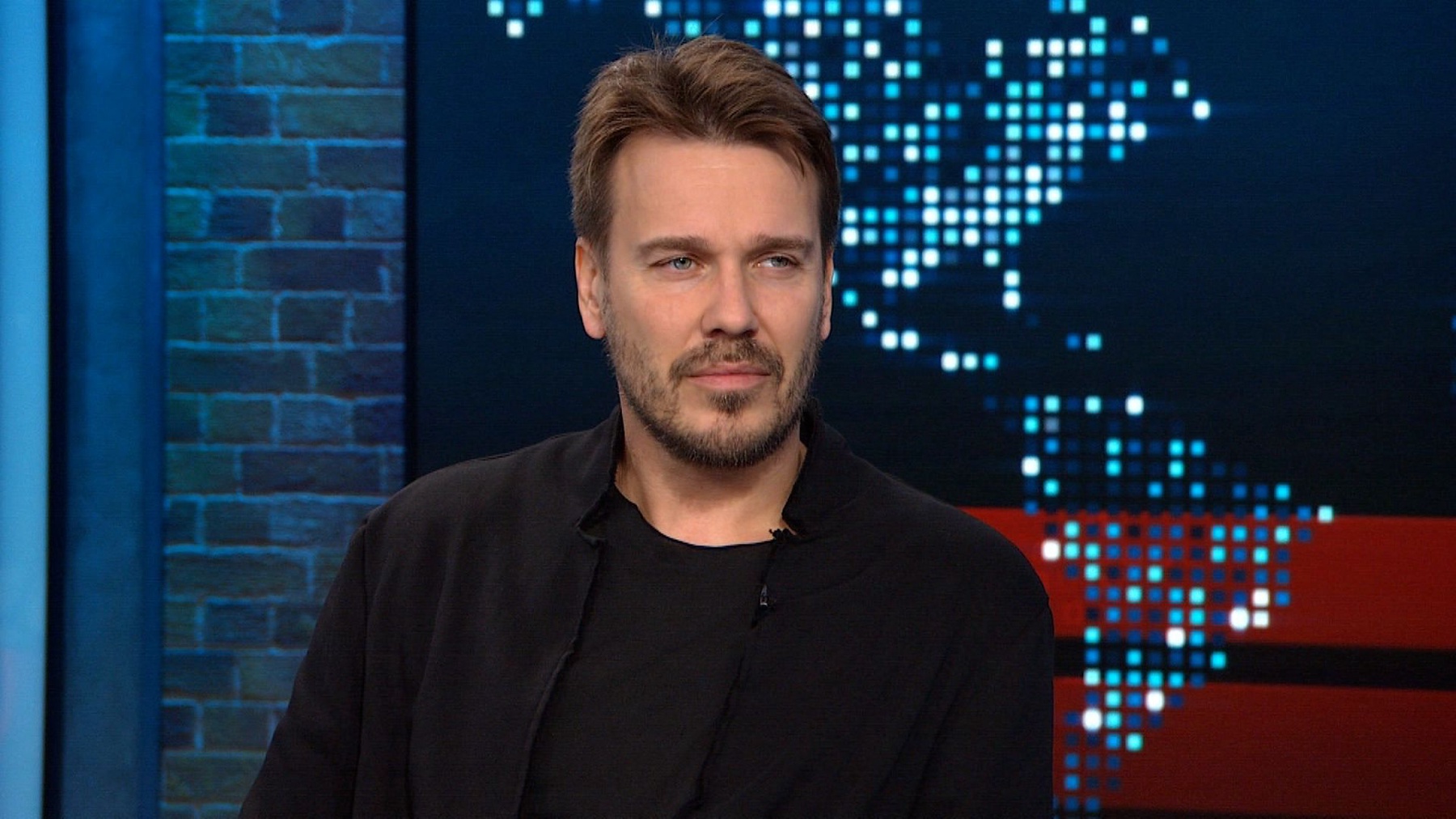
Mikhail Zygar
Russian journalist and writer
11
APPEARANCES
10
PODCASTS
Sep 27, 2026


Olivia ManesHOST
Is there anything that's reminding you of that sort of constricting of media freedom and freedom of expression, either through, you know, making it financially difficult or through other means?

Mikhail ZygarGUEST
No, it's, it's hard for, for me to compare the situation in, uh, in America and the situation in Russia that, that existed 25 years ago because, yeah, de- definitely countries are very different and the, the democratic institutions that exist in America are very different and much more developed than the ones we used to have in Russia.
Mikhail ZygarGUEST
But definitely if we, if we need to write a playbook of how independent media should endure any kind of pressure from anyone, the first word we must remem- remember is the self-censorship, because that's, that's the biggest threat to m- to media freedom.
Mikhail ZygarGUEST
When journalists know that it's not safe for them to do their job, to make investigations, to report about mismanagement, to criticize the government or anyone, the moment when, when j- journalists start being afraid or their, their bosses, their editors start being afraid of, uh, touching some topics, that's, that's the moment when we should know that we're in trouble.
Mikhail ZygarGUEST
I remember that it started with, with bits of self-censorship in Russia, uh, 25 years ago.
12 MINS LATER


Olivia ManesHOST
Is there anything that's reminding you of that sort of constricting of media freedom and freedom of expression, either through, you know, making it financially difficult or through other means?
Mikhail ZygarGUEST
No, it's, it's hard for, for me to compare the situation in, uh, in America and the situation in Russia that, that existed 25 years ago because, yeah, de-definitely countries are very different and the, the democratic institutions that exist in America are very different and much more developed than the ones we used to have in Russia.
Mikhail ZygarGUEST
But definitely if we, if we need to write a playbook of how independent media should endure any kind of pressure from anyone, the first word we must remem-remember is the self-censorship because that's, that's the biggest threat to m- to media freedom.
Mikhail ZygarGUEST
When journalists know that it's not safe for them to do their job, to make investigations, to report about mismanagement, to criticize the government or anyone, the moment when, when j-journalists start being afraid or their, their bosses, their editors start being afraid of, uh, touching some topics, that's, that's the moment when we should know that we're in trouble.
Mikhail ZygarGUEST
I remember that it started with, with bits of self-censorship in Russia, uh, 25 years ago.
12 MINS LATER


Joel RoseHOST
For more about how the dynamic has changed in the years since 9/11, I spoke with British Chinese journalist Cindy Yu and Russian journalist Mikhail Zygar.
Mikhail ZygarGUEST
I think that's very important to remember that that was almost the beginning of Putin's presidency.
Mikhail ZygarGUEST
He became president in, uh, year 2000, so he was just learning how to become the head of state, and he was trying really badly to become a friend of, uh, George W. Bush, as well as, uh, to become a equal partner for his European leaders.
Mikhail ZygarGUEST
He really wanted to, for, for example, to become a part of G8, to become a partner of the United States in, uh, in the war against terror.
5 MINS LATER


Fareed ZakariaHOST
When we're all trying to speculate, what will it do to the decision-making of this one guy?
Mikhail ZygarGUEST
Although we understand that everyone sees that that's a deadlock, Putin is clearly the person who does not understand and who doesn't see that.
Mikhail ZygarGUEST
Uh, and it's very hard to try to see the world through his, uh, point, point of view, but he's not, uh, losing this war, he thinks.


Mikhail ZygarGUEST
he doesn't really have friends because, uh, if we're talking about Kovalchuk, Kovalchuk was, was in a way, was the mastermind of the war.
Mikhail ZygarGUEST
He was one of those closest, uh, Putin's allies who, uh, who was, who was spending a lockdown with him in Valdai in, um, in 2020.
Mikhail ZygarGUEST
And they together actually wrote that script of the future war against Ukraine.
28 MINS LATER

Nick SpicerCORRESPONDENT
What is the sort of takeaway for somebody living in the here and now today?
Mikhail ZygarGUEST
You know, I'm afraid to say that I see some parallels because definitely an almighty empire that Soviet Union used to be and the almighty empire of the United States of America have something in common.
Mikhail ZygarGUEST
And I think it will be really m- important for some people in America to read this to see some obvious trends that were happening in the Soviet Union and how that empire came to its end.
Mikhail ZygarGUEST
And one of the most important reasons, as I've already mentioned, was the crisis of faith, crisis of confidence.
Mikhail ZygarGUEST
The fact that, um, for all Soviet people, the communist ideology was completely outdated and no one believed in it.
Mikhail ZygarGUEST
So basically, yes, I think liberal democracy as, as it is the, the cornerstone ideology of, uh, the United States is crucial.And cynicism, uh, which is becoming more and more influential in many countries of, of the world, is that kind of disease.
Mikhail ZygarGUEST
So I think that's, um, to, to find some pa- some unexpected parallels between historic figures, because I think, uh, unexpectedly, uh, when I was writing about Mikhail Gorbachev, for example, I found that he historically, in a way, looks like former President Barack Obama, or first Russian President Boris Yeltsin in a way, uh, reminded me of Donald Trump.
Nick SpicerCORRESPONDENT
And just to look forward for your country and the Russians who may be looking back on their history and imagining the future, do you feel hopeful for your country? Is there gonna be a moment where, uh, freedom and democracy come to the country?

Mikhail ZygarGUEST
... he's, he's trying to figure it out and he cannot because that's, that's not how the system works.
Mikhail ZygarGUEST
And that's, for him, that becomes the, the crucial moment because he realizes that freedom of speech is needed to, to inform the population about what, what, what people need to know.
Mikhail ZygarGUEST
And he opens that Pandora box and he, he lets journalists, uh, speak their mind.
15 MINS LATER

Mike PescaHOST
If you had to write this book and come out with this book, and I know you worked on it for six years, while still being a Russia in Russian, how would the book be different?

Clarissa WardMODERATOR
It may just be about greed on a certain
Mikhail ZygarGUEST
And I have this story about his predecessor who looks, if you compare pictures of Vladimir Krychkov, the last head of KGB of the Soviet Union, and Vladimir Putin, like he looks right now.
Mikhail ZygarGUEST
But I have the story of Vladimir Khrushchev in head of KGB trying to replace communist ideology with Orthodox Christianity and trying to save Soviet Union with help of the Orthodox Church.
18 MINS LATER
speaker_9AUDIENCE
Don't you think West is playing Putin's game, helping them isolate?

Clarissa WardHOST
And I wanted to start by getting to grips with what drove you or what compelled you to feel like this history needed to be retold, re-examined, and understood in a different light.
Mikhail ZygarGUEST
All the books, most books written about the collapse of Soviet Union were written in the beginning of the 90s.
5 MINS LATER
Clarissa WardHOST
But also, our ideas were better, is the kind of prevailing feeling in the US, let's say,


Erica HillHOST
He wants to go back to this map, right, long before that in terms of, as you noted, this idea of imperialism.
Mikhail ZygarGUEST
You know, Putin thinks that sanctions don't work and he considers himself to be quite invincible.
Mikhail ZygarGUEST
But speaking about your previous news about Venezuela, I think if something changes in Venezuela, Or I mean, if something really important changes to the global oil market, that could be the only factor that could really hurt Vladimir Putin, because he really depends on the oil prices.
Mikhail ZygarGUEST
As we remember, Soviet Union was really hurt in in 1984 when Saudi Arabia lifted all of all the limitations of oil production and oil prices collapsed globally.
Mikhail ZygarGUEST
So if there is the way to stop Putin from earning a lot of money from Russian oil, that's going to hurt.
Mikhail ZygarGUEST
You know, it may seem very unusual for American audience, but, you know, My book is more a book about people than some kind of political science.

33:09

W- what's Putin support like in Russia now? Is it stronger, weaker as the war continues, and with Trump returned to power?
Mikhail ZygarGUEST
We don't have any statistics. And yes, obviously, while the war is going on, uh, Putin can control the country. He can control everyone because everyone is really afraid. Uh, the war has become the unique mechanism to control the country, including, uh, uh, the elites, including his inner circle, and I think he knows that. And that's one of the main, uh, very important reasons for him not to think of, uh, ending this war because, uh, it will be much more dangerous for him if the army comes back, if the war v- veterans, uh, after the end of the war starts sp- speaking up. Uh, syst- so-called systemic liberals, people from his elite, big business are going to be very unhappy with, uh, everything what's happening. So and... There is the solution, not to stop this war because ev- everyone is going to be, um, terrified and mobilized at the same time as, as they are now.
34:18
Do people inside Russia believe Trump is a deal-making master playing three-dimensional chess with Putin? How, how do they see the Trump-Putin power relationship?
Mikhail ZygarGUEST
Hmm. You know, I would say that, uh, there are two camps, uh, and both of them are very funny. Uh, one... The biggest one, um, and s- somehow there is an alliance of Russian propaganda, uh, and Russian middle class, Russian big business, uh, see that as an opportunity because for many people, um, there is... If there is a chance to bring, uh, the situation back to pre-war conditions, to the early t- uh, 2022, it will be the best case scenario. And some- sometimes, uh, Russian propagand- uh, propagandas started praising D- Donald Trump and qu- calling him, um, a reliable partner. Um, there is an installation, uh, uh, erected next to American Embassy in Moscow. "We are..." with huge plastic ladders. "We are together," in, uh, white, uh, red and blue, colors of Russian flag and American flag as well. So a lot of people are really happy with that or they are instructed to be happy. But there is a huge part of, uh, the population who, uh, probably who are so brainwashed by so many years of, uh, anti-American propaganda and who distrust America that much, so they, uh, they suspect a lot. And basically, they, they had a very important argument on their side this morning because, uh, uh, the consequences of the, the last conversations between, uh, Volodymyr Zelenskyy and Donald Trump were not, um, really optimistic for Russians because, uh, when Donald Trump offered, uh, Z- Zelenskyy to get all Ukrainian, uh, energy infrastructure and, uh, Uk- Ukrainian, uh, nuclear power, power stations under, uh, American control and American ownership, that was a very important sign for, for many Russians, uh-