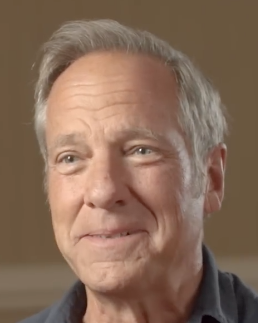
Mike Rowe
American television host and narrator
63
APPEARANCES
33
PODCASTS
Oct 18, 2026


Mike RoweGUEST
Mark invites me down to Facebook, and he talks about this thing called Watch, Facebook Watch.
24 MINS LATER


Michael BerryHOST
aria aria with the touch a touch yeah a little a little just a little piece of the italian thing just for the sophisticated folk in the audience
Mike RoweGUEST
you have sophisticated folks i think so hey you just said something you mind if i take a quick digression you may whatever it was you were trying to say what you said instead was art now What happens when you take the art out of a thing? We took the arts out of high school, the humanities.
Mike RoweGUEST
And there was a great hue and cry when we cut music programs and things like that.
Mike RoweGUEST
And before vocational technology was called vo-tech, it was called the vocational arts.
5 MINS LATER
Mike RoweGUEST
Right? And so when I say safety third, just because you're in compliance doesn't mean you're out of danger.
Mike RoweGUEST
Oh, safety third was a turn of phrase that came out of dirty jobs about 10, 12 years ago.
Mike RoweGUEST
And it was in direct response to an expression you'll be more familiar with, which was, of course, safety first.
Mike RoweGUEST
Everybody knows that who's ever worked around machines like this or has just tried to get through life.
RamonHOST
because you were a potential victim of a an attempt to change work a well-intended


Brian SozziHOST
Here's what Dirty Jobs host and creator Mike Rowe told me on this glaring issue.
Mike RoweGUEST
We've been talking about this at MicroWorks for 18 years, and it's both gratifying and terrifying, if I'm being honest, to see the numbers made real.
Mike RoweGUEST
A lot of research went into this report, and there's a lot of data in it, and we could probably talk for an hour about what it all portends and just scratch the surface.
Mike RoweGUEST
And now as we enter what looks to be a really new infrastructure build out and a really new economy, it's going to be the pinch point.
Brian SozziHOST
But what if there's, we don't have the infrastructure built by the humans to support this technology, then none of it comes to life.

Mike RoweGUEST
I also think that if he had a bunch of money, he still, he's a guy who really enjoys the simple life, and, uh, I respect that.
29 MINS LATER

Mike RoweGUEST
Even if you don't need cash today, try borrow.com right now just to see how it works.
Mike RoweGUEST
In minutes, you'll get a range of how much cash you could have wired into your account in 24 hours.


Ellie AustinHOST
Tell me a bit about how attitudes towards those jobs have changed since then and where we are right now in this moment.
Mike RoweGUEST
Well, on a personal level, it's beyond strange to see the headlines catch up with a message.
Mike RoweGUEST
You know, we started MicroWorks in 2008, and nobody really disagreed with me back then.
Mike RoweGUEST
The basic argument was you got a couple million good jobs that don't require a four-year degree.
Mike RoweGUEST
The jobs are essential, but for whatever reason, they're not lauded, they're not celebrated, and most of them are out of sight and out of mind.
Mike RoweGUEST
The premise for my foundation rhymed with the show I was working on, Dirty Jobs, pretty well.

Mike RoweGUEST
We just saw this crazy pied piper marching up and down the normally sedate halls of Overly.
9 MINS LATER

Bill CourtneyHOST
So the question then is from Fred, if the grandfather's humility and the scout master taught you how to embrace the suck, what'd Fred teach you? What's that word?

Mike RoweGUEST
It was, I was in business with Caterpillar, and they wanted to do something to draw attention to the work we were doing together around the skills gap.
Mike RoweGUEST
And I jokingly said, "Well, look, if I just write a book about the issue, you can publish it for me," 'cause I didn't have time to go to a publisher and go through the whole mishegoss of writing a book.
Mike RoweGUEST
And they were like, "Yeah, do that." So the book is called Profoundly Disconnected, and it's really just a collection of essays I had written over the years that answer that question.
Mike RoweGUEST
And in short, it was a look at the things from which we've become untethered, fundamental, like, primal things, and the way in which that happens, which is almost invariably in dribs and drabs.

Alex ClarkHOST
So when you look at, you know, what's transpired in the state of California for the last several decades, do you see this as a state-specific problem? Do you see it as, uh, like, a clue as to where the rest of the country is headed?
Mike RoweGUEST
It was, I was in business with Caterpillar, and they wanted to do something to draw attention to the work we were doing together around the skills gap.
Mike RoweGUEST
And I jokingly said, "Well, look, if I just write a book about the issue, you can publish it for me," 'cause I didn't have time to go to a publisher and go through the whole mishegoss of writing a book.
Mike RoweGUEST
And they were like, "Yeah, do that." So the book is called Profoundly Disconnected, and it's really just a collection of essays I had written over the years that answer that question.
Mike RoweGUEST
And in short, it was a look at the things from which we've become untethered, fundamental, like, primal things, and the way in which that happens, which is almost invariably in dribs and drabs.
Alex ClarkHOST
So when you look at, you know, what's transpired in the state of California for the last several decades, do you see this as a state-specific problem? Do you see it as, uh, like, a clue as to where the rest of the country is headed?

Mike RoweGUEST
Well, I mean, yeah, the data centers are a big deal, and it's worth saying, too, that it's not like they just popped out of nowhere on account of AI.
Mike RoweGUEST
Data centers have been around for decades, and they're at the root of every form of modern connectivity that we know of.
Mike RoweGUEST
China plays for keeps, and this is a really important part of building out what Larry Fink has described as a $10 trillion infrastructure.
Mike RoweGUEST
We have the money and we have the will, but we just don't have the skilled labor in place.


Mike RoweGUEST
Look, this is so far out of my lane, but, like, the buzz is asymmetrical warfare.
Mike RoweGUEST
The conversation is the, we're never gonna out-manufacture China, never in a million years.
Mike RoweGUEST
So, they're g- they're, they're companies like, like Hadrian and Apex and, and Mock who I'm actually shooting with them later this week, but they're making very, very cheap, very lethal weapons.

Bill MaherHOST
Rebuilding, to me, [laughs] is going to be a very big growth industry, and there's just not enough people to do it.
Mike RoweGUEST
Most of that's held by kids who either started a four-year degree and dropped out or who got one and statistically aren't working or not working in their chosen field.
Mike RoweGUEST
Meanwhile, we've got $400,000, 400,000 jobs in construction right now, twice that many in the defense industrial base.
7 MINS LATER
Mike RoweGUEST
You don't quite know what's going to happen if you're in the Nina, the Pinta, or the Santa Maria, and you're just sailing.

Eric BollingHOST
You know, it's not the next hundred years, but some people, you know, 60, 70 years in front of them going, well, I will I be able to make a difference? Or am I just going to be, as Elon Musk says, playing golf or listen to headphones and virtual glasses and that'll waste my life away that way?


Mike RoweGUEST
I testified before a House committee and then in front of the Senate as well on behalf of my own foundation, MicroWorks, just to talk about the need to close the skills gap and make a more persuasive case for a bunch of great jobs.

Eric BollingHOST
Aren't we saying the same thing? Won't all our construction projects be robotics? Won't all our pipe fitting skills be robotics? Won't all our ship building
Mike RoweGUEST
be robotic? It was impossible during the agricultural revolution to imagine the industrial revolution.
Mike RoweGUEST
at the height of the Industrial Revolution, to imagine the revolution in financial services and then technology.
Mike RoweGUEST
And it's virtually impossible now to imagine what the world's going to look like.

2:55
... where the kids, the, the males, the males, the men in our society are just sort of sitting there at home, living in the basement and looking at videos.
Mike RoweGUEST
I hate to paint with too broad a brush, but when you get to that number, 6.97 million, that's never happened in this country before, not in peacetime anyway.
Mike RoweGUEST
And the guest you should really have to answer that question, you know, with all the impressive credentialing behind his name, is Nick Eberstadt.
Mike RoweGUEST
He wrote an extraordinary book called Men Without Work in 2005, which became sort of the operating manual for my own foundation to a point, and republished it during the lockdowns because everything he had predicted or prophesied, uh, came true.
Mike RoweGUEST
So with regard to that cohort, roughly seven million guys sitting around, the question, or at least the first question, isn't what are they doing, it's what aren't they doing? And what they're not doing is volunteering, uh, through their local church.
Mike RoweGUEST
They're not participating in the Kiwanis Club or the Jaycees or the Rotary or the Lions Club.
Mike RoweGUEST
They're not involved in SkillsUSA or Future Farmers of America or the 4-H Club or the Boy Scouts.
40 MINS LATER
Mike RoweGUEST
There's some things about AI that frankly worry me to death, but data centers I've seen this play before, man.

Brian KilmeadeHOST
But this would be plumbers and pipe fitters and electricians, right? And they'll be turning to Mike Rowe to do that, correct?


Mike RoweGUEST
importantWe made the point earlier, I think, that, you know, our frustration with the trades sometimes is rooted in our inability to do the work ourselves.
Mike RoweGUEST
So I don't know if there's a corollary between jumping a fence or throwing a punch or changing a tire with being able to change your brakes, you know? Like, I can still change a tire.
50 MINS LATER


Leland VittertHOST
What what is the problem here? What is the need and how does the 10 million dollars solve it?
Leland VittertHOST
How much of this is the stigma, not so much for people, for people who want a paycheck, but for parents and for friends and for peers of saying, hey, I'm going to trade school to be a welder versus, hey, I'm going to learn to be an accountant?


Mike RoweGUEST
this is the reason why I was always perplexed by the way the issue becomes partisan.
6 MINS LATER

Mike CarruthersHOST
A lot of the platitudes, as you say, on office walls, uh, about teamwork and, and passion and perseverance and all this that, uh, there is a different view, and you take that different view, and so let's talk about that.
Mike RoweGUEST
Well, if you think about all of what passes for good advice, you can really just give me a topic and I can give you the Dirty Jobs corollary to it.
Mike RoweGUEST
We spend a lot of time talking about the importance of working as a team, and obviously there are tons of examples Where that makes perfect sense to understand and embrace, but it's so easy to go too far, and that's typically what we do.

Mike RoweGUEST
I, I don't know if it's gonna happen or not, but I would not be surprised if Jim Farley started building, um, auto shops and training facilities under the Ford umbrella, just like Henry did 100 years ago.
Mike RoweGUEST
I-- Not, not a week goes by where I don't get a call from some industry leader, including Jim, who-- that, that wants to talk about the extraordinary Opportunities within their own silo.
21 MINS LATER


Mike RoweGUEST
There was a big infrastructure pitch, and President Obama had pledged to create three million shovel-ready jobs, and I wrote him a letter that you can find today, and I just said, "Look, man, I'm rooting for you.
Mike RoweGUEST
I love it." Remember, Dirty Jobs is killing it at this point, and I'm, I'm out there, and I'm saying, "I'm not an expert, but from what I've seen, and I have had a front row seat for a while to a lot of this, I don't think you can-- I think you're gonna have an easier time filling these positions if you're talking to a country who feels enthused about picking up a shovel, right? And if, if you're assuming that shovel-ready jobs are just gonna be filled because you create them, I, I'm afraid you're gonna have a hard road." Right? So I-- that's my message.
Mike RoweGUEST
A year ago, I was at a, uh, an energy conference in Pittsburgh held by, convened by Dave McCormick, who I know you know.
9 MINS LATER
Leland VittertHOST
And people said, OK, we have to stop demonizing dads and we have to start making not being a father shameful rather than being a strong father shameful.
Mike RoweGUEST
With Father Knows Best and Leave It to Beaver, we were all the way in that direction.
Leland VittertHOST
But be so successful at, and yet be so scared and feel as though you are failing.
MattSOUNDBITE_SPEAKER
Welcome to Colorado.
Mike RoweGUEST
What if OSHA got it wrong? What if it's really safety third, right? And so when I say safety third, just because you're in compliance doesn't mean you're out of danger.
Mike RoweGUEST
Safety third was a turn of phrase that came out of Dirty Jobs about ten, twelve years ago, and it was in direct response to an expression you'll be more familiar with, which was, of course, safety first.
16 MINS LATER
Scroll for more appearances