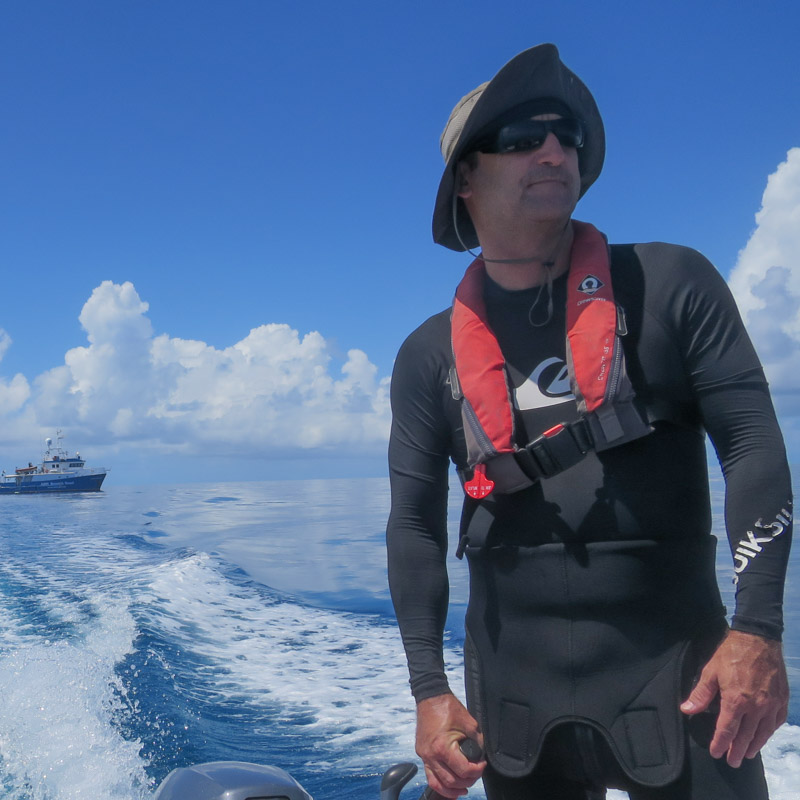
Mike Emslie
2
APPEARANCES
2
PODCASTS
Aug 18, 2026


Lincoln BertoliHOST
yeah okay and we'll touch on that a little bit further Mike can we just ask you around the practicalities of collecting the data and releasing it it's an annual monitoring program if you like what happens you get the data you synthesize it what happens next

Mike EmslieGUEST
Then we come back into the office and for all the kind of imagery that we collect to quantify the benthos, that all gets run through an AI algorithm as a first pass and then checked by human observers.
Mike EmslieGUEST
And then we're able to be able to tell how much cover is associated with hard corals and etc.
Mike EmslieGUEST
Once all the data has been QA, QC, we then, I guess, go into reporting modes and we have a number of different avenues for that.
Mike EmslieGUEST
We've got an interactive online dashboard where the general public or anyone can go and check out the status of their favorite race and then each year we produce an annual report which comes out in around august each year and that then updates everyone on on what we've found in the preceding 12 months and what the status of the reef is yeah and then sets that in the context of the 40 years so we're looking at how much coral is out there at the moment have we seen intensive bleaching over the preceding 12 months have we seen outbreaks of pound of thorns starfish that really gives an update of the status of all the reefs that we go and visit
8 MINS LATER
Lincoln BertoliHOST
Mike, can I ask you, how has this program after 40 years or even earlier influenced other large scale monitoring programs on other coral reefs around the
Mike EmslieGUEST
world? Well, I guess it really laid the blueprint for how you go about long term, robust, rigorous scientific monitoring.


Sally SaraHOST
So how, how does this data fit into the bigger picture at the moment, Mike, about the health of the reef as best we understand it?
Mike EmslieGUEST
Well, this program is now in its fortieth year, so that gives us a really, you know, unique look at the status of the Great Barrier Reef, and we can certainly set this year in the context of that whole data set.
Mike EmslieGUEST
And I guess what it shows is that, uh, for two of the three regions, the, the coral cover's above average, well above average, so that's some good news.
Mike EmslieGUEST
Um, you know, it's a, it's a, a place that's the size of a small country like Italy, so there's a lot of variability in the state of reefs.
Mike EmslieGUEST
But the other thing we have noticed is that over the last fifteen years we've started to see really increasing volatility in the levels of hard coral cover that are on the reef.
Mike EmslieGUEST
We've gone from record lows, uh, to record highs, followed by the largest annual declines, and this volatility is really indicative of a, a system under stress.