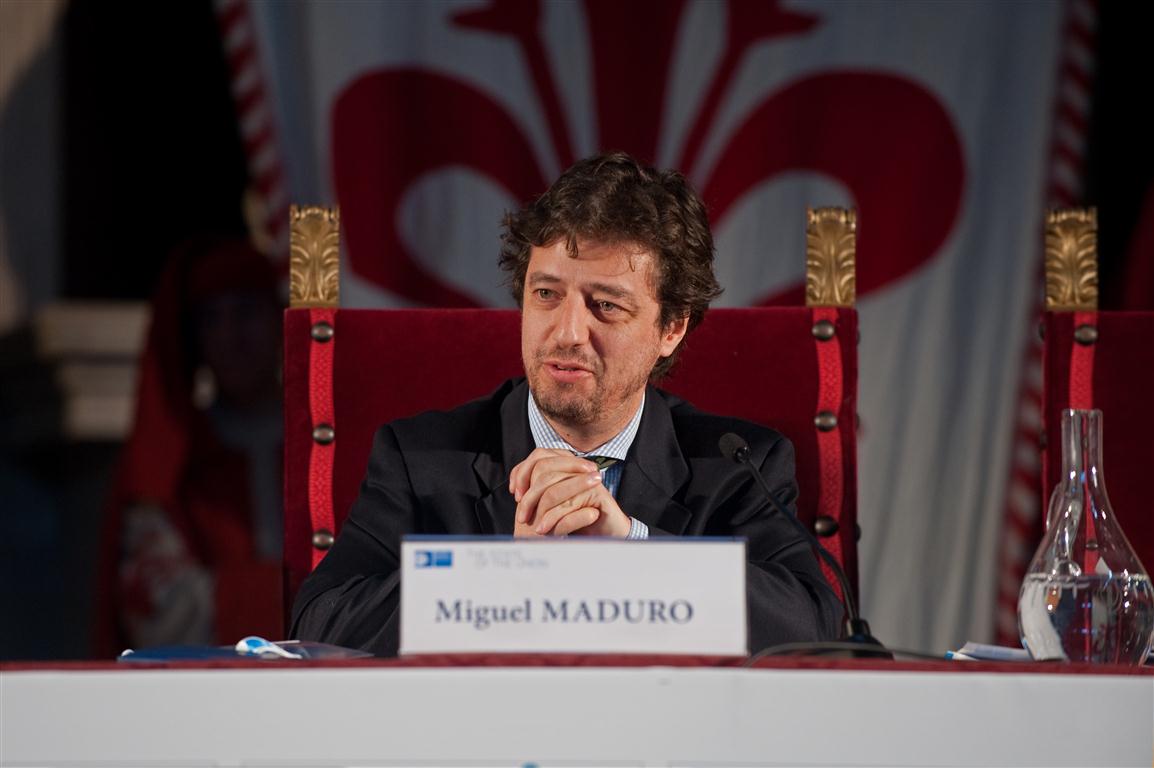
Miguel Poiares Maduro
Portuguese Politician
10
APPEARANCES
7
PODCASTS
Aug 23, 2026

Nicklas DegnHOST
Jeg har fået fat i Miguel Maduro for at høre hans syn på alt det, vi nu har set udfolde sig hos FIFA og Infantino de seneste uger.

Miguel MaduroGUEST
Well, not particularly surprised by the project that mr. Infantino attempted and to certain extent even by the reaction that happened though I'm more surprised that there was such outrage at it deserved outrage than I am for the proposal to have been put forward or for the project to have been undertaken by mr. Infantino.
Miguel MaduroGUEST
First I'm not surprised with the project itself, because I'd see it as simply one more step on a trajectory of hyper commercialization of football that FIFA has undertaken many years ago, even before the presence of Infantino, the presidency of Infantino, and that Infantino himself has been gradually but steadily promoting, and that it is also a strategy of hyper commercialization that is not exclusive of FIFA.
Miguel MaduroGUEST
But we see it at the level of all the football associations and confederations, including UEFA.
Miguel MaduroGUEST
And and this strategy of hyper commercialization happens because of the set of incentives that are at play in FIFA.
Miguel MaduroGUEST
First, FIFA sits at the heart of a systemic conflict of interest between being, on the one hand, the regulator.
14 MINS LATER


Ryan BridgeHOST
And he's trying to get by on a technicality, right? He's saying his first term was only two years, and you're meant to have three four-year terms, therefore he's short and he's due another one.
Miguel MaduroGUEST
Yes, that is what he's invoking, but there is no basis, In the text of the rule or the purpose of the rule for that, the text of the rule makes no distinction between whether the terms take four years or three years.
Miguel MaduroGUEST
It also doesn't distinguish whether he was elected, the president is elected in an extraordinary, ordinary Congress.
Miguel MaduroGUEST
But furthermore, and perhaps even more importantly, it clearly goes against the spirit of the rule.
Miguel MaduroGUEST
When the rule was adopted in 2016, when they were trying to reform FIFA already then, it was clear the objective was not to allow presidents to be presidents for more than 12 years.
Miguel MaduroGUEST
so not to allow people to be present for as long as Avalanche had been present or Plata had been present.
Miguel MaduroGUEST
And he's trying to get by on a technicality, right? He's saying his first term was only two years and you're meant to have three four-year terms, therefore he's short and he's due another one.
Miguel MaduroGUEST
Yes, that is what is invoking, but there is no basis in the text of the rule or the purpose of the rule for that.
Miguel MaduroGUEST
The text of the rule makes no distinction between whether the terms take four years or three years.
Miguel MaduroGUEST
It also doesn't distinguish whether he was elected, the president is elected in an extraordinary ordinary Congress.

AislingHOST
So you think he'll hold on, but why has this proposal to sell off part of the World Cup provoked such a backlash?
2:35
The first one is the backlash has been led at FIFA by UEFA and many see this as an action of UEFA guided at least as much out of principle as on behalf of the integrity of the game, preventing it to be totally dominated by commercial interests, as also being on UEFA's own interests.
3:02
We need to realize for many people in other parts of the world, what is guiding UEFA is protecting the commercial interests of its own competitions because Mr. Infantino has been developing FIFA's competitions, including a club competition that, for example, challenges the dominance at the global level of the Champions League and its commercial value.
3:27
And so this is the reason why UEFA might have opposed and may have started this fight with Infantino.
3:38
But at the same time, it made visible something that for all of us that follow FIFA for many years knew it's already there, an hyper commercialization, putting ahead its commercial interests, maximization of profits, ahead of the interests of fans to have access, for example, to reasonable ticket prices, or to see matches on TV, or to the interests of players.
4:02
So I think that led to a level of public outrage that tipped the public interest, and that's the reason why it might have led to this kind of public crisis for Infantino.
AislingHOST
What reforms would you like to see introduced? Do you think perhaps that its regulatory role should be separated from its commercial interests, perhaps?

Miguel MaduroGUEST
up?It was known already in the backstages of world football that UEFA was not happy with Infantino, but they believed that they had no chance of ousting him.
Miguel MaduroGUEST
I think they probably are going to test that with other football, foot- football associations from other confederations.
Miguel MaduroGUEST
And the fact that so many people close to Infantino have now distanced themselves from Infantino, and that other confederations have also opposed him, may mean that indeed his days are over at FIFA and he may be replaced.
Rebecca KesbyHOST
Could that lead to a backlash? Could other confederations, I mean, notably the governing body of Africa, CAF, might they actually be quite cross that UEFA has forced this decision because some of those countries could have done with the cash, couldn't they?
Miguel MaduroGUEST
Uh, but it is well known in the governance of FIFA the extent of the power of the president, uh, of FIFA and the lack of appropriate, uh, checks and balances.
Miguel MaduroGUEST
And, and in reality, that is linked to that dominance of the commercial activities of FIFA because it's through the maximization of the profits and revenues of FIFA that basically the president gets more money and uses th- this money to feed and keep in place a system of patronage that supports, uh, his power.

Paul HenleyHOST
That's a one-off capital, uh, to fund development, they say, and Mr. Infantino adds, "Every nation should benefit from the riches football creates." What's wrong with that argument, in your mind?

Miguel MaduroGUEST
I think it's one more example of the risks that result from a systemic conflict of interest that is at the heart of FIFA.
Miguel MaduroGUEST
That is, FIFA is both the regulator of football and the main commercial actor in that market.
Miguel MaduroGUEST
And what this highlights is the extent to which FIFA is prioritizing its commercial activities and its profit maximization, over its role as regulator of the football system.
Miguel MaduroGUEST
This role as regulator would require to take into account the interests that go well beyond profit maximization, such as making football accessible to all the fans, promoting competitive balance, athletes' well-being.
Miguel MaduroGUEST
And unfortunately, that's no longer the case because Profit maximisation, the commercial dimension, has taken over the dimension of a regulator of football and to act on behalf of all the ecosystem of football.
Rebecca KesbyHOST
Did that affect their, their game? Um, there was a, a Somali ref that was banned from, uh, arriving in the country altogether.
Miguel MaduroGUEST
Well, what that highlights is the extent to which, uh, FIFA has double standards in how it applies what itself, uh, claims to be the principle of political neutrality and how it uses the power it has in negotiating with hosting countries of its events, such as the World Cu- Cup.
Miguel MaduroGUEST
Because on the one hand, FIFA often, uh, almost threatens those states, um, with withdrawing the competition, for example, if they don't give it a special tax status and other, other advantages.
Miguel MaduroGUEST
But then when it comes to issues like those, uh, uh, it prefers to defers to those states, and in this case, to the United States and, and President Donald Trump.
Miguel MaduroGUEST
Uh, is another example, I'm afraid, of that culture of governance that I was mentioning.
Miguel MaduroGUEST
Uh, and, and basically, as I've, I've said this many times, FIFA is a, a system of rules without a rule of law.
Miguel MaduroGUEST
And what all these cases and, uh, this selective application of the rules, uh, invoking the principle of political neutrality one day to prevent any form of, um, uh, of regulation by, by a state, for example, and in the other day, developing a very close relationship with political persons like Donald Trump and, and others.
Rebecca KesbyHOST
A-around, uh, $10 billion has been made from this World Cup and, uh, you know, perhaps, uh, FIFA would say that they pla- plow that back into grassroots level sports in poorer countries, which has allowed those countries to, you know, front up some really quite spectacular teams this tournament.

William MomofaHOST
To understand what this really means, we spoke to Miguel Maduro, former chairman of FIFA's governance committee and one of the world's leading experts on sports governance.
Miguel MaduroGUEST
What one can deduce is that FIFA finds... that it's in its best interest or the FIFA leadership finds that is in its best interest for this president of a football association to stay in power.
Miguel MaduroGUEST
So they will find a way of creating an exception to the rule of term limits and allow that person to stay in power.
Miguel MaduroGUEST
But of course, that's what makes FIFA, as I often say, and the system of rules as an organization that has rules, but does not have the rule of law.
William MomofaHOST
asked Maduro, is there any hope to reform an organisation like the Ghanaian FA? In


8 MINS LATER
Miguel MaduroGUEST
the ease to which voting control can take place and voting syndicates can be created and therefore through which elections can be very easily controlled.
Miguel MaduroGUEST
The supposedly independent bodies that could constitute the mechanism for checks and balances for increased scrutiny.