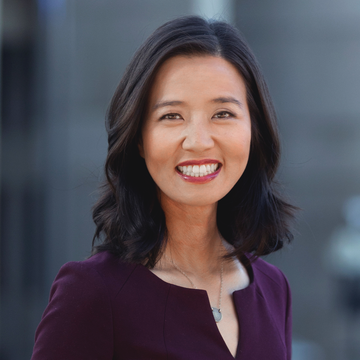
Michelle Wu
Mayor of Boston
12
APPEARANCES
7
PODCASTS
Oct 29, 2026

Cammie KnightHOST
Did either candidate express alignment or lack thereof with specific politicians?

Michelle WuGUEST
Yeah, so there was actually a very big debate where Julianna Stratton, the Democratic candidate, kept trying to liken Don Tracy to Donald Trump, but that was something that he kept rejecting.
Michelle WuGUEST
But yeah, we found that much of the policies that he was supporting were almost the exact same as Donald Trump.
Michelle WuGUEST
He criticized Operation Midway Blitz in Chicago, but he said that it didn't go according to plan because of sanctuary cities and because cities weren't cooperating with immigration authorities, but he didn't criticize saying that ICE was inherently wrong or ICE was doing something wrong.
Michelle WuGUEST
I think it all boiled down really to affordability at the end of the day and Canada's different take on affordability.
Michelle WuGUEST
I think they recognize that that's an issue that a lot of Americans are really dealing with.
Michelle WuGUEST
Stratton's policies for increasing the minimum wage and tax cuts for the middle class and tax increases for the wealthy.


Michelle WuGUEST
There was a whole technology upgrade where for the first time last election cycle, our poll workers used what are called poll pads, basically tablets where everyone gets checked in live.
Michelle WuGUEST
And that way you can monitor the level of ballots, the number of ballots that have been given out in each precinct and also cross-reference it to the voter database in real time and be assured that all the Supplies are where they should be.
Michelle WuGUEST
The tricky part about this November, just in general for voters, is that there are so many ballot questions that it is a nine page ballot.
Michelle WuGUEST
But just want to remind people to go all the way through the ballot, all five sides of the three pages.
Michelle WuGUEST
I think odds are I don't have to talk to that developer in a generic way because if you have a project that's already been approved in Boston, we've already been talking to you.

speaker_16AUDIENCE
Thank you.
Michelle WuGUEST
I think the issues that you mentioned, safety, schools, quality of life, is what we are pushing on every day and what we are seeing important progress on.
Michelle WuGUEST
Challenges of homelessness and the opioid epidemic and mental health are not solved by any means.
Michelle WuGUEST
But I will just share kind of we follow the data overall to have a picture of what happens year to year.
13 MINS LATER

Jim BraudeHOST
One, how do you respond to the Globe's criticism? And two, even if you find it or even if it's a point of view with which you are obviously in disagreement with, Why shouldn't people who are critical of schools be able to buy an ad space and voice their point of view?

Michelle WuGUEST
We try-- [chuckles] So this is a big point of contention because apparently every other child in the whole world has a phone and, and access to technology, uh, according to them.
Michelle WuGUEST
But we, we try very much to also preserve room for reading, so we try to have a no screens policy.
Michelle WuGUEST
More and more of the assignments do involve doing your math homework on the computer or following up with a certain set of, um, programs that allow for individualized study at a pace that better matches your student.
Michelle WuGUEST
And so we're seeing many of our schools now using programs like that, which allow for different, um, needs to be addressed in the classroom.
Michelle WuGUEST
Um, even the assignments are posted on Google Classroom, and, and so we have to access it that way.

Tiziana DearingHOST
So how do you then get some things done? Let's say th- the next two years, with the reality of the situation at hand, what is your strategy to get things that you need passed by the Massachusetts legislature passed?
Jim BraudeHOST
In the two races where your challengers lost to incumbents, Brownsburger and Collins, do you – While you say you don't regret having urged them to run, do you worry that their opposition to things that you care about for the city, which is, I assume, why you urge people to challenge them, is going to get more intense and be more difficult for you to move things on Beacon Hill? Because you've had a fairly tough go on a lot of issues there.
Michelle WuGUEST
And you have to really feel it, want it, believe in it to be a credible candidate.
Michelle WuGUEST
And Latoya Gale and Daniel Lander, I know we haven't seen the last of the two of them because they were amazing candidates.
Michelle WuGUEST
both of whom I was proud to endorse but endorsed much later into their campaigns and was not part of a massive sort of do someone's bidding or anything like that.
15 MINS LATER
Jim BraudeHOST
In retrospect, do you have any regrets about how you handled, uh, these kinds of issues in the wake of, uh, the death of this, again, this woman who you knew?
Michelle WuGUEST
I take every detail of our city very seriously, and I see it as the job of any leader within an organization to be able to understand at a thirty-thousand-foot view and also at the ground level how decisions are being made and where resources are being allocated.
Michelle WuGUEST
And so, um, we are still in the midst of rebuilding and, um, getting our streets and, um, roadway operations to a point where it's not only responsive but also sustainable and, um, able to be carried out in the long run.
Michelle WuGUEST
There were-- There, there have been, um, you know, over the history of Boston's fifteen years of working on multimodal streets, there have been different reports written and internal audits done over many years.
Michelle WuGUEST
In the last several weeks, I've gone through and read probably four hundred pages of, of all of them.
Michelle WuGUEST
And any one of those snapshots from twenty twenty-two, from, um, twenty seventeen, you could have applied it to-- if you didn't see what the date was, you could have thought easily that it was being written about right now based on what some of the headlines and the concerns have been, that, um, historically there has always been a push and pull in every transportation and streets department about when are you maintaining and, and managing the operations of repaving, um, making sure you're, you're, um, keeping s-- uh, crosswalks and sidewalks built up and, and smooth and, and safe, and when are you doing new things and using your dollars and capital investments to add a pedestrian bump out or to add a new bike lane that is protected with, um, either posts or concrete or, or some other barriers.
Michelle WuGUEST
We haven't gotten that balance right all the time in the city, and it's always been a push and pull over the last fifteen years.
17 MINS LATER
CharlesAUDIENCE
So I just wanted to get an understanding of where you stand on the budget cuts that are gonna be made for this year.
Michelle WuGUEST
I didn't, I didn't get to read the one that just came out this year, but I went through it extensively last year and the year before as we were going through the tax legislation conversation.
Michelle WuGUEST
And there's a-- The key sleight of hand that they're doing, first of all, this organization's goal is to advance, um, corporate, uh, uh, in, in this case, trying to reduce, um, property taxes for commercial interests rather than homeowner occupied, uh, residential interests.
Michelle WuGUEST
That is what a lobbying organization is supposed to do, is to make their best case that they possibly can.
9 MINS LATER
Michelle WuGUEST
I remain fully supportive of trying to make sure we're improving public transit access and traffic flow and beautification on that corridor.
Michelle WuGUEST
Now, the grant funding that has been allocated, it's funding that's in hand, over $150 million between state and federal funds that is tied to public transit improvements with a center running bus lane as the way to ensure that there's significant improvement in experience for public transit riders.
Michelle WuGUEST
In the last version of the public design for this project, the way the bus stops were initially placed would nearly double the number of stoplights on that corridor, and so that design, for example, I could not support, and we should not pursue federal funding if it is left at where it is.
Michelle WuGUEST
But that-- the, the way the process always happens is you start what you-- you put something on paper, and then you refine and refine and re-refine as it gets through the process.
Tiziana DearingHOST
Would you tell Blue Hill Ave residents that that's a serious, plausible option?
CurtisAUDIENCE
Um, I wanted some clarification about some of this new budgetary cuts that are mostly impacting the local arts community, and I wanted clarification on why this should be justified for a police budget where the police have been falling short on this new initiative for delivery drivers across the city.
Michelle WuGUEST
Um, thank you, Curtis, for calling in, and, um, thanks for raising a bunch of different issues, some of which I think are very much related and some of which are maybe less related.
Michelle WuGUEST
So, um, you know, we are in a different time now than the country and the city were in, let's say, uh, pre-COVID, uh, you know, seven, eight years ago, when interest rates were near zero, when it was incredibly, um, basically cheap to get money to be able to fund development projects that could then, um, generate lots of economic activity in a different way than right now, when energy costs are spiking because of wars that have been started, when tariffs and other federal policies continue to create this uncertainty over everything, and when interest rates show no signs of abating anytime soon.
10 MINS LATER


Sacha PfeifferHOST
How much do you think are the limits of what you can accomplish as a mayor given that the legislature has to sign off on a lot of what you wanna do?
Michelle WuGUEST
We're also surrounded by the context of what's happening at the state and national level and around the world.
Michelle WuGUEST
And that has had a real influence on what we're able to do, even with all of the resources that we're pouring into it, housing and housing production at the local level.
Michelle WuGUEST
On public transportation, yes, we are at three bus routes that are free in the City of Boston, fare-free to our residents.
Michelle WuGUEST
They have made a huge difference in our economic connectivity, and we have to do more.
Sacha PfeifferHOST
How are you finding the right way to push back without undignifying the office?

41:35

What- what- what lesson did you gain from that? What would you say, uh, to Democrats who have to be running and trying to take House seats away from some of those Republicans?
Michelle WuGUEST
Look, one thing now, um, I am proud to report instead of a seven-week old baby, uh, (laughs) that I had at that time, now I have a 10-month old and, uh, in all of these weeks that have passed by, unfortunately we continue to see the same playbook used again and again, a false narrative trying to paint cities as dangerous, scary, horrible places simply because people are different from each other.
Michelle WuGUEST
When, come to Boston, come to any of this country's thriving major urban hubs and you'll see beautiful communities where people are bridging their differences, getting things done and- and especially in our city, we have made tremendous progress over the last four years.
Michelle WuGUEST
More expansion of free universal pre-K and early education, investments in our schools and a- advanced math and new programs and rigorous academics, and just a sense of safety from being not only the safest major city in the country, the lowest levels of crime ever recorded in Boston's own history, but a real sense of belonging and community.
Michelle WuGUEST
You have to stand up for what's right, and most of all you have to get things done that matter to people.
43:04
people.What can you do now in the face of Donald Trump's attack, in so many ways, on your city?


Jordan KlepperHOST
What do you, what do you say to the people who, uh, in your constituency who, who might feel like, "Hey, why are we doing this? What's the big deal with this, uh, sanctuary city thing? If people are illegally in the country, shouldn't we arrest them and get rid of them?" What is the big deal?
Michelle WuGUEST
In a community where over a quarter of your residents come from... were born in another country, if people are afraid to drop their kids off at school, or call 911 when they need help, or share information when they actually have information to report about a crime that happened, that makes everyone less safe.
Michelle WuGUEST
Whether or not you are an immigrant, whether or not you're here in this country six generations or, or just arrived.
Michelle WuGUEST
And so all of the, the buzz around, you know, whether these kinds of cities that are more welcoming for immigrants are more dangerous, it's about a false narrative that immigrants are somehow more likely to commit crimes or cause harm, and that is just simply not true.
Michelle WuGUEST
We know that in our city where our immigrant communities are entrepreneurs, are holding up our health...
speaker_34AUDIENCE
(laughs)