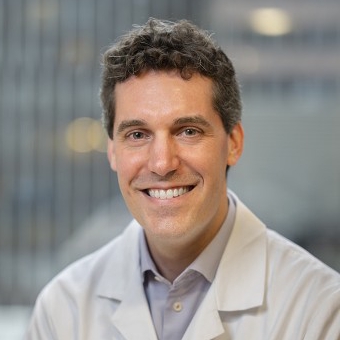
Michael Postow
Chief of the Melanoma Service at Memorial Sloan Kettering Cancer Center, where he is a board-certified medical oncologist devoted to the care of people with melanoma.
5
APPEARANCES
5
PODCASTS
Sep 3, 2026


Michael PostowGUEST
Each of our tumors is very unique, and the goal of a treatment like this in broad brushstrokes is to boost our own body's immune response against the specific aspects of the tumor that are unique to an individual such that our own immune systems can seek and destroy anything that looks like that tumor in our bodies.
Michael PostowGUEST
And so what happens is that the tumor is removed from a patient, the DNA is sequenced, and the, there's a complicated computer algorithm essentially that determines what among the mutations that are present in the tumor are immunologically relevant in that not all the mutations in the tumor are relevant for an immune response.
Michael PostowGUEST
But by seeing what genes are mutated in a tumor and what genes might be relevant to a, a productive immune response, an mRNA construct is made for that individual patient based upon characteristics of that individual patient's tumor, and then the patients receive this therapeutic vaccination.
Michael PostowGUEST
And the theory is that this boosts that patient's immune response only against the aspects of the tumor that are within that patient's individual tumor.
Michael PostowGUEST
And by having that enhanced immunity, that has been shown to protect that patient from future melanomas coming back.

Ira FlatowHOST
Are the vaccines intended as a complementary treatment to existing ones, or could a vaccine therapy replace other types of drugs entirely?
Michael PostowGUEST
In melanoma, this vaccine was tested with Keytruda because Keytruda is a current standard of care for this patient population that has had melanoma surgically removed and is at risk of recurrence.


Whit JohnsonHOST
Tell us about it and what we've learned from this, and how the vaccine actually works.
Michael PostowGUEST
This is a huge advance for patients with melanoma, and also for, hopefully, all of medical science.
Michael PostowGUEST
This vaccine works by when a patient has a tumor surgically removed, melanoma in this instance, in the laboratory we can study those tumors and see what's different about this tumor from all of the other cells in a patient.
Michael PostowGUEST
And then a vaccine is made such that when that vaccine is administered to the patients in combination with a drug called Keytruda, it teaches the body's immune system to go and protect that body and fight against-

Michael PostowGUEST
This principle has been demonstrated in melanoma first, but there's really no reason that this should only be considered a melanoma treatment.
Michael PostowGUEST
Clinical trials are ongoing all around the world and in our institution, MSK, where we're testing these types of vaccine approaches in patients with lung cancer, bladder cancer, kidney cancer.


Wolf BlitzerHOST
So if you could be specific, Dr. Postow, who will this treatment help the most? And when might patients be able to actually access this new treatment?
Michael PostowGUEST
Right now, what we know about this treatment is that for patients with surgically removed high-risk melanoma, so that's stage 2B and higher surgically removed melanoma, this experimental personalized cancer vaccine in combination with an immune therapy drug called Keytruda was shown to prevent recurrences of melanoma more than Keytruda alone.
Michael PostowGUEST
So right now, the efficacy has been established for patients with melanoma that have had high-risk melanoma removed surgically and preventing recurrences of their melanoma.
Michael PostowGUEST
This platform could be applied to many different types of cancer where surgery alone is often not curative.
Michael PostowGUEST
And our hope is that in the future with additional clinical trials underway currently, patients that have surgery for other types of tumors will eventually have this type of an option, and that this ultimately will be shown to prevent their recurrences as well.
Wolf BlitzerHOST
As a doctor who specializes in all of this, what do you want people to understand about this technology?

Michael PostowGUEST
We're thrilled with the results of this phase three study that have been reported on top line information so far.
Michael PostowGUEST
This drug is something called intismeran, and it's a personalized cancer therapeutic vaccination strategy where a patient's tumor is used as a blueprint to make their own individual vaccine.
Michael PostowGUEST
And the idea is that if we can just steer the immune response directly to the tumor cells that are abnormal, then in theory, that would be the exact type of response we want to eliminate the residual tumors that might be within a patient that we can't see.
Michael PostowGUEST
And what that actually means for patients in this trial, these patients had high risk melanoma.
Michael PostowGUEST
It was surgically removed, and the vaccine in combination with another drug called Keytruda was shown to reduce the risk of these patients having recurrent melanoma in the future compared to Keytruda alone.

Brad MielkeHOST
Um, how important is it that this was an mRNA vaccine? Like could you have done this with a different vaccine, or is, was this technology the only way you could make something like this?

Michael PostowGUEST
Even with the best surgical resection of melanoma, unfortunately, a lot of patients will have recurrences.
Michael PostowGUEST
And now we can tell these patients that we can make a vaccine just for them that in combination with Keytruda will decrease the risk that their melanoma will ever come back.
Michael PostowGUEST
So this is a huge advance for patients with melanoma, and our hope, as we were hearing, is that this will be expanded in other contexts to many different types of cancers as well.

Boris SanchezHOST
I- if you had your way, what kind of testing would you do to see what broader use this might have, this mRNA technology, to address other cancers?