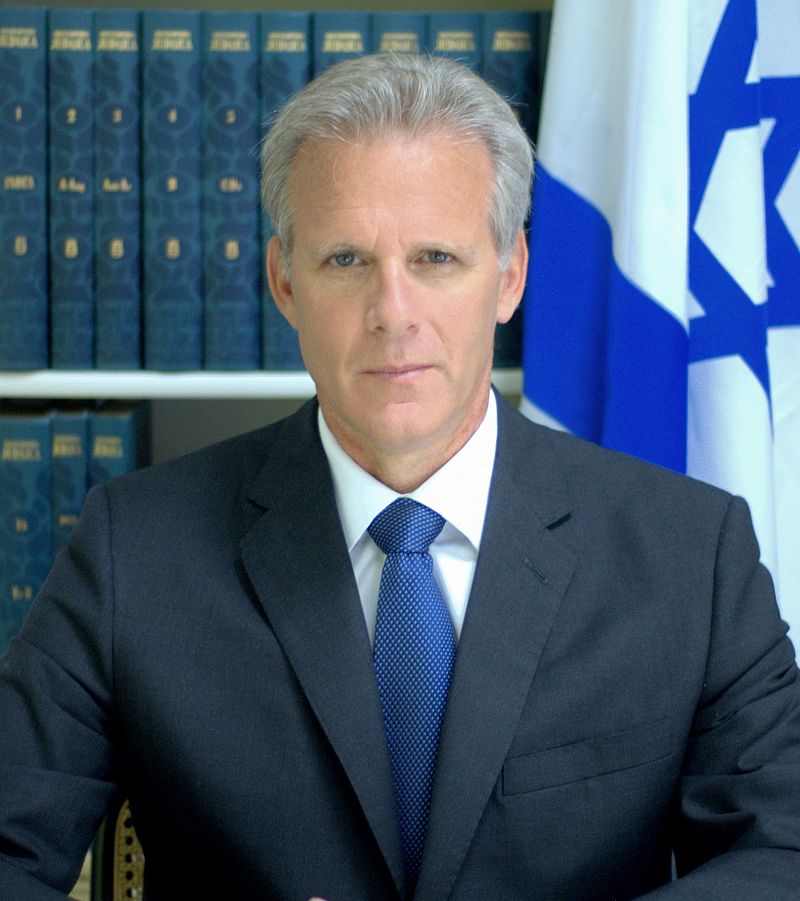
Michael Oren
Writer and former Israeli Ambassador to the United States
109
APPEARANCES
29
PODCASTS
Nov 13, 2026

Bret StephensMODERATOR
And Jonathan, you'll have the rebuttal after that.
Michael OrenGUEST
And I honestly asked the audience how many people had been present at my bar mitzvah.
Michael OrenGUEST
Now I can ask you how many people are going to be present at my grandson's bar mitzvah, which is next month.
14 MINS LATER
Bret StephensMODERATOR
Yeah,


Michael OrenGUEST
That the Yashar party of Ghazi-Eisenkot holds together the Change Coalition, which is a euphemism of get rid of BB Coalition.

Hugh HewittHOST
So is he dying to get back into the cabinet? Some, because that government won't last with, and I, and I think they'll all be radioactive if they sit with the joint list, right? They'll be radioactive.


Benjamin AnthonyHOST
I'd like you to give us your prognosis and diagnosis of what has taken place.
Michael OrenGUEST
And what was that era? The era of about 50 years that really began in the aftermath of the Six-Day War.
Michael OrenGUEST
It accelerated after the 1973 Yom Kippur War, the first memorandums of understanding that began with the Clinton administration in the 90s, and then through this century with the Bush MOU and then the Obama MOU.
Michael OrenGUEST
uh aid reaching 40 billion dollars a year but that's just the beginning of it like during the recent war and really the ongoing war that began October 7 2023 the Biden administration gave us something the equivalent of 22 billion dollars in emergency aid and that doesn't include all the aid that went into the development of Iron Dome which I was privileged to help bring from Washington David Sling, Arrow 2, Arrow 3, and the list is quite, quite long.
Michael OrenGUEST
In current dollars since 1948, something in the vicinity of $300 billion in American aid toward the state of Israel.
Michael OrenGUEST
Israel is the largest recipient of that aid in the world, but there are countries that actually get much more, Germany, Japan, South Korea, get more money than Israel does, but it's not listed as aid.
11 MINS LATER


Lazar BermanHOST
So let's start our discussion by taking a look a little bit backward and say, what do you think are the major issues, the major currents driving through American civil life, through American politics that fed to the Democratic victory yesterday?
Michael OrenGUEST
It's a more special relationship than any other bilateral tie that the United States has with any country in the world.
15 MINS LATER
Lazar BermanHOST
What do you think his next two years will look like? And how likely do you think it is that he will want to strike Iran again in a significant fashion?

Lazar BermanHOST
So let's start our discussion by taking a look, you know, a little bit backward and say, what do you think are the major issues, the major currents driving through American civil life, through American politics that fed to the Democratic victory yesterday?
Michael OrenGUEST
Let's see if we can do this very quickly on one foot as it were because I think as you intimated earlier, Laser, the U.S. has a relationship.
Michael OrenGUEST
It's a more special relationship than any other bilateral tie that the United States has with any country in the world.
16 MINS LATER
Lazar BermanHOST
What do you think his next two years will look like? And how likely do you think it is that he will want to strike Iran again in a significant fashion?


Joshua HoffmanHOST
This is a guest essay by Michael Oren, former Israeli ambassador to the U.S. and founder of the Israel Advocacy Group.
Michael OrenGUEST
Contrary to the iconic Saul Steinberg map, published on the New Yorker's cover in 1976, America does not end at the Hudson River.
Michael OrenGUEST
Israeli Prime Minister Benjamin Netanyahu once told me, in fact, America begins 70 miles west of New York and ends 70 miles east of Los Angeles.
Michael OrenGUEST
And in the middle of that vast expanse sits the verdant, generally prosperous, and usually stable state of Michigan.
Michael OrenGUEST
The great American Jewish composer Irving Berlin back in 1914 wrote, that's why I wish again that I was in Michigan.
Michael OrenGUEST
For it is in Michigan, improbably but plausibly, that the future of American Jewry will be decided.
Hugh HewittHOST
What do you make of our race in Michigan against Mike Rogers, seven-term congressman, state legislator, army officer, FBI agent, up against Abdul El-Sayed, who I think is at least Muslim Brotherhood adjacent?
Michael OrenGUEST
That is, if a person who hates, hates the land that is the homeland of the Jewish people, that is home to more than half the Jewish people, who sympathizes with those who wish to destroy those people and destroy that state and does so openly, And he does all this not from, you know, kind of crazy New York, right, Hugh? Right, but does it from mid-America, from Michigan, a prosperous, verdant, and largely stable state.
6 MINS LATER
Aviva KlompasHOST
Because when it comes to security policies, I don't think there's a lot of daylight between what Netanyahu, Eisenhower, Bennett, and many of the other leading candidates, Lieberman, I don't think there's a lot in what they think that's different.
Michael OrenGUEST
You know, I love prophecy, and I'm usually pretty good at it, but this is a hard one.
Michael OrenGUEST
I still think that Gotti Eisenkant is going to pull this out at some level, but he'll fall short of the 61 he needs.
Hugh HewittHOST
And then second question, no matter who is the prime minister, will they stand shoulder to shoulder and tell the IDF to fly wing to wing with America if there is another round coming with Iran?

Michael OrenGUEST
A vote held several weeks ago in the U.S. Congress whether to suspend military aid to Israel.
5 MINS LATER
Hugh HewittHOST
Dr. Oren, what's going to happen? I just want to get it done and figure out who's going to be the next prime minister of Israel.
Michael OrenGUEST
I was just listening to your previous segment about prophecy, okay? So now you're asking me to be a prophet about what's going to happen.
Michael OrenGUEST
On the basis, and I believe in prophecy, don't I? I don't necessarily want to fulfill that role, but here it is.
Hugh HewittHOST
Dr. McLaurin, are you anticipating any kind of an October surprise from or to Iran that would affect yours and our elections?


Erick EricksonHOST
Let's talk first about October 7th, because the most horrific thing to me after October 7th was watching some people react not with horror, but with joy to what happened a- as if Israel ha- had gotten what it deserved and, and th- this idea that, well, it's about Israel, but yet they were targeting people who were Jewish, weren't Israeli citizens.
Michael OrenGUEST
It, it's a very hard day here, uh, on October 7th, the third anniversary of this war.
12 MINS LATER

Erick EricksonHOST
Let's talk first about October 7th, because the most horrific thing to me after October 7th was watching some people react not with horror, but with joy to what happened a- as if Israel, uh, had gotten what it deserved and, and this idea that, well, it's about Israel, but yet they were targeting people who were Jewish, weren't Israeli citizens.
Michael OrenGUEST
It, it's a very hard day here on October 7th, the third anniversary of this war.
12 MINS LATER


Aaron MacLeanHOST
How-- What are the various ways in which this issue could play out? What do you think is going to happen?
Michael OrenGUEST
It, it is an immensely complex issue, and I'll try to simplify as much as I can.
Michael OrenGUEST
Um, it is Zionist, which was the, the national liberation movement of the Jewish people.
Michael OrenGUEST
It wasn't a religious movement per se, though many religious people are Zionists and see the creation of the Jewish state as, as a, as, as kind of divine intervention, uh, in, in Jewish history.
Michael OrenGUEST
Um, but the ultra-Orthodox are people who basically look at Zionism and say, "This is-- These are Jews arrogating the exclusive purview of God, which is to bring about the Messiah and bring about the redemption of the Jewish people.
26 MINS LATER
Aaron MacLeanHOST
Tell me a bit about your father and his experiences in a little bit more detail, and how did that shape your worldview growing up, and how did it intersect with your decision to become a lone soldier in Israel?
Hugh HewittHOST
What did you make of the Miliband speech? Because it went on from there into even worse and more sinister suggestions.
Michael OrenGUEST
Well, Ed Miliband cares great about injustice in the world, but they don't say a word about the fact that China's put a million Muslims in concentration camps, doesn't care whether Turkey illegally occupies half of Cyprus.
Michael OrenGUEST
And that, wow, the big British, big, brave British are going to beat up on the Jewish state because they care about injustice in the world.
Michael OrenGUEST
Hugh, but, you know, there's a memory from World War II of Europeans killing Jews even when they were losing a war.
Hugh HewittHOST
How important is that issue to the elections, which ought to be about the straight Iran and Israel security issues?
Michael OrenGUEST
Okay, let's begin with the fact that this is not the first election since October 7th.
Michael OrenGUEST
It's the first election since December of 2022, which means that this is a very rare accomplishment of any Israeli government to go its full four years.
Michael OrenGUEST
And why this happened, in spite of the truly unprecedented, almost unspeakable vicissitudes of the last three years, is because nobody in the government wanted to break up the government.
6 MINS LATER
Aviva KlompasHOST
Who you said was kingmaker, and I was going to check in and see if he's still kingmaker.
Michael OrenGUEST
Well, it's insofar as they tend to shoot missiles at my home, yeah, I got an opinion about them.
Michael OrenGUEST
Uh, and now they have taken the coastline along the Bab el-Mandab waterway, uh, which means that Iran is effectively controlling that waterway.
Michael OrenGUEST
And from the Bab el-Mandab, watch this, Iran will now try to control the entrance to the Suez Canal.
Michael OrenGUEST
The Sheffield factor going back to the Falklands War of 1982 when a French-made rocket was fired by the Argentinians at it.
Hugh HewittHOST
So, Ambassador Oren, if we want to establish the deterrence for the United States targets that Israel has established for its entire country, what would you advise President Trump to do right now rather than after they get lucky?
Michael OrenGUEST
I think the Iranians are going to try to drag the United States into more kinetic activity to get oil prices driven up, to weaken the Republican chances of retaining the two houses of Congress.
Michael OrenGUEST
October 7th was a result of successive Israeli governments being passive, while massive terrorist forces, enemy forces built up on our borders, on Gaza, in Lebanon, etc.
Michael OrenGUEST
It's curious that these members of Congress are smiling." Because they've just endangered the security of their children and grandchildren.
Michael OrenGUEST
The United States has one, count them one, ally in the world that's willing to fight side by side with the United States.
Michael OrenGUEST
To fight as not just military equals, but certainly technologically equals if not beyond that.
Hugh HewittHOST
What is the best case and worst case for what he brings home from his meetings this week with President Trump?
Michael OrenGUEST
Well, the worst-case scenario, let's start with that, would be if President Trump says to him, listen, our interests have diverged.
Michael OrenGUEST
We understand that you really care about that ballistic system in the hands of the Iranians.
Michael OrenGUEST
You care about the nuclear program and the – highly enriched nuclear dust, as the president called it.
Michael OrenGUEST
What we really care about is the Strait of Hormuz and getting oil prices down.

Michael OrenGUEST
You achieve the five goals, Alex, that the United States and Israel set out at the beginning of this war, which was ending Iran's nuclear program, shipping abroad the nuclear stockpile of highly enriched uranium, ending Iran's intercontinental ballistic missile program, ending Iranian support for terror around the Middle East and across the globe.
Michael OrenGUEST
And then as the war progressed, really additional demand was an end to Iranian attempts to control or even block shipping of energy cargoes through the Strait of Hormuz.
Michael OrenGUEST
Anything short of that, maybe partial victory, for example, having Iran give up its nuclear program.

Alex MarlowHOST
So what is your hope for the Trump administration? What do you believe is the best policy going forward?

AsmongoldHOST
Mm-hmm.
Michael OrenGUEST
It's not just that they have tried to destroy the State of Israel again and again for the last 46 years.
8 MINS LATER
John RobertsSOUNDBITE_SPEAKER
Yeah, of course
Scroll for more appearances