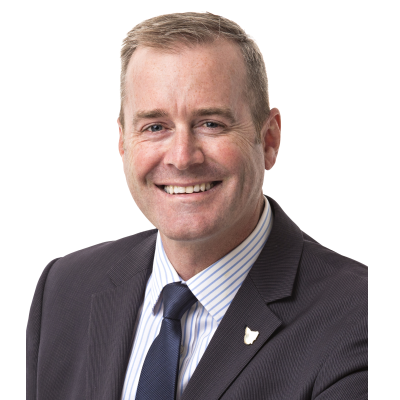
Michael Ferguson
Member of the Tasmanian House of Assembly
8
APPEARANCES
3
PODCASTS
Sep 30, 2026

45:47

What does that mean to you, a spiritual machine? It cou- could that be a thing?

Michael FergusonGUEST
That's a really interesting turn to add into the conversation 'cause I would say that spirituality in that regard could be a fourth component that's independent, that doesn't necessarily require consciousness, doesn't even necessarily require intelligence.
Michael FergusonGUEST
Um, and so a spiritual machine in that regard could be one where the machine itself now has some kind of worship or devotion that has become part of its structure.
Michael FergusonGUEST
Or more modestly, when we talk about spiritual machines, I think of machines that can interface with humans in order to stimulate human spirituality.
31:25
Anyway, Michael had some valuable thoughts about this, not about Cortical Labs specifically, but what about this field might mean for us and our future.
Michael FergusonGUEST
Well, once you start to bring biological substrate into it, then I become more persuaded that perhaps there could be some kind of engineering of consciousness.
Michael FergusonGUEST
Even in the examples that we're using right here where we're talking about computer processing and the way that neural nets, using the computer science term, are understood to operate, and then the parallels with the way that the brain is understood to operate, I do get concerned that there's both a little bit of a superficiality and a circularity to it, to where we're making these AI computer models, calling them neural nets because we're presupposing that we understand precisely the way that organic neurons are working.
Michael FergusonGUEST
And then if some of those models have explanatory value, then we might think that we've solved the problem of neuron processing.
Michael FergusonGUEST
We don't, we don't understand all of the levels and the scales of information processing.
Michael FergusonGUEST
And so there's active debate about within the neuron itself, is there computation? Is there information being processed? If so, how? We are familiar with the synapses between neurons, and we think about signal going between neurons through the synapses.
34:04
Seven eras, each one marked by a fire, running from an ancient migration forward to a moment of great choice.

Michael FergusonGUEST
And really the question arose in our minds, how might we as a choir respond to this artwork? So what can the audience expect from the concert then? So in terms of the concert, we're exploring homelessness through a programme of musical works, but we take really the audience on a journey.
Michael FergusonGUEST
So we begin with a poignant work which makes use of a loop of a homeless man, which has been weaved into a composition which evolves in a journey over half an hour.
Michael FergusonGUEST
We move into the realm of mercy and hope and we end on a very hopeful note.

William CrawleyHOST
When you say that this piece, Jesus' Blood Never Failed Me Yet, is constructed in From the loop of a homeless man, what does that mean and how was that material gathered?
27:10
Do you think that's almost like a, a fundamentalist viewpoint? Do you think something similar is happening within their minds if they're believing this?
Michael FergusonGUEST
I mean, what stands out the most to me is, again, once you get to that level of existential threat and of totality, something shifts in the brain.
Michael FergusonGUEST
The way that you're coding and representing those thoughts is gonna be different.
Michael FergusonGUEST
And when you're talking about this five to ten percent chance that it ushers in the end of humanity, it does-- I mean, to me, it sounds like prophecy.
Michael FergusonGUEST
It sounds like the motif that we've seen across cultures for thousands and thousands of years.
Michael FergusonGUEST
And I think that there's actually a lot that we could import from prophetic traditions in terms of how is it that we even interpret and respond to these types of probabilities that are being thrown out to us.
6 MINS LATER
33:39
Wh- when you think about mind versus brain or mind and brain, what comes to your mind?
Michael FergusonGUEST
One of the ways that meaning is conceived cognitively is that it's reflecting back to us a continuous train of episodic memories, that we all accumulate these scenes, we try to make meaning out of them, and over the course of constructing a life narrative, we weave together more and more of these remembered episodes.
Michael FergusonGUEST
And so one cognitive theory of meaning is that it really is that internal monitoring of how continuous and secure are the integrations of our memories.

Michael FergusonGUEST
Guys, uh, this morning we're gonna be continuing a series that we've just started last week, a series in Colossians.
Michael FergusonGUEST
We're gonna be thinking about how Jesus, um, is the, he's the preeminent one, he's the Lord over all creation, and Colossians really helps to, uh, emphasize that.
Michael FergusonGUEST
I would love it if you've got a Bible with you, if you could turn with me to Colossians 1:15.
Michael FergusonGUEST
Um, if you don't have a Bible with you, you can just follow along on the screen.
speaker_1UNKNOWN
[laughs]
Michael FergusonGUEST
I took all the credit, and that poem hung on the wall of Miss Sweeney's English class for the next year or so.
41:33
Here's Dr. Michael Ferguson, director of the Harvard Neurospirituality Lab.
Michael FergusonGUEST
And they get used interchangeably, but I really do think that they're very independent things and that they're not even necessarily interdependent.
Michael FergusonGUEST
So with intelligence, we should clarify too that most of the time in AI when people are talking about intelligence, they're talking about a pretty narrow form of intelligence that cognitive scientists call fluid intelligence, which it's about recognizing patterns and completing patterns.
Michael FergusonGUEST
So with fluid intelligence, you don't necessarily need to have consciousness or awareness.
Michael FergusonGUEST
So for us to say, "Okay, we've got an artificial intelligence," to me, it doesn't necessarily follow that it has to either have consciousness or even be a mind.
Michael FergusonGUEST
What stands out the most to me is, again, once you get to that level of existential threat and of totality, something shifts in the brain.
Michael FergusonGUEST
The way that you're coding and representing those thoughts is gonna be different.
Michael FergusonGUEST
And when you're talking about this five to ten percent chance that it ushers in the end of humanity, it does-- I mean, to me, it sounds like prophecy.
Michael FergusonGUEST
It sounds like the motif that we've seen across cultures for thousands and thousands of years.
Michael FergusonGUEST
brain.One of the things that we see in the brain signatures is that the inversion of the fundamentalist signature is a signature for central pain.
Michael FergusonGUEST
And so the implication there is that by going into a mental activity state where you're recruiting these fundamentalist styles of cognition, that the brain is actually turning down the activity in pain circuits.