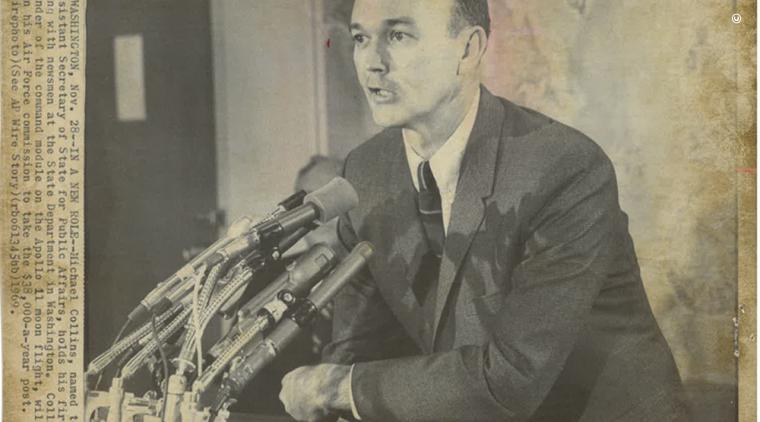
Michael Collins
Astronaut and former United States Assistant Secretary of State for Global Public Affairs
8
APPEARANCES
7
PODCASTS
Oct 1, 2026


Michael CollinsGUEST
I, um, I was pretty average at school, but um, and I had a lot of jobs leading up to, uh, a lot of occupations and interests leading up to the research journey.
Michael CollinsGUEST
But um- Yeah, I guess what led, led to that journey was, um, losing my little brother to suicide and also too many, uh, blokes that were good friends, um, before my brother's suicide.
Michael CollinsGUEST
So up until then, it had just been, oh, this is, you know, really shit what's happening to men and getting over it.
15 MINS LATER

speaker_2HOST
Dr. Collins, can you talk to us a little bit about the psychiatrist's role in mental health care for individuals in the IDD population?
Michael CollinsGUEST
Yeah, that's a good question because part of it is understanding clients who have IDD don't need a psychiatrist just because they have that.
Michael CollinsGUEST
In the same sense, someone may have difficulty reading or you don't go to a psychiatrist and get treatment and then you're better at reading.
Michael CollinsGUEST
Many of the people who have IDD, when they have psychiatric disorders, because they have difficulty with communicating, it can be very confounding.
20 MINS LATER


Georgia TolleyHOST
What was it that caught your attention? What made you realise that something was wrong?

Gordon BorrellHOST
Where's that growth coming from in terms of budget? Are advertisers taking it from something or are they adding to their budgets to buy OTT?
Michael CollinsGUEST
But I think there are a couple of other real growth drivers that it's important not to lose sight of.
Michael CollinsGUEST
One is that it's not just growing the eyeballs, the overall pie is growing.
Michael CollinsGUEST
And I think this is one of the really exciting parts about our industry right now is that television historically, it has been fragmented, it's been difficult to buy.
Gordon BorrellHOST
How about a company like Sarkis Tarzian or somebody that might have two stations or three stations and they're not in really big, big, big markets? Anything they can do, is it just kind of a wait for them?

PeterHOST
Thank you for coming along.
Michael CollinsGUEST
Peter, thank you so much and a very big thanks to each of you for joining this evening.
Michael CollinsGUEST
I am indeed a member of the ACS and and drew upon the expertise of the community a number of times during the research that went into this book, which was invaluable.
Michael CollinsGUEST
It's a wonderful group of people who I think are you know, really sort of understanding and furthering the extent to which cricket shines a light on and is indeed integrated into a wider kind of spectrum of questions about history, society, culture, and dare I say, even politics.
Michael CollinsGUEST
I think that's probably to some people's chagrin, the fact that cricket is a heavily politicised game.
Michael CollinsGUEST
But in some senses, the talk that I'm about to give is an effort to sort of persuade you, if you need persuading, that that is in fact the case and that cricket in its very origins and essence has always been the carrier of politics.
24 MINS LATER
George LammingSOUNDBITE_SPEAKER
men.
Georgia TolleyHOST
What was it that caught your attention? What made you realize that something was wrong?

Mark QuinnHOST
And it's something that developed over the years with you, is it? Or was there always an attraction? Well, I always tell the story
Michael CollinsGUEST
My father, before he died, one of the presents I got at Christmas was a toy projector.
Michael CollinsGUEST
And I used to have little shows at home for my friends and we'd sit down and we'd run a play cinema.
Michael CollinsGUEST
And I got an enormous satisfaction out of looking at other people enjoying themselves.
6 MINS LATER


David KrisHOST
Uh, can you tell our listeners a little bit about your career, including your current role as the acting head of the NIC, and maybe a little bit about what the NIC, the National Intelligence Council, uh, really is?
Michael CollinsGUEST
Well, thank you, David, of course, and thank you so much for this opportunity to exchange some thoughts with you on some of our priorities and as, of course, they relate to the National Intelligence Strategy.
Michael CollinsGUEST
I joined the agency a long time ago at CIA originally as an analyst of mostly East Asian affairs, served in various capacities as a manager, as an analyst in different AORs, uh, was a chief of staff on the seventh floor for the deputy director, deputy director for our East Asian Pacific Mission Center.
Michael CollinsGUEST
I was formerly, prior to this job, the chief strategy officer for the CIA, uh, where I learned a lot about and participated in some fantastic, uh, conversations about all of our respective government strategies, including the role of the intelligence community.
Michael CollinsGUEST
And now I moved over to the National Intelligence Council, um, in a sense getting me back to the analytic basics, uh, that I grew up doing, if you will.
Michael CollinsGUEST
The National Intelligence Council within ODNI, the Office of the Director of National Intelligence, is fundamentally responsible for pulling together the coordinated view of the entirety of the US intelligence community on the issues around the world that our policymakers have to wrestle with.
15 MINS LATER