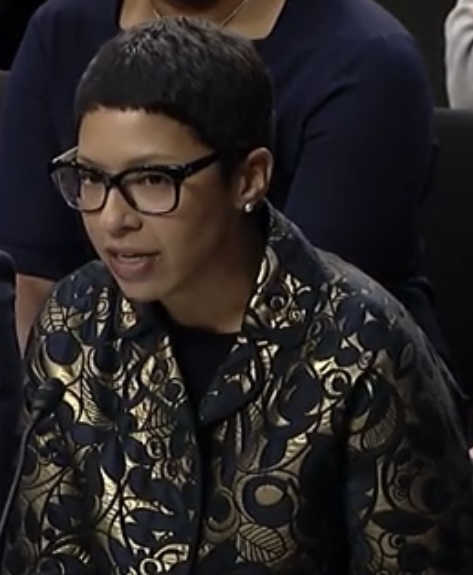
Melissa Murray
Legal scholar
131
APPEARANCES
47
PODCASTS
Nov 7, 2026

30:15

What can the Democratic majorities in the House and Senate do, if anything, in these two years before there could possibly be a Democratic president? To rebuild, help rebuild DOJ, reinstitute norms, codify norms.

Melissa MurrayGUEST
Well, so, you know, one thing, the president is obviously not inclined to go along with a Democratic policy agenda, so there's likely to be vetoes.
Melissa MurrayGUEST
And they have such strong numbers that maybe that is a possibility if they can get their Republican colleagues to play along.

Melissa MurrayGUEST
... a leader could weaponize various portions of the federal government against someone just because they don't like what they say or what they represent.
Melissa MurrayGUEST
The idea [laughs] that there would be repercussions including a raid on your home and an investigation of what apparently seem to be decades old allegations of immigration fraud, that actually just seems preposterous and so out of step with Democratic norms.

Ari MelberHOST
And so I mention identity as both on the big group all over the place, but with the extra passion or shall we say bias, uh, it's against these women of color.


Alicia MenendezHOST
But you, can you give us a sense just o- of timeline here, Melissa, how this is likely to play out given that there was sort of this, this temporary relief, but there is, of course, a longer term question?
Melissa MurrayGUEST
That's why we're back in court today trying to get the judge to extend that grace to those outlets to be able to cover the President.
Melissa MurrayGUEST
A- again, this is access to the White House, but not all aspects of pool coverage.
Melissa MurrayGUEST
So Judge Kelly's earlier order didn't address certain things like whether or not certain members of the White House pool could be allowed on Air Force One, and indeed members ofMSNow, CNN, Politico have not been allowed on Air Force One.
7 MINS LATER
Melissa MurrayGUEST
But to me, the most striking part was the part where Jack Smith conceded that maybe he had been too much of an old school prosecutor, that he was about showing his work in court, talking to juries, when this particular task was so sensitive, um, a- and so consequential that he probably needed to be communicating with the American public on a more regular basis than he had.
Melissa MurrayGUEST
And so to me, that was sort of an admission that we are in a space where law and politics are perhaps converging in a really interesting way, and the old school norms that used to govern our public servants may not hold in the same way, and this is becoming more of a publicity driven, publicly minded kind of enterprise than what we are perhaps used to.
Melissa MurrayGUEST
Uh, a- again, I, you know, I know that he was sort of conceding maybe he had done some things differently.

Melissa MurrayGUEST
The court has already had something to do with these elections because they've allowed a lot of this election chaos to fester.
Melissa MurrayGUEST
They decided them initially on jurisdictional grounds and then had them come back when the period was right for review.
Melissa MurrayGUEST
But it allowed a lot of chaos to fester, a lot of questions to linger about what would happen in the election and that by itself.

Ali VelshiHOST
Can you just, I know you've explained this very well in the past, but for those who are less familiar with it, can you explain what that means, the regular agenda that the court sets and the shadow docket?

Melissa MurrayGUEST
I mean, this is a court that's kind of been all over the place on immigration issues.
Melissa MurrayGUEST
The court granted the government's request for stay of a lower court order enjoining that policy.
Melissa MurrayGUEST
So now the administration is allowed to continue removing people to third countries, even though this case is going to be heard on the court's merit docket later this term.
Melissa MurrayGUEST
That's really important because there has been a lot of reporting that not only are these people being removed to countries where they have no connection, they're also being removed to countries where there is a very high possibility that they will be tortured, that they may be punished severely, um, that some may actually be sold into slavery or even trafficked in some of these countries.
5 MINS LATER

Jacob SoboroffHOST
Uh, you know, they're basically putting it like, should big oil pay for climate change? Um, talk to us about that case and what else you're looking at, uh, in the cases that are coming up before the Court.
Melissa MurrayGUEST
But to me, the most striking part was the part where Jack Smith conceded that maybe he had been too much of an old-school prosecutor, that he was about showing his work in court, talking to juries, when this particular task was so sensitive, um, a- and so consequential that he probably needed to be communicating with the American public on a more regular basis than he had.
Melissa MurrayGUEST
And so to me, that was sort of an admission that we are in a space where law and politics are perhaps converging in a really interesting way, and the old-school norms that used to govern our public servants may not hold in the same way, and this is becoming more of a publicity-driven, publicly-minded kind of enterprise than what we are perhaps used to.
Melissa MurrayGUEST
Uh, a- again, I, you know, I know that he was sort of conceding maybe he had done some things differently.

Melissa MurrayGUEST
So the first instance, these payments from Lyons to both the secretary's wife and to the secretary himself seem to violate existing ethics laws, at least with regard to the amount of money that one can make and profit from one's position as a government employee.
Melissa MurrayGUEST
You're not supposed to receive additional funds from your government work, so there's that.
Melissa MurrayGUEST
And then I think there's the very real implication that the payments to Ms. Heinz may in fact simply be an income transfer to her husband, and it's related perhaps to the fact that Mr. Lyons, in addition to being among the MAGA faithful, is someone who is pushing certain policy proposals that the secretary is in a position to weigh in on in significant ways.
Melissa MurrayGUEST
So there are real questions here, certainly ethical questions, likely questions that run against the extant law, if it even matters to Mr. Kennedy.

Nicolle WallaceHOST
But I wonder if you have any ability to assess how much damage is done in the interim.

Melissa MurrayGUEST
Well, our Constitution is basically a document that's about preventing tyranny, the consolidation of government power in a single branch of government.
Melissa MurrayGUEST
The idea that you would ban accountability institutions from the White House because you don't like the content that they are disseminating, that's not very First Amendment forward.
Melissa MurrayGUEST
The idea that you would ban MSNOW and CNN because they're fake news, you don't like their content, you don't like their coverage, that's not consistent with the First Amendment.

Antonia HyltonHOST
Melissa, do you see the dysfunction, the mixed messages that come out of Congress right now as having a direct relation to the broader constitutional crises we sometimes find ourselves in?

Eugene DanielsHOST
And there's a difference between the president's, it seems, a difference between the president's spaces, so like the Oval Office and the Air Force One, and blocking, as he has done today, Kayla Gardner and our videographer from coming on the White House grounds at all.
Melissa MurrayGUEST
The president does not have the authority under the First Amendment to deny access to the press pool.
9:21
Not just how unusual this is, but the threat this poses to the Constitution and our democracy.
Melissa MurrayGUEST
I will also say, though, that I don't think adherence to the law is really the point here.
Melissa MurrayGUEST
I think the president and certainly those in the White House who have law degrees know that this is a losing battle for them.
Melissa MurrayGUEST
But that's not really the point, because in the interim, you have a situation where certain news outlets are going to be punished.
Melissa MurrayGUEST
But it also sends a message to smaller news outlets and independent journalists who are also covering the president, people and institutions that may not have the vast coffers of Politico or CNN or MSNOW to fight something like this.
Melissa MurrayGUEST
... itself is problematic, uh, by, you know, putting things in blind trusts.
Melissa MurrayGUEST
Uh, like, you know, many presidential siblings have run into issues, Roger Clinton, Billy, um, Carter.
Melissa MurrayGUEST
This, the expanse of what the Trumps are doing really does seem to be quite new and unprecedented.


Melissa MurrayGUEST
Note, DiGenova was not the first person in this role charged with doing this, like unifying all of these investigations into some sort of coordinated grand conspiracy, as the Trump administration has said.
Melissa MurrayGUEST
The earlier lawyer also departed again because apparently she was not moving fast enough.
Melissa MurrayGUEST
And pr- Justice Kavanaugh didn't even refer the first matter to the full court.
Melissa MurrayGUEST
He's the one from whom, to whom the petition is in- initially directed, and he has the option to refer it to the entire court if he thinks it requires the entire court's attention.
Melissa MurrayGUEST
But this was a situation where the Missouri Supreme Court had earlier weighed in and said that as a matter of state constitutional law, the Missouri GOP could not use the new redrawn Trump-ordered map from 2026, and instead had to use the 2022 map that had been in place as a result of the 2020 decennial census.
Melissa MurrayGUEST
So the Missouri Supreme Court already said what had to happen and said that it had to happen as a matter of state constitutional law.
10 MINS LATER
Melissa MurrayGUEST
Obviously, if the court is following the Constitution and following statutes, this whole episode raises a lot of red flags.
Melissa MurrayGUEST
Certainly, the whole idea of federalizing elections flies in the face of what the Constitution prescribes.
Melissa MurrayGUEST
And there are various statutes that provide protections for the data of American citizens and for all of the reasons that Jason just suggested.
Melissa MurrayGUEST
But as you say, this is a court that has been very amenable to this administration's request, especially when those requests are made on the shadow docket.
Alicia MenendezHOST
Melissa, appeals are already underway, but how much longer can this limbo go on? We're 55 days away from Election Day.
Nicolle WallaceHOST
But the Trump administration, which doesn't know where the countries are in the continent of Africa, found 1,000 in three weeks?
Melissa MurrayGUEST
The point is to continue fueling and stoking a narrative, however untrue it might be, in order to continue to sow chaos and to provide a permission structure to effectively take an election.
Melissa MurrayGUEST
I mean, you know, we have right now states going to federal court to challenge this, and red states coming back saying, "We need the US Postal Service to be involved in election administration.
Melissa MurrayGUEST
We need this kind of assistance from the federal government in order to secure our elections." These states have the authority through the Constitution to do that independently.
8 MINS LATER


Melissa MurrayGUEST
I think what you have here is the president trying to maneuver around accountability institutions at a time when critique against him is really at a fever pitch.
Melissa MurrayGUEST
And, you know, one of those important accountability institutions is the media.
Melissa MurrayGUEST
There is New York Times versus Sullivan, which is a huge Supreme Court case from 2017.

Melissa MurrayGUEST
That was the first time I think surrogacy really hit the headlines in the United States.
Melissa MurrayGUEST
It was really different, I think, from this particular case, in part because the surrogate there, Mary Beth Whitehead, actually was the genetic mother of the child that she ultimately carried to term and bore.
Melissa MurrayGUEST
And so this is a situation where she was artificially inseminated with another man, not her husband's sperm.
6 MINS LATER

Erin RyanHOST
But like what would it look like if they had people that were actually informed on like maternal health setting these guidelines? What would that look like? Yeah, I don't know.
Melissa MurrayGUEST
I mean, what AG Bonta is describing is a very complicated system that requires the federal government to draft this list for the states to then match their own voter rolls against this list, and then determine whether or not they're in compliance, and that all happens at the Postal Service.
Melissa MurrayGUEST
I mean, there's a lot going into this, and we are not that far away from these ballots going out.
Melissa MurrayGUEST
Um, North Carolina's ballots go out on September 4th, so there's not a lot of time here.
Alicia MenendezHOST
Melissa, your reaction to what we heard from the attorney general, it would almost seem as though their theory is if you say the quiet part out loud, then it can't possibly be nefarious.
Melissa MurrayGUEST
I mean, just a few days earlier, we had the attorney general of the United States doing a most extraordinary thing, which is speaking at one of the president's rallies, which, again, might seem to violate the Hatch Act, something that he is charged with enforcing.
8 MINS LATER
Alicia MenendezHOST
Melissa, where does this specific issue fit into this court's view of executive power?

Melissa MurrayGUEST
I think there are questions about whether the Constitution and the scaffolding that it creates for our government is enough to sustain us in this moment, that this is a stress test for the Constitution.
Melissa MurrayGUEST
The Constitution, when it was written in 1787, when those men came to Philadelphia, they were working through trauma.
Melissa MurrayGUEST
They had the trauma of the colonial period where the British Parliament and the British Crown had taxed them relentlessly, had sent a standing army of redcoats into their midst.
Melissa MurrayGUEST
And they were also dealing with the trauma of fighting a war against the greatest global superpower that the world had ever seen with a government that was literally held together with gum and friendship bracelets.
24 MINS LATER

Ken DilanianGUEST
And, you know, the things that he's railing against, the things that he says he's going to fix
Melissa MurrayGUEST
fix... are the things that he broke, and he's been part of the apparatus that has led to the disunity in the Department of Justice, that's led to people leaving, that's led to low morale.
Melissa MurrayGUEST
I mean, now him taking to the podium and saying that he's going to restore the morale in this beleaguered department is a little bit like a burglar promising to put back all the stuff he burgled.
Melissa MurrayGUEST
And you- you're right, um, he's not only a, a very good public speaker, he's someone with a really interesting background.
Melissa MurrayGUEST
He's someone who went to Brooklyn Law School during the evening program, humble roots, and he's risen to the very top of the legal profession.
10 MINS LATER
Nicolle WallaceHOST
If there are people who know, as Shane Gillis and Joe Rogan there clearly do, that this is flagrantly illegal at the time, are they legally exposed?


Melissa MurrayGUEST
So, yes, I will start by saying I'm not necessarily an apologist for the Constitution.
Melissa MurrayGUEST
I recognize the ways in which this is an imperfect document written by imperfect people that has, for some reason, managed to survive.
Melissa MurrayGUEST
It is the longest lived written Constitution in existence and has been a model for other systems who are moving to constitutional republics or democracies.
Melissa MurrayGUEST
And that's worth thinking about why it is the model and how people have improved upon it.
Melissa MurrayGUEST
I will say, I think one of the things that inspired me to write this annotated guide, and I say write in quotation marks because I did not write the Constitution.
26 MINS LATER

Scroll for more appearances