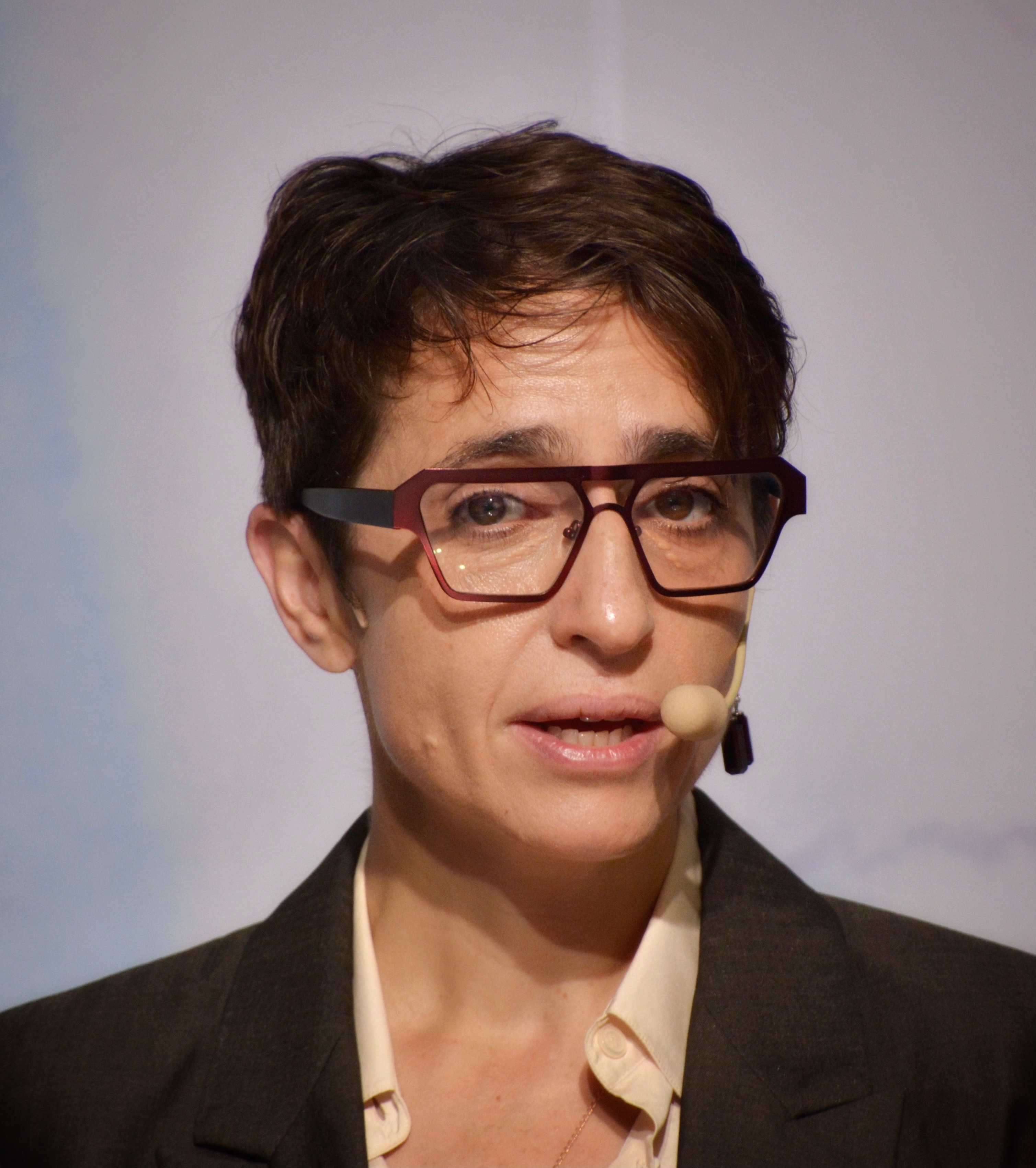
M. Gessen
American journalist and author
24
APPEARANCES
17
PODCASTS
Sep 24, 2026


Alisa SolomonGUEST
It's all about, oh, I'm going to save the musical theater, which has been taken over by people who have tendentious messages instead of writing good stories.
37 MINS LATER


M. GessenGUEST
So b- because again, the point of the law, right, is to exclude an entire group of people.
M. GessenGUEST
So the situation that's created, right, um, is people who haven't gotten the letter and sometimes go on the Kansas DMV website, um, to, uh, to check whether their driver's license is valid, you know, and find out that it's valid, don't know if they are, quote-unquote, legal.
6 MINS LATER

Mary HarrisHOST
But as a Russian, you also had this experience with identity documents where you realized how they could constrain you too,
M. GessenGUEST
right? Well, everybody's identity documents constrain you and give you rights, right? That's the tension.
M. GessenGUEST
And in Russia, we even have an expression for that, which is without a piece of paper, you're a little bugger.
M. GessenGUEST
And at the time it was reported, and then six months later, people had sort of forgotten about it.
12 MINS LATER
Mary HarrisHOST
I'm Why didn't you talk to people in those groups? Because it seemed like a choice to me and an important choice.


Mina KimHOST
So can you talk about that experience? I mean, you did 35 hours of interviews with him,

M. GessenGUEST
Part of it was that by the time I found myself in the courtroom room, rejoicing in what looked to me like the humiliation that he was suffering on the stand.
M. GessenGUEST
And actually, he ultimately acknowledged that, yeah, he felt embarrassed to be testifying, to be facing the questions he was asking, he was facing because he sounded so ridiculous, right? And he sounded so bad on the tape.
M. GessenGUEST
I get embarrassed for stand-up comedians and want to run out of the room with their bombing.
5 MINS LATER
Mina KimHOST
sort of allow that person back into the family as someone like as a family member in the sense of like somebody that you fully do talk about existing um because in your family I think I remember it sort of being something that was talked about definitely not with the seriousness and intensity um once you started really reporting this out right

M. GessenGUEST
So one of the hallmarks of fascism is creating an exclusionary idea of the national community.
M. GessenGUEST
But I'm particularly interested in this driver's license business because one of the concepts that are... very important to me in sort of understanding fascism is Hannah Arendt's concept of denationalization.
M. GessenGUEST
And she wrote about denationalization as something that the Nazis started doing to Jews many years before the Holocaust and all the things that we know so much more about, right? But on these moves that sometimes seemed absurd and and sometimes seemed mean-spirited but inconsequential, they all added up to pushing people outside the boundaries of the nation.
M. GessenGUEST
So in Nazi Germany, it was prohibiting Jews from holding certain jobs, prohibiting Jews from living in certain spaces.
M. GessenGUEST
And I actually refer to this in the article in The Times, there was this crazy law that was passed I believe, in 1935 that required all Jews to add a middle name to their identification documents.


M. GessenGUEST
Forty-five years ago, my parents, my little brother, and I came over to this country from the Soviet Union, extending the family across continents.
M. GessenGUEST
Over the decades, the family, my father really, stretched to absorb spouses, in-laws, even though they spoke a different language, children, both biological and adopted, ex-spouses who chose to stick around, and eventually grandchildren.
M. GessenGUEST
Over those same decades, as in any family, people made bad decisions, said things they hoped no one would remember, got mad at each other, held grudges, came around, and the family stretched as needed.
speaker_3SOUNDBITE_SPEAKER
I, I understood that, uh, something's wrong with their marriage, but beyond that, no.


Richard FidlerHOST
What does it feel like to be living in a country that's going through this experience where its democratic institutions are slowly being strangled?
M. GessenGUEST
Um, well, you s- you said two words, creeping and slowly, that I would not exactly apply to the United States.
M. GessenGUEST
Creeping and slowly was true of the rise of Vladimir Putin and, and his autocratic state, and I think of all the contemporary autocracies that I've certainly written about or reported on.
M. GessenGUEST
In a sense, perhaps the, the effect is the same, because I remember what felt probably the worst in Russia was that something shocking would happen.
M. GessenGUEST
It was fourteen years ago that they put somebody in prison for the first time for peaceful protest, but that means twelve years into Putin's presidency.
9 MINS LATER


Ezra KleinHOST
Uh, I, I'm just curious how you have understood her killing, this moment, what its meaning is.
Masha GessenGUEST
Um, which I also feel is important to say because in one sense, the spectacle of a driver being executed in an American street is not unfamiliar.
Masha GessenGUEST
What was different here was that it wasn't police, it was ICE, and the person that they killed was a white woman and not a Black man.
Masha GessenGUEST
So i- this is another one of those instances where we've sort of been on this descent and then fell off a cliff, and the particular cliff is Trump has been, for almost a year now, talking in military terms and war terms about American cities.
21 MINS LATER
Masha GessenGUEST
Things that are somewhat like this invasion of Venezuela have happened before, right? The United States has gone to war without the authorization of the United Nations.
Masha GessenGUEST
Presidents have carried out strikes on foreign countries without briefing Congress.
Masha GessenGUEST
But the combination of all of that, the scale of all of that, the amount of time that has now passed without Congress still being briefed, right? We're taping this on Monday morning and from what I understand, there still hasn't been, um, a briefing for- f- uh, for Congress and we're two days out from the operation.
Masha GessenGUEST
And then the rhetorical framing of it, the sort of Trump standing in front of reporters and repeating in various ways, "We're going to run that country." Right? All of that just puts us in an entirely different kind of territory, um, and I think terrifying.
Masha GessenGUEST
And as for Putin, I think that early on- on Saturday, there were some commentators who sort of said, "Oh, Putin is probably upset because Maduro was his ally.
19 MINS LATER

Steve StrombergHOST
So i- is spheres of influence even the best way to think about it? Is it that we have our backyard where we have a particularly strong interest, but we really have interests everywhere that the United States can pursue and defend? Uh, how do you see this, Masha?
Masha GessenGUEST
I feel like the four people I ended up including give a kind of range of responses, and maybe the person I'm most interested in is Jonathan Dekel, and he is just a mess.
Masha GessenGUEST
Um, I actually realized that, uh, the first time I ever interviewed him, which was about six months after October 7th, he is a Jewish Israeli who lives in an intentional co-living community.
Masha GessenGUEST
It's a village called Neve Shalom-Ohr Ha'Selam where half the families are Palestinian citizens of Israel, half the families are Jewish Israelis, and the entire project is to create a kind of working model of the future, of this co-living, not coexistence, but co-living because of the intentionality and because of the constant conversation.
Masha GessenGUEST
And he told me a year and a half ago that he had moved there thinking that he was going to bring up his children, to not serve in the military, to live in a different Israel Palestine than the one he knew.
Masha GessenGUEST
And the morning of October 7th, he reported for reserve duty without being called, and so when I interviewed him six months into this, he was just...
Masha GessenGUEST
Like, one of the sentences that I remember him saying was, "Look, I'm okay with this being done in my name.


Ailsa ChangHOST
Okay, that said, the president has pointed out that he has heard from people who feel safer now because of the increased law enforcement presence on the streets in D.C. Now sure, those reports have not been independently verified, but do you think there is an argument that the visible presence of law enforcement can make many people feel safer?
M. GessenGUEST
One is that we have a president who systematically says things that are not true, so I think it may be a mistake to engage with this assertion that he has heard from people who say they feel safer.
M. GessenGUEST
You know, there are more complicated things than whether one or two or even dozens of individual people feel a particular way.
M. GessenGUEST
There are things that we measure that have to do with public safety and any other policy.
Ailsa ChangHOST
I mean, you lived in Russia as that fledgling democracy tipped into authoritarianism, and I'm just curious if you could flesh that out a little bit more in terms of do you see any echoes of that in what is happening in Washington DC right now?
Masha GessenGUEST
A little over a year later, Karen found out that he was on another list, the list of extremists and terrorists.
Masha GessenGUEST
It meant that the Russian state froze whatever assets he still had in Russia, so he'd been smart to sell his apartment.
Masha GessenGUEST
Just to make this clear, he hadn't been informed that there was a case against him.
Masha GessenGUEST
Karen had to hire a lawyer to figure out what he was charged with and which prosecutor was charging him.
7 MINS LATER
speaker_13GUEST
And when I'm saying that, "Well, I'm honored by that," or, "They're stupid," um, I feel that's this reaction just shielding you from the sadness and tragedy of that.

Masha GessenGUEST
Or more to the point, I don't think Putin thinks that he can survive an end of the war to Ukraine, an end to the war in Ukraine.
Masha GessenGUEST
There's absolutely no reason, political, psychological, economic, that would force him to end the war, except for the possibility of being brought to his knees on the battlefield.

Nermeen ShaikhHOST
And what about domestically? I'm guessing how how is this war now perceived in Russia? I mean, to the extent that one can gauge public opinion, what is it? And is there any remaining independent media operating in Russia now?
M. GessenGUEST
Or, more to the point, I don't think Putin thinks that he can survive an end of the war to Ukraine, uh, uh, an end to the war in Ukraine, and that basically tells us any- e- everything we need to know.
M. GessenGUEST
There's absolutely no reason, political, psychological, economic, that would force him to, uh, to end the war, except for the possibility of being brought to his knees on the battlefield.
M. GessenGUEST
Um, nuclear, moving nuclear submarines, playing a game of nuclear chicken is not going to do it.


Chris HayesHOST
Uh, we've now seen a US senator, and I think there's some part of me that can say, "Well, in each circumstance, there was a misunderstanding or things got out of control." But as someone who has written about authoritarian normalization, what does it feel like to you?
Masha GessenGUEST
In fact, I think it was more than 20 years before the first elected official was arrested in Russia because, um, you know, we- we- we think that it- it's not just that there's this sort of perception that elected officials have higher status, but they are actually representatives of the people, right? Each such arrest, each such assault is an assault, uh, and an insult to a very large number of people.
Masha GessenGUEST
And so, the fact that Trump is communicating and his administration is communicating, you know, "I don't care who you are.
Masha GessenGUEST
I'm going to bring you to- to your knees no matter whether you are somewhat accommodating, like Governor Newsom of California, uh, or you're rebellious, uh, like the mayor of Newark.

David LeonhardtHOST
Um, can you give us some sense of what that looked like from your time in Putin's Russia, and for listeners who aren't familiar with your whole history, just when it was that you were in Putin's Russia?
Masha GessenGUEST
I went back to Russia from the United States as a correspondent in 1991 and stayed for 22 years, until I was forced to leave by the Kremlin, and then I continued going back and forth and reporting until a couple of weeks after the full-scale invasion of Ukraine commenced.
Masha GessenGUEST
So yeah, I reported on Russia for more than 30 years and on Putin's autocratic rise, autocratic breakthrough, and autocratic consolidation for the duration.
Masha GessenGUEST
It's not a term I would use, actually, because I don't know if it's about exhaustion.
Masha GessenGUEST
I think it's... it's a very human and, in a way, very beautiful desire to normalize, to habituate, to find our footing in any situation and to keep on living.
17 MINS LATER
David LeonhardtHOST
We need so much more." But I also see some signs of hope and I at least wanna lift up the people who are opposing him, and I'm curious how you think about that balance and how we can end up avoiding the nihilism, um, that can be a favor to would-be autocrats.


Jane CoastonHOST
I'm curious as to what, first, what you think what lessons Americans can take from Russian history, but also, what can Americans do in this moment, in this political cl- climate to stay sane, to stay shocked, but w- what is it that we can't learn from Russia and from Russia's experiences?
M. GessenGUEST
I think there's, like this larger point of Russians are always, as a culture, ready for sacrifice and ready to say, "Okay, let's tighten our belts and get through this period of hardship." That's a really easy thing for Russian autocrats to use because that sentiment of "we need to sacrifice for the greater good" is, is really ingrained in the culture.
M. GessenGUEST
But I actually think it exists in this country and I think Trump, with his really excellent political instincts, is tapping into that.
M. GessenGUEST
When he says, "Well, you know, we may have to live through a period of hardship, uh, and things may get tougher because of tariffs and girls may have to have fewer dolls, but then things will get better," that's super familiar to me.
M. GessenGUEST
And that, I think, taps into what is probably not so culturally specific, which is this tendency of people to substitute a sense of belonging to something great for their personal sense of happiness and wellbeing and private connectedness.
M. GessenGUEST
So I think with all the differences in culture, this is actually something that Americans could learn from Russians, like to recognize the political appeal of belonging to something great and the really age-old trick of totalitarian leaders who are always dangling the carrot of stability while creating greater and greater instability so that people fall into line following this ever-dangling carrot.
Jane CoastonHOST
Does it make a difference if readers aren't receptive to this coverage, if readers aren't the people who are asking for this? What is the role of journalists here, do you think?


Nicolle WallaceHOST
Well, it's, right, it's the adaptive response to trauma, but does it have a downside in terms of putting our country on a path to resist autocracy?
M. GessenGUEST
Well, the downside is the obvious one, right? It's that just when we have our footing, just when you have gotten your mind around what's happening is the time to act.
M. GessenGUEST
And, you know, again, because Putin took so long to do what he did, there were so many times when you could look back, uh, to a year before, two years before, 20 years before and say, "We could have done so much," because that was before there was censorship.
M. GessenGUEST
That was before people were going to prison for peace- peaceful protest, right? And when we had all that room, we didn't act.
M. GessenGUEST
And so it's always too late if we give into that s- uh, to that adaptability response.

speaker_0NARRATOR
Here's what to make of it.
Masha GessenGUEST
The Trump administration has threatened, at this point, I hesitate to say how many high-profile universities, with pulling their federal funding, which in this case means pulling research grants.
Masha GessenGUEST
Some of them amounting to more than two billion dollars, as in the case of Harvard, unless they submit to various demands.
speaker_2SOUNDBITE_SPEAKER
Harvard's president wrote a letter in response saying the school quote, "Will not surrender its independence or relinquish its constitutional rights by agreeing to the terms."
Masha GessenGUEST
And in effect, these demands are to place the university under direct federal oversight.
Masha GessenGUEST
So the pretexts that the administration is using have to do with DI and anti-Semitism.
Masha GessenGUEST
But the real reason, I think, is anti-intellectualism and greed, and the fact that Trump is building a mafia state.

Amy GoodmanHOST
He says he's, yes, reaffirmed he's going to take Greenland, is now told the Pentagon to prepare to take Panama, and talks about, once again, getting rid of the Palestinians in Gaza and rebuilding it for the world's people, he said.
M. GessenGUEST
Which really, you know, I was listening the other day to a bunch of interviews from Canada that The Daily was broadcasting, and I was thinking this sounds so much like the way we used to talk about Russia and Ukraine, by we I mean Russians and Ukrainians.
M. GessenGUEST
And, you know, there are all these tropes, like, we're so close, we're practically one people.
M. GessenGUEST
So many Canadians live, or so many Ukrainians lived in Russia, so many Canadians live in the United States.
7 MINS LATER
Amy GoodmanHOST
But I'm guessing if you can respond to this overall attack on not just trans people, but the overall LGBTQ community, including the national federal website honoring Stonewall, removing the T from LGBT, despite the fact that it was trans women who led the protests that really gave birth to the modern-day LGBTQ movement in this country.

Amy GoodmanHOST
Has now told the Pentagon to prepare to take Panama, and talks about, once again, um, getting rid of the Palestinians in Gaza and, um, rebuilding it, uh, for the world's people, he said.
M. GessenGUEST
You know, I was, I was listening the other day to a bunch of interviews from Canada that The Daily was, uh, broadcasting, and I was thinking this sounds so much like the way we used to talk about Russia and Ukraine.
M. GessenGUEST
And, you know, there are all these tropes, like we're so close, we're practically one people.
M. GessenGUEST
So many Canadians live, or so many Ukrainians lived in Russia, so many Canadians live in the United States.
7 MINS LATER
Amy GoodmanHOST
Gessen, if you can respond to this overall attack on not just trans people, but the overall LGBTQ community, including, um, the national federal website, um, honoring Stonewall, removing the T from LGBT, despite the fact that it was trans women who led the protests that really, um, gave birth to the modern-day LGBTQ movement in this country.


Masha GessenGUEST
Exactly. So yeah, that might be where we are actually. Um, I mean, you know, I'm inclined always, um, to listen to what, uh, people with power say out loud because I think they tell us everything. And there has been a lot of searching, you know, is Trump a part, uh, a Russian agent? Is he doing Putin's bi- bidding? But I actually think he tells us everything that, that we need to know. Um, he's an over-confident, under-informed, impulsive man who really wants the Nobel Peace Prize and thinks that he, i- doesn't know what he doesn't know, think- thinks that he is in a position to force U, uh, Russia to, uh, and Ukraine into a peace agreement that will make him the greatest ever. Right? Um, and he's hitting some stumbling blocks. Uh, as far as he is concerned, Zelenskyy not playing the supplicant is a stumbling block, and Russia bombing the shit out of Ukraine, yet again, is another stumbling block. So he reacts in real time. He reacts by shouting at Zelenskyy in the Oval Office, and he reacts by threatening Russia with sanctions because he, I think, sincerely thought that it would be enough to dangle the carrot of no sanctions to get Russia to, uh, to commit to peace in Ukraine.
15 MINS LATER
Masha GessenGUEST
Uh, and (clears throat) I think Trump is basically being aligned, uh, with those parties. Um, he's just as Euro-skeptic. The whole sort of idea of Europe and all of its values, uh, the, you know, the, the foundational values of the European Union which are peace and human rights, um, they're foreign and weird to him. And so, he treats all of Europe with a, with a, with a kind of, uh, built-in resentment. So, um, and I think he probably feels less comfortable, more challenged by even somebody like Macron who played him masterfully and probably didn't and, uh, leave him feeling so great as when Putin much less masterfully, much more directly, from what we can gather, appeals to just his naked ambition and his sense of power. Uh, you know, they, they probably, you know, they talked for a year and, uh, for, um, an hour and a half the day we knew of of the, that one long phone call, and my guess is that they talked about how powerful they are and how they would, they could cover up the world. And, um, and Macron probably brought up a lot of things that were more complicated, uh, that challenged Trump's sense of himself in the moment, uh, that were prob- that probably brought up issues that were unfamiliar to Trump, made him feel less than confident. Um, all of that is just deeply uncomfortable for him.


Aaron GilchristHOST
All right. We know you'll stay on top of it. Courtney Kube, thank you. And joining me now is Masha Gessen, a Russia and Putin expert, and an opinion columnist for The New York Times. Masha, thanks for being here. Uh, what's, what's your reaction to how President Trump has handled relations with President Zelenskyy versus how he's handling them with President, uh, Putin? W- what do... what does this mean, do you think, for our standing in the world?
Masha GessenGUEST
Um, hi. It's good to be here. Well, I don't know that I have anything terribly original to say on this score. Uh, we're seeing Moscow jubilant. Uh, they're celebrating, uh, splintering the West. Alexander Dugin, who is sort of the, the, the self-taught philosopher who feeds Putin a lot of his talking points, has been tweeting, or posting on X, uh, exuberantly celebrating that, as he says, "We're no longer at war with the West. We're not at war with the United States. We're not at war with Hungary. We're not at war with Slovakia." Um, but of course the biggest win, right, uh, is they're no longer seeing a Western alliance united in defense of Ukraine, united inadequately, I should say, for the last three years. Uh, there has been a lot of overstatement of the kind of he-... uh, aid that Ukraine has received in the last three years, especially from the United States. But still it was united, it was still helping Ukraine defend itself, and that is no longer the case.
Aaron GilchristHOST
You know, in a, in a significant way, we have seen European leaders try to appease President Trump. Uh, both Macron and Starmer announced some additional defense commitments before they, uh, visited the White House over the last couple of weeks here. Is that the best strategy for the Europeans, or does there come a point where Europe needs to push back harder on the US?
Masha GessenGUEST
You know, I can't tell European leaders what to do, and I'm not, you know... tha- I'm not an expert on that kind of strategy. What I can say is that there's a huge difference between what European leaders have to do and what Zelenskyy has to do. Some people have asked, "Why hasn't Zelenskyy used the sort of combination of flattery and some advanced concessions to get Trump to-... uh, to be more, uh, inclined toward him. Well, he is the president of a country at war and he also sees Trump being played and he also sees his overconfidence, which is quite transparent, and he realizes that Ukraine stands to lose absolutely everything because of Trump's overconfidence and because of his conviction that he is a bril- br- brilliant negotiator. European leaders understand this too and they understand that Ukraine has functioned as basically a buffer zone between them and an aggressive Russia and that now is the time to step up and help def- uh, Ukraine defend itself because in fact, Ukraine is defending all of Europe, a point that Zelenskyy has made over and over and which European leaders do hear.

Scott DetrowHOST
So I got them on the line to talk about how they make sense of the Trump administration so far.
Masha GessenGUEST
You know, we imagine autocracy as extreme repression, as the usurpation of power, and all of that is true.
Masha GessenGUEST
And for some people, living under autocracy is terrifying because they're direct political targets.
Masha GessenGUEST
But for most people, from my experience, uh, or most of the time, living under autocracy is just dumb.
Masha GessenGUEST
We are engaged now with things like, should the United States buy Greenland? Uh, did DEI cause the plane and, uh, and helicopter collision? These are absurd propositions, and yet intelligent people start asking stupid questions like, "Can the United States take over Gaza and redevelop it as a seaside resort?" The idea that people have obligations to one another, that there's a law-based world order, at least we aspire to having one, all of this is being delegitimized with these bad ideas.
Scott DetrowHOST
How have you thought about this, uh, since the election, and, and what do you think about that dynamic that seems to really be playing out?
Masha GessenGUEST
One is that I think that Americans voted for Donald Trump because there are some really major problems with the system of government as it's constituted.