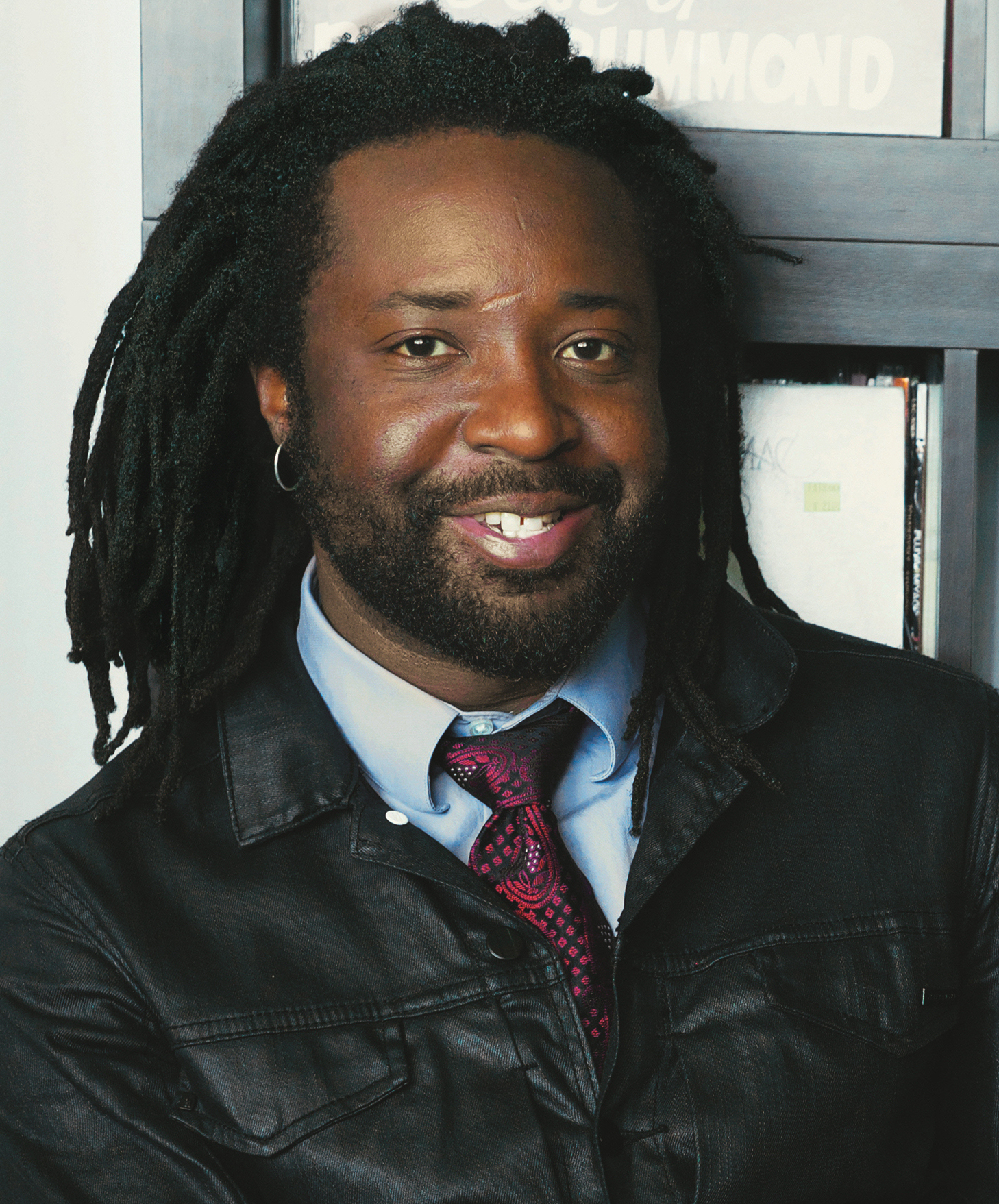
Marlon James
Jamaican writer
23
APPEARANCES
20
PODCASTS
Oct 11, 2026


James CrawfordHOST
It seems perhaps innocuous to our modern ears, but in that place, at that time, it really isn't, is it?

Marlon JamesGUEST
In 1988, even if you didn't experience it yourself, every gay Jamaican knows of a story of a gay person being beaten.
Marlon JamesGUEST
My character, when he's not rehearsing, goes through a place called Tropical Plaza.
Marlon JamesGUEST
And Tropical Plaza was infamous for a massive riot that erupted because two men, I guess, touched each other.
Marlon JamesGUEST
They even ran into a pharmacy and the police, who was used to beating them, had to, like, They had to be guarded against because these people were about to destroy the farmers that they went into.
8 MINS LATER


Marlon JamesGUEST
Jordan has one of the longer sections in the book because Jordan takes it on himself to be this instrument of revenge.
Marlon JamesGUEST
in the sense that he's inspired by the Seven who decide to take revenge in their own hands in America, not realizing that the guy who throws himself off the roof at the beginning of the novel is one of the Seven, and that the road he's going is going to drive him mad, especially if he takes on that role.

Marlon JamesGUEST
Um, I remember going back a few years ago, and there was a LGBT association for students, and I, which I didn't even know it existed, and I'm giving them their it gets better speech.

Marlon JamesGUEST
You know, I tell people history changes every day depending on who's writing it.
Marlon JamesGUEST
So sometimes the, the stories that we need or the stories that reflect on people who are not leaders, you know, who are not famous, have to come from, from fiction, has to come from the books.
Marlon JamesGUEST
You know, there, there are certain things you're gonna l- learn about yourself from Huckleberry Finn that you're not gonna learn from, you know, from Shelby Foote.

Jordan KlepperHOST
Do you see it as an act of choice or an act of necessity in Jamaica at the time?

speaker_12UNKNOWN
What were you, what was-
Marlon JamesGUEST
I, I'm not sure I was trying to wrestle it from the tabloid history because I don't really respect the tabloid history.
Marlon JamesGUEST
And I think, I think in some ways acknowledging a tabloid history is to give it a certain credence, which I, I, you know, I wasn't able, I wasn't able to take it as legitimate.
Marlon JamesGUEST
Um, that said, yeah, it, it's, it's, the, the, the idea that, um, even, you know, it must have been him kill himself.
Marlon JamesGUEST
You know, that's why reading about lynchings was, was, was, um, really helpful because a lot of times lynchers would say, "Yeah, they, they, they, you know, they all hanging themselves," and so on.
Marlon JamesGUEST
One of the things I thought was really interesting about the public's reaction to it is that predators like him need the public to thrive.
6 MINS LATER
speaker_13UNKNOWN
... or...?
Marlon JamesGUEST
You know, I tell people history changes every day depending on who's writing it.
Marlon JamesGUEST
So sometimes the, the stories that we need, or the stories that reflect on people who are not leaders, you know, who are not famous, have to come from, from fiction, has to come from the books.
Marlon JamesGUEST
You know, there, there are certain things you're gonna l- learn about the soul from Huckleberry Finn that you're not gonna learn from, you know, from Shelby Foote.
Marlon JamesGUEST
You know, I tell people history changes every day depending on who's writing it.
Marlon JamesGUEST
So sometimes the, the stories that we need or the stories that reflect on people who are not leaders, you know, who are not famous, have to come from, from fiction, has to come from the books.
Marlon JamesGUEST
You know, there, there are certain things you're gonna l- learn about the soul from Huckleberry Finn that you're not gonna learn from, you know, from Shelby Foote.
Marlon JamesGUEST
I think, um, when you're in the margins, sometimes, you know, in order to not have the light turned on you, and, and in order to not have the oppressors come and knock on your door, you find ways.


Marlon JamesGUEST
So the exorcism actually happened for years after I became a Christian because I became a Christian as big in church.
13 MINS LATER

speaker_18ADVERTISER
What is this?
speaker_18ADVERTISER
not feeling good about any of this.


Jeffrey BrownCORRESPONDENT
But what you're showing us is that they are, in some ways, performing all the time.
Marlon JamesGUEST
They're drawn to act in a play because performing, acting, code switching is something that I think Certainly for me, if you're gay, if you're queer in a homophobic country, you learn how to act.

Marlon JamesGUEST
and um an identity is so fluid it's never permanent it's never set um and that of course spills over into sexual identity and it spills over into into um gender and so on but that was one of the things that was such a pleasure to learn from the research just how fluid and how up for grabs all these things were and i wanted that kind of sensory world that sensual world in the book i also think um I think it's, for me at least, it's one of the things that was very different from the fantasy I read quite a bit of, where a lot of those things are sort of cut and dry, to the point where they're dependable.
Marlon JamesGUEST
But I kept going, what if Strider were in Game of Thrones? You know? But it's...
Marlon JamesGUEST
I think that there are things that we hold on to to the point where they become kind of sources of prejudice, like the idea of what a man is and what is normal or what is straight, what is gay, what is so on.
17 MINS LATER


28 MINS LATER


Audie CornishHOST
And that's why this is important to talk about in terms of the representation, because you're like, you don't want to, you want to go past Bob Marley and Sunny Beach commercials, and then you take us all the way to the gully, you know what I mean? And it's showing something even more, showing something that you're almost scared to show a public that already knows has reduced your community to stereotypes.
Marlon JamesGUEST
Yeah, but it's easy to play the game of just, well, let's just swap it out for a different stereotype.
Marlon JamesGUEST
Let's take away one short-sighted thing for another short-sighted thing and have beautiful beaches and wonderful people.
Marlon JamesGUEST
Even in this era, which is 20 years or four today, There are all these sort of complex negotiations people are making.
Marlon JamesGUEST
There are people with queerness, with homosexuality, with difference, and so on.
10 MINS LATER


Traci ThomasHOST
And I'm just wondering for you, a person who reads and loves books and talks about books on your podcast, what you are hoping to do, what it feels like for you, what is exciting to you about having your work be so directly in conversation with other texts? Yeah.
Marlon JamesGUEST
Well, I mean, all of that is really deliberate because I'm always in conversation with other texts.
Marlon JamesGUEST
Um, I, you know, I, um, I'm in, in a lot of ways, even more inspired by non-text art.
Marlon JamesGUEST
Um, you know, I'm, I'm more in, you know, I put on, I put on jazz music before I write, um, If I can't figure my way through a paragraph, I'm more likely to look at art than read a story.
11 MINS LATER


Juana SummersCORRESPONDENT
I wonder, did you want the novel to resist identifying one morally correct way to survive?
Marlon JamesGUEST
There isn't one, and I'm not sure any of them were morally correct or morally incorrect.
Marlon JamesGUEST
But the character in the book who chooses vengeance not only loses a sense of mooring, not only loses a sense of self, he lose, he, he kinda loses his mind.
Marlon JamesGUEST
Um, the, the, the there's a price you pay even if you feel justified There's a price you pay for trying to go through evil to get to good.
Marlon JamesGUEST
I remember all the homophobic cool kids took the bus to school at 6:00, so I realized if I take the bus at 6:15, I don't have to deal with any of them.


Marlon JamesGUEST
Because in Jamaica, and I can only speak for my country, in Jamaica, masculinity was always up for grabs.
Marlon JamesGUEST
There is a scene in the second section, Black Jacks, where this guy reels off all the people he should kill.


Eric NewmanHOST
So I want to talk a little bit about this character as one who is using— different masks maybe in order to like live the life that he feels is expected and then the life that he wants.
Marlon JamesGUEST
Um, well, I mean, the first thing about, about Matt is unlike a lot of people who wants to close, which he has the means, um, and he can do it, and he has light-skinned privilege, and he has pretty privilege, and all of that.
Marlon JamesGUEST
But he also, as we get to know him more near the end, again, he's also scarred by who he should be and who he shouldn't be.
Marlon JamesGUEST
He is really, really sort of shell-shocked by the hatred because he's one of the people who's attacked.
Marlon JamesGUEST
And he's attacked pretty – I mean, they're all attacked badly, but he's also attacked particularly badly.
10 MINS LATER
Eric NewmanHOST
Well, as we okay, so as we kind of wind down, I want to just ask about like, how did this writing this book doing the research for this book, make you encounter or reencounter your own experience as a gay Jamaican?


Mythili RaoHOST
What is it that makes it possible to bridge that they don't get to have a chance at?
Marlon JamesGUEST
And sometimes, I think somebody alludes to this in the book, sometimes one of the worst things that trauma does is that it leaves you in the present tense.
Marlon JamesGUEST
I know for me, like, for example, I'm triggered when I run across schoolmates, because I remember how horrible high school was.
18 MINS LATER


Brad ListiHOST
Were there parts of your gay experience that were illuminated by literature that really helped you to solidify your thinking?
Marlon JamesGUEST
I read Giovanni's Room when I was, what, 50? And the first thing I thought of is, man, if I read this when I was 18, I'd have gone so far in the closet, I'd be onto my fifth kid by now.
Marlon JamesGUEST
One of the things I remember about, well, one, it's Jamaica, so there's no way you could get a gay book in Jamaica without announcing you're buying a gay book.

speaker_5UNKNOWN
[laughs]
Marlon JamesGUEST
And it just came all at once that everything I was living at that time, the lie I was living, the, the, the ways in which I was not being myself was all in this effort to never disappoint my mother.
Marlon JamesGUEST
And I realized at that point my entire life was built around the sham of not ple- not displeasing my mom.
speaker_6UNKNOWN
[laughing]


Abby PhillipHOST
Are current leaders over-leveraging the future for the next generation? That's next.
Marlon JamesGUEST
My search for the scariest house in America has taken me to some unsettling places.
Chris MurphySOUNDBITE_SPEAKER
The spooky.
Ari ShapiroADVERTISER
... "We knew you had to be our first in-person guest."
Marlon JamesGUEST
I think what people like, what I've gotten from people, is that they like that it's showing them as them.

Marlon JamesGUEST
In that really ugly incident we saw in Minnesota, protesters called an ICE officer the N-word.


Marlon JamesGUEST
soon?I, I do, and to echo what Josh just said, they know more than we know, and that's appropriate.
Marlon JamesGUEST
They have to keep some of these facts close to their chest because I would be very surprised if they don't have some information about some car somewhere.
Marlon JamesGUEST
But rather than let that out, thereby telling the person in the car maybe to change cars or whatever, they're going to keep that close to the chest.
Marlon JamesGUEST
That's just, you know, investigation 101, to gather a lot of information and let some of it out to the public so you're getting additional information.
Marlon JamesGUEST
But that critical mass of information they have to keep close to their chest until they develop it properly, and that information getting out would give information to the bad guys that they don't want them to have.