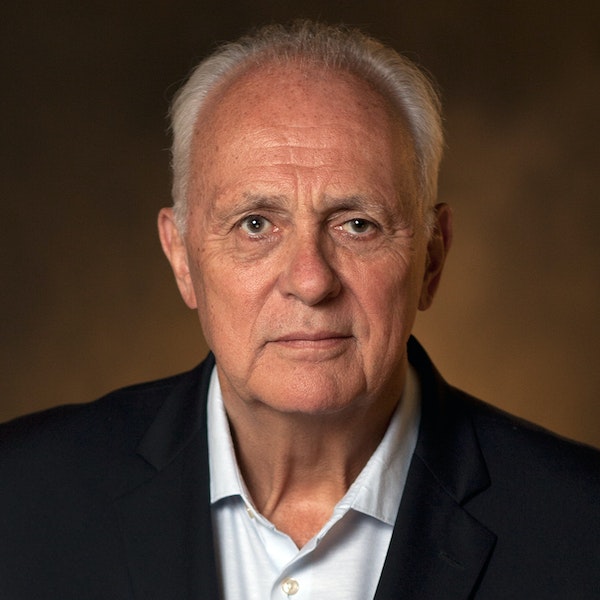
Mark Malloch Brown
Journalist and former Deputy Secretary-General of the United Nations
5
APPEARANCES
3
PODCASTS
Sep 21, 2026

Julian WarrickerHOST
Those major issues, as you see them, what would you put at the top of the list?

Mark Malloch BrownGUEST
Well, I think obviously the two big wars, Ukraine and Iran, are going to feature largely.
Mark Malloch BrownGUEST
Iran, I think, particularly, but with Ukraine trying to make sure it's not forgotten.
Mark Malloch BrownGUEST
I think there will be a lot of discussion of how to sort of renew the authority of the UN, which will fold into the discussion, the debate about who's the best person to succeed.
Mark Malloch BrownGUEST
And a sort of strange joker issue which has come up very, very quickly, but which is dominating discussion in New York at the moment in the events around the UN proper is AI and, you know, the risk of some global disaster around it and the Longer term prospects for employment around the world, etc.
Mark Malloch BrownGUEST
So, you know, three big issues with climate not to be forgotten as a fourth.

Tim FranksHOST
In terms of the last ten years and António Guterres' two terms, how do you think he's navigated that minefield?
Mark Malloch BrownGUEST
It's been a surprise because on paper, and indeed for those of us who knew him, he seemed an almost ideal Secretary General in that he'd been Prime Minister of his country, Portugal, and then spent ten years as the High Commissioner for Refugees.
Mark Malloch BrownGUEST
And yet he's been one of the most disappointing Secretary Generals that we've seen in the organization's eighty-year-plus life.
Mark Malloch BrownGUEST
It's been marginalized in not just the major conflicts, Ukraine and Gaza, but even more modest regional conflicts which nevertheless are extracting a huge toll of life, such as Sudan, DRC, Yemen, Myanmar, and the UN is sort of missing in action.
Mark Malloch BrownGUEST
But I think you have to blame above all the situation in which he's been Secretary General, the first Trump term, the disappointing Biden years, and then a second Trump term.
Mark Malloch BrownGUEST
He's never had a partner in the United States who could support peacemaking efforts and development efforts around the world, and other countries have been slow to step in and make up the difference.
Tim FranksHOST
Well, I just wonder whether that sort of leads to whether in a way we're expecting too much of the United Nations, that maybe the United Nations needs to scale back its ambition and that it's not so much about conflict resolution as maybe concentrating on things like peacekeeping, things like, I mean, hugely important humanitarian affairs where they, they do seem to have quite a bit of purchase.

Julian WorrickerHOST
I mean, what, what of the man they are succeeding, whoever is eventually picked, António Guterres? H-how do you assess the job that he has done?
Mark Malloch BrownGUEST
Well, it is this perverse thing because, you know, on paper, he should have been a storied secretary-general.
Mark Malloch BrownGUEST
He'd been prime minister of Portugal for a dec- for I think ten years, then run the UN High Commissioner for Refugees for ten years.
Mark Malloch BrownGUEST
So he was the perfect outside-inside candidate, you know, and yet he's been one of the most disappointing holders of the office.
Mark Malloch BrownGUEST
And I think in his case, it's largely been the bad luck of the times and, and period during which he's held it.
Mark Malloch BrownGUEST
He, you know, then had the very disappointing Biden years and then a second Trump term.
Julian WorrickerHOST
But is the UN now capable of being, to use your word, activist, or, or does it now need some serious reform in terms of how it operates, how it votes, who has the most influence within it? In other words, is it now fit for purpose?

Mark Malloch BrownGUEST
Well, you know, obviously there was some speculation earlier that David Miliband might come back.
Mark Malloch BrownGUEST
And, you know, David would've been an, you know, instantly well received around the world.
Mark Malloch BrownGUEST
In the intervening years, he's run the International Rescue Committee, a big American NGO, and has really built a huge sort of standing, uh, across the global community.
Mark Malloch BrownGUEST
His, you know, passionate commitment to the climate issue and the fact that there's a ton of international work around that, conferences, et cetera, mean he's also a well-known figure internationally.
Rebecca KesbyHOST
Uh, he's also got to keep Donald Trump on side, hasn't he? Where are the priorities going to be?


Sara PantulianoHOST
Has this information become one of the defining tools of power in international affairs?
Mark Malloch-BrownGUEST
I think it's certainly, whether it's the tool or the consequence of what's happened to power, I think remains always a little uncertain because I think you've got to put it in the context of the breakdown of both the domestic and the international political order as we've known it through most of our lifetimes.
Mark Malloch-BrownGUEST
We know that domestically in many of our countries, there is an extraordinary sort of populist movement driven by certain groups in society feeling inferior.
Mark Malloch-BrownGUEST
a new economic insecurity, a loss of wealth versus other groups in society.
Mark Malloch-BrownGUEST
It's sort of knocked the bottom out of the sort of social democratic 80 years that we've lived through.
8 MINS LATER
Sara PantulianoHOST
How much of this current information crisis is really a crisis of trust in Western institutions?