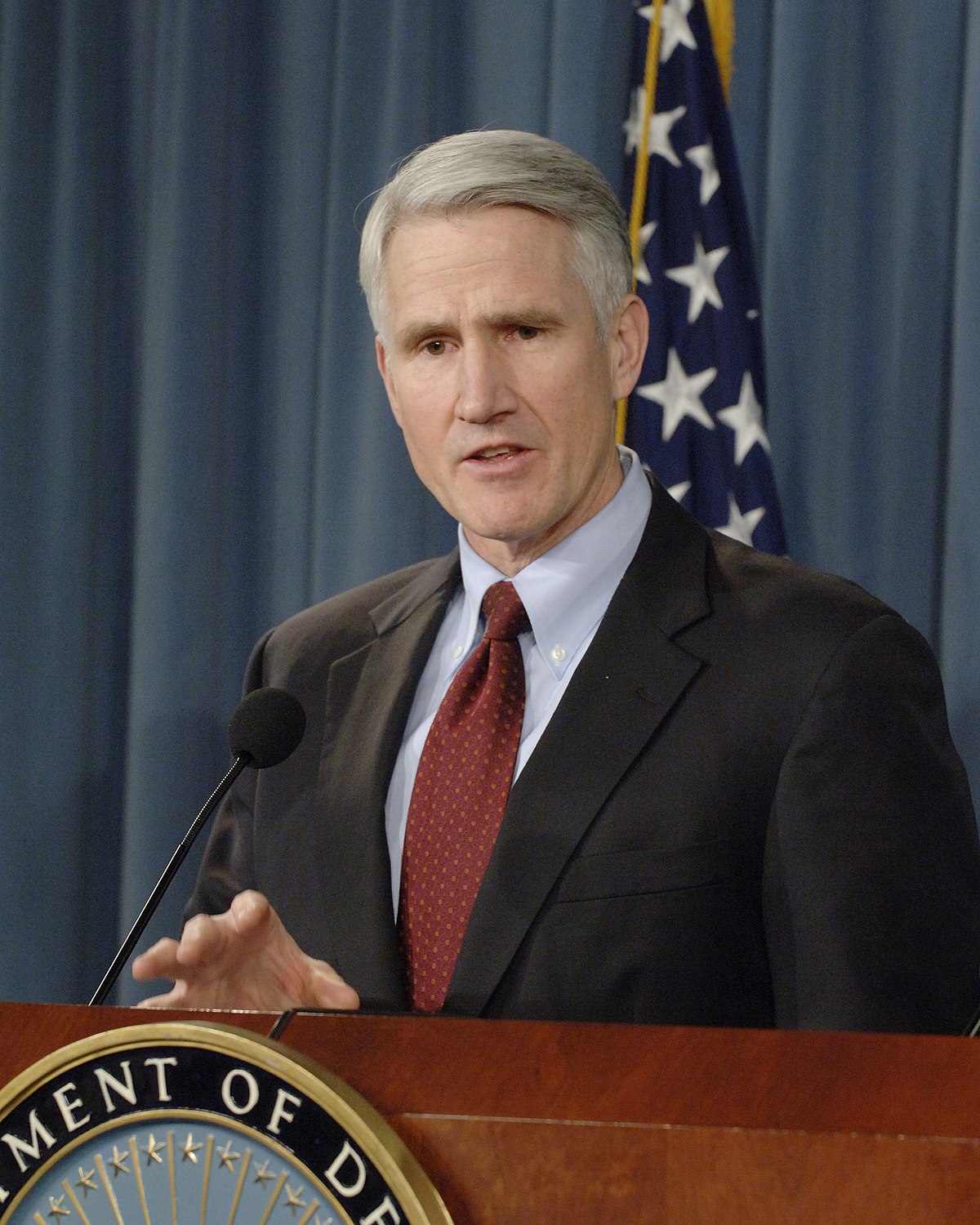
Mark Kimmitt
Former United States Assistant Secretary of State for Political-Military Affairs
36
APPEARANCES
17
PODCASTS
Oct 13, 2026

speaker_3HOST
Walk us through the pros and, and cons of getting the US directly involved.

Mark KimmittGUEST
Look, I think it's important for the audience to know that the forces of the legitimate government of Yemen are making progress on the ground.
Mark KimmittGUEST
If we're going to support, we ought to support, as we used to say, by, with, and through the Yemeni forces.
speaker_3HOST
Do you think this, uh, is an indication to Mohammed bin Salman, if President Trump doesn't get more involved, that he's perhaps over-relied on the United States for security?
Mark KimmittGUEST
Well, I think it's important to understand that the Saudis and the Emiratis fought together against the Houthis about 10 years ago, weren't very successful.

Pete HegsethSOUNDBITE_SPEAKER
We are winning.
Mark KimmittGUEST
I don't believe that that's the right way to communicate actions that put American men and women at risk.
Mark KimmittGUEST
It may make you feel good to have a neat TikTok video of Karg Island blowing up.
Mark KimmittGUEST
One really has to ask if they're taking the communications and information operations role seriously.

Mark KimmittGUEST
The biggest strategic mistake made by the regime in Tehran is believing that The midterms, the economy and the people of America are their communications, targets and opportunities.
Mark KimmittGUEST
And let's be honest, the American people aren't mobilized to protest this war.

Kailey LeinzHOST
As we hear this kind of rhetoric from the administration, and we've heard similar things from President Trump as well, who just within the last week has suggested low-keying it, focusing more on economic measures, is it because our military measures were not and cannot be enough?
Mark KimmittGUEST
It's, it's really gotta be a combination of economic, diplomatic, and military.
Mark KimmittGUEST
Uh, right now, uh, the military doesn't seem to be able to break through the resistance model of patience and, uh, standing back and taking the blows as Iran has been doing.
Mark KimmittGUEST
So I think what they're doing is turning up the knob on the economic sanctions-

Jackie HeinrichHOST
up.What do you think it's gonna take for a measurably different outcome this time, and how much does that depend on the Iranian people rising up again?
Mark KimmittGUEST
Well, first of all, I think we've got to understand we're sending two different messages to the Iranians.
Mark KimmittGUEST
We have people that are saying, "I think this is gonna be over quickly," but you heard the president just then basically caution patience.
Mark KimmittGUEST
They hear about we need to b- we don't like forever wars, we wanna get out of this quickly, we wanna get this done quickly.
Jackie HeinrichHOST
So the White House always reiterates that nothing any state does is going to make a difference in what the US does, but at what point does this sort of stuff mandate a response from the US?


Piers MorganHOST
When you've read that report, does that worry you, or is this normal stuff that goes on in any war?
Mark KimmittGUEST
Well, I certainly wouldn't be upset and worried if I was Admiral Cooper in terms of how many Patriots, how many, uh, JDAMs, how many fast-attack, um, Tomahawk missiles we have.
Mark KimmittGUEST
The people that are worried are the, uh, INDOPACOM commander and could well be the EUCOM commander, whose contingency plans all depend on having a certain availability of those, uh, critical materials.
Mark KimmittGUEST
I believe that Admiral Cooper's going to get what he needs from this administration simply because he's in a war.
Mark KimmittGUEST
Uh, but Cooper and the INDOPACOM comm- uh, the INDOPACOM commander and the, and the, uh, European command- commander are probably shaking in their boots.
Mark KimmittGUEST
Look, one thing that wasn't mentioned, and I wanna throw this in here, uh, because there is another dimension and there's another set of actors in all this, and that's the Europeans.
12 MINS LATER
Piers MorganHOST
General Kimmitt, I think I detected a slight shake of the head there, or was it an involuntary tick?


John BickleyHOST
So first, where do things stand with the conflict between the US and Iran today?
Mark KimmittGUEST
Well, I think frankly, we're sort of at a, uh, status quo with the fighting going back and forth, somewhat tit for tat.
Mark KimmittGUEST
There seems to be a necessity for some kind of break point, uh, in one way or the other, uh, to this conflict.
Mark KimmittGUEST
I think we might see our bombing campaign take on different, uh, tactics than we've seen up to this point.
Mark KimmittGUEST
We're starting to go against dual use targets like infrastructure, bridges that can be used by the military, but also are used by the civilian population as well.
John BickleyHOST
Adding to that, how much will our allies in the region potentially prove the key if we really have to change the nature of the conflict to come to some sort of resolution?


Erin BurnettHOST
I mean, how concerned are you tonight, given where this is at this moment, about the risks to the tens of thousands of US troops that are in the Middle East now?
Mark KimmittGUEST
Well, I, I think both Brett and I are concerned about that significantly because, again, all we need is one mistake made by an air offense artilleryman who misses a missile coming in.
Mark KimmittGUEST
I mean, we saw that in Al-Asad inside of Iraq, where we luckily did not lose a significant number of troops.
Mark KimmittGUEST
But when you have a large concentration of them, as we do in Kuwait, Al Udeid in U- in Qatar, and some of the other bases in UAE, that could certainly happen.
Mark KimmittGUEST
It is clear that if the United States is the unilateral, uh, protector of the Gulf, uh, of the Strait of Hormuz, that will not work.
Mark KimmittGUEST
The fact is we are a belligerent in this conflict, and for us to try to control it is a war situation.

Mark KimmittGUEST
The Iranians always respond, "You're gonna see another strike." Not clear how we get out of this dynamic because the two sides disagree about the strait.
Mark KimmittGUEST
There are two problems with this ceasefire, particularly w- regarding the strait, but also with nuclear weapons.


Trace GallagherHOST
He goes on to talk about how you can start refunding the proxies again to do more harm to the interests of the United States in the Middle East.
Mark KimmittGUEST
Yeah, well first of all, I agree with General Keane, and not simply because he was my commander at one time, but he's absolutely right.
Mark KimmittGUEST
The Iranians need money the way that a body needs blood, and they're running out of blood right now.
Mark KimmittGUEST
And but if they get a transfusion the way that the last ad- the, the Obama administration kept them alive for a number of years with funds transfers, uh, they'll just keep this up.
Mark KimmittGUEST
What would be their incentive to either, uh, change their nuclear program, or change their proxy program, or change their ballistic missile program? As long as they can keep their head over wa- head above water with new money, they won't stop.
Piers MorganHOST
Do threats like that have any significance anymore? Do you think the Iranians care when Trump saber rattles like that? And is, on a practical reality level, is it realistic to think that there could be, say, a pause of a month, two months, 60 days, whatever, and at the end of it, if Trump isn't happy, he starts the military attacks again given what's been going on for the last 16 weeks?
Mark KimmittGUEST
Well, the answer to your question, your last question, is of course they could start the military campaign up again.
Mark KimmittGUEST
Um, now, would it have any effect? Uh, I think we've gotta understand that military success up to this point has not had a strategic effect.
Mark KimmittGUEST
And part of that is this, the, the resistance model that is being used, which says they win by not losing.
22 MINS LATER


Cabot PhillipsHOST
Now, I know it's difficult to ascribe motives to a fanatical regime, but what do you make of this from the Iranian side, just from a tactical perspective? Are they maybe trying to drag out this conflict further, but why would they do this in the middle of peace talks in the first place?
Mark KimmittGUEST
I think they're going to do whatever they can to hang on to their nuclear program.
Mark KimmittGUEST
What did they do? They diverted our attention for weeks by closing the Strait of Hormuz.


Mark KimmittGUEST
First of all, I think we've got to realize that a significant amount of that money is not going for real f- war fighting capability.
Mark KimmittGUEST
Uh, it is probably a significant amount is going into, as your other guest said-Better personnel costs.
Mark KimmittGUEST
But there's a significant amount of Canadian equipment that needs backlog maintenance repair.
Mark KimmittGUEST
Your, your Leopard tank fleet is quite a bit of shambles, is gonna need a lot of money to bring it back up to operational capability.

speaker_11HOST
How do, how do we make it more realistic when you say, you know, sending those ships in, in order to do what?
Mark KimmittGUEST
Uh, in order to continue to, uh, assist the Iranians in wrecking their economy.
Mark KimmittGUEST
Uh, sooner or later, uh, I think that more combat action will make the Iranians understand that we need to achieve some of our other core objectives.
Mark KimmittGUEST
We saw that, uh, when we lost a couple, uh, until they were recovered inside of Iran.
Mark KimmittGUEST
But sometimes, uh, putting the US military at risk is certainly better than putting our allies at risk.
Mark KimmittGUEST
Look, if, if one of the agreed points is that the US reduces its presence in the Middle East, uh, that's gonna make the Middle East allies mad as badgers.

Joe KernenHOST
Is it d- a- are you pessimistic that, that you're, what you would like to happen i- is actually possible given the, you know, the, the headwinds from, from trying to continue this?

Anderson CooperHOST
How do you think the Iranians would interpret that, that movement? Um, what do you think they're there for?
Mark KimmittGUEST
Well, I think the Iranians are gonna look at that as an additional capability for the littoral area, the, the, uh, beach area of Iran, for either Kharg Island capability or for, uh, going down into the, uh, islands that control the straits, like Larak and then the Thumb Islands.
Mark KimmittGUEST
I think what's more significant is the additional 90 aircraft, fighter aircraft, that the H.W. Bush would bring.
Anderson CooperHOST
Do they have the power to do that? I mean, obviously we have seen strikes at, at a number of ports throughout the region by them.
Mark KimmittGUEST
The fact is, between the pragmatists and those that still believe in the principles of the Ir- of the Iranian revolution, it's clear the IRGC still has a power structure to be behind the scenes, and it could well be increasing in their power.
Mark KimmittGUEST
Uh, I think the thing we don't talk about a lot with regards to the military power is the speedboat capability that's, uh, basically hidden along the beaches, the littoral, uh, of the Persian Gulf.
Mark KimmittGUEST
A speedboat is what knocked out and killed Americans, uh, uh, in the USS Cole attack.


Mark KimmittGUEST
That's a very, very specialized course given to pilots and, in some cases, other special operations forces.
Mark KimmittGUEST
You're plane has crashed, you're possibly injured, you have nothing more than what you're carrying on yourself, and some communications.
Mark KimmittGUEST
The first and most important thing is to, as they say, learn to live like a bunny.
10:14

Is it because these planes are just workhorses, they're around and they do get the job done? Why are we still using these and what are they really good at?
Mark SchwartzGUEST
And when you put terms out there like air supremacy, uh, air dominance, it builds an expectation that
Mark KimmittGUEST
Look, General Schwartz and I both know it, war is ugly, it's messy, and bad things happen, and we are not making that clear to the American people as we're engaging this operation, that, that things are going to work out completely the way we want it.
Mark KimmittGUEST
And the very fact that we're talking about this, uh, as something extraordinary means that this administration candidly has not managed the expectations of the American people in terms of what the costs of this war will be.

John BermanHOST
But when you hear him talking about the oil in the strait, uh, does that give you a sense of what the strategy is?


Ian DaleHOST
How seriously do you take these comments by Donald Trump, and do you think there would be support within the United States for the United States to withdraw from NATO?
Mark KimmittGUEST
Well, as a little bit of my background, I was also the senior military assistant to the NATO Military Commander, so I know this quite well, and I've served under NATO command in Bosnia and in Kosovo.
Mark KimmittGUEST
Uh, the NATO, uh, charter is a treaty of the United States, so the president alone can't revoke the treaty.
Mark KimmittGUEST
Uh, he can suspend the treaty, and I think what we ought to be thinking less about the legalistic and more of the practical, which is the president could certainly hold back on, uh, support for NATO in any future operation.
Mark KimmittGUEST
We used to do what we called force generation conferences for NATO operations, and in that force generation conference, we would be putting spaces to faces and the contributions of the individual countries to the staffs and the units for that particular NATO mission.
Mark KimmittGUEST
The easiest way for the United States to signal its displeasure is just offer no soldiers or equipment or staff officers to that, uh, major operation.
John BermanHOST
So in your opinion, would hitting these facilities that provide millions of civilians with power and fresh water, would hitting them constitute a war crime?
Mark KimmittGUEST
Well, uh, it certainly would be against international law that we don't, uh, that we don't necessarily adhere to.
Mark KimmittGUEST
I think if we take a look at history, uh, going against these kind of facilities is not unusual in American bombing campaigns in the past.
Mark KimmittGUEST
That has changed since the Geneva Conventions have been updated, but even as recently as the bombing of Haiphong Harbor and Hanoi during the Vietnam War, uh, we didn't hold back at all.
Mark KimmittGUEST
Uh, I'll leave it to the lawyers to, to define whether it's a violation of international law or a violet- or a war crime.
Piers MorganHOST
And yet I don't see how he can stop it if the Iranians have worked out that it's the economic part of this war that they're currently winning.
Mark KimmittGUEST
Uh, even if they're won by the Democrats, uh, the fact remains is that nothing is gonna get done, uh, in the United States Congress, whether the Republicans still in charge or whether the Democrats are in charge.
Mark KimmittGUEST
Uh, but look, I think that Donald Trump now recognizes that the advice he took or the, or the orders that he issued are not achieving the results, uh, he wanted.
23 MINS LATER

Mark KimmittGUEST
But I think we've still gotta remember there are hundreds, if not thousands, of speed boats that are hidden along that coastline in coves, camouflaged in, in open sight as commercial vehicles.
Mark KimmittGUEST
I- it's important to understand that we don't have nearly the capability to bring up the mines, to escort the tankers, to escort all the equipment that we did in the first Tanker War.
Mark KimmittGUEST
We've got about 50 helicopters that can spot them, but we only have four boats, four entire boats in the Navy that can actually do mine countermeasure.

Anderson CooperHOST
The stuff in the strait, the, these other strikes, this is a sideshow." Is that accurate, or is the strait and these other things a sign of it's not going as well as the administration would like it?
Mark KimmittGUEST
Well, I think it's important to understand that the air campaign has been going very well.
Mark KimmittGUEST
But as we said last time, very little of this is going to lead to victory, particularly the air component of this, so-
Mark KimmittGUEST
Well, it, it, it means that we have raised the stakes in this war considerably.
Mark KimmittGUEST
It's gone simply from a, uh, take out the military, take out the regime, but now we're trying to take out the e- economic lifeblood of this country potentially.
Mark KimmittGUEST
I mean, it really is, um, he is holding Kharg Island, in my mind, hostage to ensure that, uh, Iran allows the, uh, ships through the Strait of Hormuz.
Mark KimmittGUEST
But as Jeremy [clears throat] properly said, uh, this could blow out of proportion, because if that oil infrastructure is attacked, uh, it is clear that Iran is going to attack the rest of the infrastructure in the Middle East.
Mark KimmittGUEST
And, uh, at that point, this, this, the prices of oil will just go out of control.
Mark KimmittGUEST
Although I, I really do believe that, uh, the military is correct when they say they have taken out most of the drones.

Mark KimmittGUEST
Well, look, my feeling, Caitlin, is that we went to war because we were unable to achieve three key issues at the negotiating table.
Mark KimmittGUEST
A continuation of the nuclear program of Iran, a continuation of the ballistic missile and drone program of Iran, and a continuation of the proxy program that Iran has run since 1979.
Mark KimmittGUEST
I think we ought to do everything we can to compel the Iranians back to the negotiating table, having given up those programs as an entry ticket.

Kaitlan CollinsHOST
When you see Iran's control over the Strait of Hormuz and the danger that potentially poses, what do you see from a military and economic perspective?
speaker_0CORRESPONDENT
Have a listen.
Mark KimmittGUEST
Well, in the middle of a war, it's hard to, uh, get a tape measure out in terms of the US standing.
Mark KimmittGUEST
Uh, they understand the benefits to their countries by the United States' actions if, in fact, Iran, uh, is neutered with its ballistic missiles, with its proxies, and with, with its nuclear program.
Mark KimmittGUEST
I think the greatest fear of the Middle East is if that we stop this war before those three goals are achieved.
Mark KimmittGUEST
And I think at that point, uh, the countries in the region would question why the United States went to war, uh, if it did not achieve its core objectives, uh, in that fight.
speaker_0CORRESPONDENT
Have a listen.
Mark KimmittGUEST
We have given a significant amount of intelligence over the last four years to Ukraine about the targeting of Russian positions, so the fact that the Russians are returning that favor quid pro quo, um-
Ian DaleHOST
Um, General Kimmitt, um, what, what, what is your definition of what victory looks like here?
Mark KimmittGUEST
Uh, we left the negotiating table because the Iranians were unwilling to negotiate on the issues of proxies and ballistic missiles, and they were starting to get into the finest detail about their nuclear program.
Mark KimmittGUEST
Those are our three core interests, nuclear, ballistic missiles and drones, and proxies.
Mark KimmittGUEST
In, in my mind, anything else than that, and I would agree, uh, with the comment that that would either be mission creep or boots on the ground.
Ian DaleHOST
Su- surely, uh, making regime change an objective, which I think most people think was the objective at the beginning, surely there, there is some sense to that.
Scroll for more appearances