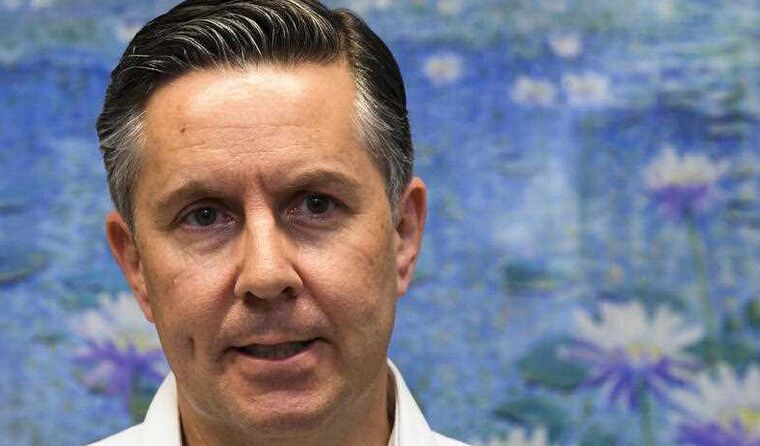
Mark Butler
Minister for Disability and the National Disability Insurance Scheme
33
APPEARANCES
16
PODCASTS
Oct 26, 2026

Milton DickMODERATOR
Minister for Health, the Minister for the National Disability Insurance Scheme and the Minister for Disability.

Mark ButlerGUEST
I'm asked why the government made the announcement we did in the budget this year to change the private health insurance rebate arrangements for over 65s.
Mark ButlerGUEST
First of all, just to be clear, what it is that we have decided to do is to return those rebate arrangements, or effectively a subsidy, that government pays for private health insurance to its original design.
Mark ButlerGUEST
So the two households living next to each other on an income of $50,000 or $80,000 or $100,000 would receive exactly the same taxpayer subsidy for their private health insurance, whether they were 60 or 50 or 65.

Mark ButlerGUEST
Well, I think there certainly are some areas talking to MPs over the last week where MPs and senators don't feel they get the protection that they need.
Mark ButlerGUEST
We'll have a very serious, deep discussion about that over the course of this week.
Mark ButlerGUEST
But as you say, beginning probably today, and we'll take the advice of the federal police and other security agencies about that.
Mark ButlerGUEST
The federal police and security agencies like ASIO have been very open for some time now, well before last week, about the threat environment and the nature of and the scale of the threats being made towards MPs, their staff and their families.
Mark ButlerGUEST
Well, we've heard really a message for some years now that women don't feel they get the choice and the access and the affordability for their healthcare that they need.

TomHOST
Have you had some concerns about their political discourse for some time, whether that be from politicians, or I guess are becoming more and more personal in some of their attacks, as well as the wider sentiment on social media from more rogue elements of the community? Is that a concern for you lately?
Mark ButlerGUEST
Yeah, I think we've all seen a level of often hate and disrespect and intolerance in our political debate that we never really used to see here in Australia.
Mark ButlerGUEST
And whether it's the Director of National Intelligence, the head of ASIO or the head of the Federal Police or the Prime Minister or many others, There have been warnings now for a number of years to turn the temperature down and rediscover that sense of respect and tolerance that I think always did characterise our debate here in Australia.
Mark ButlerGUEST
Almost everyone comes to these debates with the best interests of a terrific country at heart.
Mark ButlerGUEST
But we just seem to have lost a bit the ability to have those debates with respect.
Mark ButlerGUEST
And as the Director of National Intelligence has said, hate becomes the breeding ground for violence.
speaker_2HOST
Would you like to see an increase in the amount of security and protection that's offered to members of parliament?

Mark ButlerGUEST
It's completely free of charge and it has the level of quality about it that you'd expect from an official Medicare service.
Mark ButlerGUEST
Almost 200,000 of them say that they would otherwise have gone to the hospital emergency department in their area or called triple zero.
DavidHOST
In your opinion, are we witnessing a dangerous escalation of political violence in this country?
Mark ButlerGUEST
The Director of National Intelligence, the head of ASIO, the Prime Minister, the AFP, they've been warning for some time of the need to turn the temperature down, the huge increase in hate.
Mark ButlerGUEST
But that that hate could turn into violence and I think that's what we're all grappling with this morning and we're grappling with overnight.
DavidHOST
Do our parliamentarians need to perhaps look within? That's where we need to begin on this?
Milton DickMODERATOR
We'll hear from the Honourable Member for Spence.
13 MINS LATER
Milton DickMODERATOR
I call to the Minister for Health, the Minister for the National Disability Insurance Scheme and the Minister for Disability.
Mark ButlerGUEST
Thank you Speaker and thank you to the Member for her question and for her role in being the Deputy Chair of the Parliamentary Inquiry into Thriving Kids that really helped to inform the Thriving Kids Advisory Group's recommendations not just to the Commonwealth but to all governments about the design of this important program.
Mark ButlerGUEST
As the member knows, when we had discussions with jurisdictions about the rollout of this program that will provide support to children under the age of nine with more mild to moderate support needs associated with developmental delay and or autism, all state governments indicated that they wanted to take the lead in service delivery.
Mark ButlerGUEST
We will be doing things at the Commonwealth level that are appropriate, for example through primary care settings and such like, but the bulk of service delivery will be undertaken at state and territory level.
Mark ButlerGUEST
Well, Tony Burke's been working on the plan that he announced at the Press Club yesterday, Nat, for a considerable period of time and we're constantly engaging, particularly with business groups who rely so heavily on migrant workers.
Mark ButlerGUEST
I know in the healthcare sector and aged care and disabilities, Those services simply would not function properly without a strong flow of migrant workers, doctors, nurses and workers in those care sectors.
Mark ButlerGUEST
I think what these groups are talking about are what I think are some pretty reasonable controls on the number of backpackers, not who come necessarily, but who stay for two or three years.
Mark ButlerGUEST
And look, we've had to do that to be able to focus our efforts and target workers, the skilled workers that are in very high demand in sectors like construction, in healthcare, those doctors and nurses that I talked about, in agriculture, in resources and law enforcement.

Natalie BarrHOST
So what makes you even think that you'll reach your target this year? Can you even make these figures?

Sally SaraHOST
Do you accept that illicit cigarettes and vapes are already widely available and law enforcement alone won't be enough to change that?
Mark ButlerGUEST
Well, on vapes, what I'd say is that in the three years before we took action, vaping, particularly among young Australians, because that's really the population that were using vapes, increased by more than fivefold.
Mark ButlerGUEST
So vastly fewer teenagers and young adults are vaping than before because of the changes we made.
Mark ButlerGUEST
So don't accept that they're widely available, they're less available, they're more expensive than they were before we took the changes.
Mark ButlerGUEST
On tobacco, though, there's no question we have a very serious challenge on our hands as a country with the scale of the illegal market.
Sally SaraHOST
Should the government have consulted on this savings measure before it was revealed in the budget?

Mark ButlerGUEST
We think this is a really important step in the very fast-changing landscape of social media.
Mark ButlerGUEST
And it's pretty unremarkable, really, to expect that big companies have a duty of care not to harm Australian citizens, particularly, frankly, young Australians.
Mark ButlerGUEST
Now, we'll have more to say through Annika Wells about the opt-out, opt-in debate that is happening quite rightly about this issue.
Mark ButlerGUEST
But the idea that algorithms are used in a way that prevents and minimises harm to Australians, I think is a pretty unremarkable one.
6 MINS LATER
Sally SaraHOST
Should the government have consulted on this savings measure before it was revealed in the budget?
Mark ButlerGUEST
Can I say first of all that conversation between Shervo and Richo was really powerful and really important.
Mark ButlerGUEST
We also need to put it in international context as that graph just showed our debt is much lower than other countries we compare ourselves to.
Mark ButlerGUEST
There's a constant task of governments to manage that debt, get it down as much as possible, try and find ways to deliver savings in budgets so we can have things like the back-to-back surpluses we delivered early in our term.
Mark ButlerGUEST
We've got debt down by almost $200 billion against the projections that we inherited back in 22.
Sally SaraHOST
What action is available to the Australian government to keep pushing for justice?
Mark ButlerGUEST
She said how outraged the Australian government, and I think Australia more broadly, was by the lack of accountability shown by this decision, how outraged we were about the timing of the announcement on World Humanitarian Day of all days, just to rub salt in the wound of the Frankcom family and so many other Australians.
Mark ButlerGUEST
And as you know, Sally, she called in the, uh, ambassador, the Israeli ambassador to Australia, and made those positions, um, abundantly clear to him, and we did the same over in Israel as well through our office there.
Mark ButlerGUEST
Uh, the, the Foreign Minister Penny Wong said also yesterday she'd been engaging again with the Frankcom family, with Zomi's brother in particular, I think, with whom she'd been talking the night before, only a few hours before this announcement was made by the Israeli government, about what further actions the family wanted or the family was asking the, the government to take and, uh, obviously she'll be, uh, considering that very seriously.
5 MINS LATER
Mark ButlerGUEST
Well, we certainly want them investigated, and frankly, I think we want some answers from the Liberal Party organization about their involvement in organizing these, uh, these disruptions.
Mark ButlerGUEST
And I certainly want to see them on the PBS so that Australians have access to them in an equitable way.
Mark ButlerGUEST
Maybe 600,000 Australians are accessing that private market, but they have to pay $5,000 or $6,000 each.
Sally SaraHOST
Is the government prepared to modify its bill to get it passed during this fortnight?
Mark ButlerGUEST
Uh, and, um, a- and was obviously noticed by all of us, not just the opposition.
Mark ButlerGUEST
Uh, the opposition indicated up to the end of last week they hadn't yet formulated a position and, and certainly not a position they'd put to government.
Mark ButlerGUEST
I think Jane Hume, who was the acting opposition leader, uh, late last week, said they wanted to continue to see the evidence befo- uh, before the inquiry, uh, before they formulated a position to put to us.
Mark ButlerGUEST
But I'm confident, again, over the course of this sitting fortnight, there will be constructive discussions between the government and the opposition about that.
Sally SaraHOST
Are you pursuing a headline about bulk billing at the expense of addressing underlying financial pressure in the system?
Sally SaraHOST
What sort of picture does this data paint on smoking? What do you think has contributed to the lower rates of smoking in Australia?
Mark ButlerGUEST
Well, we know that more than 90% of smokers want to quit, and we've been boosting the, the resources a-available to them to help them quit.
Mark ButlerGUEST
So, uh, the, the, the apps that are now available to help you quit that have prompts, um, that, that, that help you sort of resist urges and things like that.
Sally SaraHOST
What sort of picture does this data paint on smoking? What do you think has contributed to the lower rates of smoking in Australia?
Mark ButlerGUEST
Well, we know that more than 90% of smokers want to quit, and we've been boosting the, the resources a-available to them to help them quit.
Mark ButlerGUEST
Uh, more information campaigns for the first time in a decade, uh, more ways in which they can get support to quit.
Mark ButlerGUEST
So, uh, the, the, the apps that are now available to help you quit, that have prompts, um, that, that, that help you sort of resist urges and things like that, downloads of them have been doubling year on year.
Mark ButlerGUEST
More people are getting prescriptions for nico- uh, nicotine replacement therapy than happened in the past, in spite of the fact there are fewer smokers in Australia.
MelHOST
Uh, how come this hasn't been something the government's moved on?
Mark ButlerGUEST
We're very keen to, to work on, um, registration schemes for workers across the care economy, not just in the NDIS but also in the aged care sector as well.
Mark ButlerGUEST
It doesn't make much sense to have workers registered if they're employed by providers, uh, who are not registered and, and whom we know nothing about.
Mark ButlerGUEST
So, a- as you know, Mel, the, the bill before the parliament, uh, has a range of measures to bring more providers under the scope of registration.
Mark ButlerGUEST
Last week we, uh, registered for the first time providers of supported independent living and platform providers.
MelHOST
Given you're now going through a, a similar major reform process with the NDIS, is there a bit of a lesson there from the aged care process that going a little bit slower and taking more feedback on board might be a better way to go than trying to rush it through as soon as possible?

Melissa ClarkeHOST
So if you've been monitoring it, are there any amendments at this point to the legislation that the government would be willing to support based on what you've heard in these hearings?
Mark ButlerGUEST
Well, the, the, the broad direction of travel of the plan [clears throat] I'm convinced is absolutely the right one.
Mark ButlerGUEST
It reflects really three years of work since the independent review of the NDIS was undertaken way back in 2023, and endorsed by all governments at the National Cabinet.
Mark ButlerGUEST
Obviously there's been a very... a range of different pieces of work done since then, lots of consultation around things like foundational supports.
Mark ButlerGUEST
So I'm absolutely convinced the plan I announced eight weeks or so ago is the right plan for the NDIS.
Mark ButlerGUEST
But there will also be some things that we are looking at, as I've said, from the debate in the House of Representatives, some of the crossbenchers' proposed amendments, just to improve things like transparency and some other things like that.

Mark ButlerGUEST
Uh, the NDIS is probably the most significant social reform this country's made since Medicare in the '80s.
Mark ButlerGUEST
It's transformed the lives of hundreds of thousands of Australians for the better, and I completely understand why they're desperately concerned to hang on to that reform.
Mark ButlerGUEST
It's grown far too big, it costs too much, and it's become a honeypot for shonks and rorters.

David SpeersHOST
On that first point, the states didn't sign up to cutting the growth rate of the NDIS down to 2%, did they?

Mark ButlerGUEST
Right to say, more Australians deal with arthritis and other musculoskeletal conditions than any other chronic condition, with the possible exception of mental health issues.
Mark ButlerGUEST
I mean, 7 million or more Australians, that's about one in three Australians, are dealing with this really debilitating set of conditions, osteoarthritis, rheumatoid arthritis, As you say, gout is a very common condition as well, often not really very well understood because it's often associated in...


Mark ButlerGUEST
You know, is it fringe or is it mullet? You know, which is the way should it be, and this- that's broken marriages, that one.
Mark ButlerGUEST
Uh, you know, the Bunnings sausage, onions on top or onions underneath? And everyone has an opinion on these things, right? And so you can have a great conversation, and then you bring everyone back into the room, and the question then is, I'm much less concerned about what the, what the answer is.
Mark ButlerGUEST
I'm much more concerned about were you able to voice your opinion, and did you feel heard, and were you able to debate it, robustly it sounded like to me? Um, and did anybody change their mind? But did everybody feel heard? And that is a fun way of just, That's psychological safety.
Mark ButlerGUEST
Much better to do something like that with your team than say, "Okay, today we're gonna focus on psychological safety." Don't ever mention the phrase.
14 MINS LATER
Sally SaraHOST
Are you confident the Coalition will support the government's bill to reform the NDIS? Uh, given that you want to start implementing these changes quickly, wh- what impact would a three-month delay in passing the legislation have on the budget?
Mark ButlerGUEST
Uh, we know that from, from documents we've provided to the Senate that a 12-month delay would impact the budget by about $17 billion.
Mark ButlerGUEST
I mean, we wanna make changes pretty much immediately to deal particularly with the cost blowouts that I've talked to you about before that we've seen-Since only December.
Mark ButlerGUEST
But I've been really pleased with the, the constructive way in which we've been able to engage the opposition.
Mark ButlerGUEST
Angus Taylor made a big point in his budget and reply of recognizing the need to cooperate with government on NDIS reform.


Chris SmithHOST
What can you tell us about the diphtheria numbers that are now recorded? What's the update on that? And have we lost a child already?
Mark ButlerGUEST
Look, the, the latest numbers that I've got overnight are there are about two hundred and twenty cases that have been reported through our national surveillance system.
Mark ButlerGUEST
About sixty percent of them are in the Northern Territory, which is really the center of this outbreak.
Mark ButlerGUEST
Uh, a few cases have, uh, been found south of the border in the APY Lands in the very far north of South Australia.
Mark ButlerGUEST
A, a few cases in Queensland, and then quite a number in the northern part of Western Australia as well.
Mark ButlerGUEST
We've been working very hard with the Northern Territory government, and we'll be finalizing a package today, uh, not only to get more and more vaccines into the area, but we need to surge the workforce to, to get the needles into people's arms.
Chris SmithHOST
What can you tell us about this Ebola outbreak in Africa? Or, or, uh, now moved into Uganda, I hear this morning.
Sally SaraHOST
Has the government lost control of the cigarette market, and is there a way to turn it around?
Mark ButlerGUEST
Well, first of all, I'd just point out that, that the vast bulk of the increases in excise happened under the former government, well over 200%, and we've increased the excise by a fraction.
Mark ButlerGUEST
But leaving that point aside, I think we all recognize that we've got a very, very serious problem in the tobacco market here in Australia.
Mark ButlerGUEST
I mean, we see it in many other countries around the world, where the flood of cheap illegal tobacco through the global market has really, has really spurred a big increase in an illegal market.
Mark ButlerGUEST
I mean, not only is that a very serious problem around crime, but it's also probably the biggest threat we have to our most important public health program, which is to drive smoking rates down.
Sally SaraHOST
Has the government lost control of the cigarette market, and is there a way to turn it around?
Mark ButlerGUEST
Well, first of all, I'd just point out that, that the vast bulk of the increases in excise happened under the former government, well over 200%.
Mark ButlerGUEST
But leaving that point aside, I think we all recognize that we've got a very, very serious problem in the tobacco market here in Australia.
Mark ButlerGUEST
I mean, we see it in many other countries around the world, where the flood of cheap illegal tobacco through the global market has really, has really spurred a big increase in an illegal market.
Mark ButlerGUEST
I mean, not only is that, [coughs] excuse me, a very serious problem around crime, uh, but it's also probably the biggest threat we have to our most important public health program, which is to drive smoking rates down.
Sally SaraHOST
Is it fair enough to expect that welfare benefits across 17 areas outlined last night should be reserved for Australian citizens rather than permanent residents?
Mark ButlerGUEST
Well, let's talk about one of them for which I have responsibility, the NDIS, because that's got a bit of coverage.
Mark ButlerGUEST
And your listeners, you and I, would know so many of them who've been here for years, some of them for decades, having kids here, building businesses here, certainly paying taxes here.
Scroll for more appearances