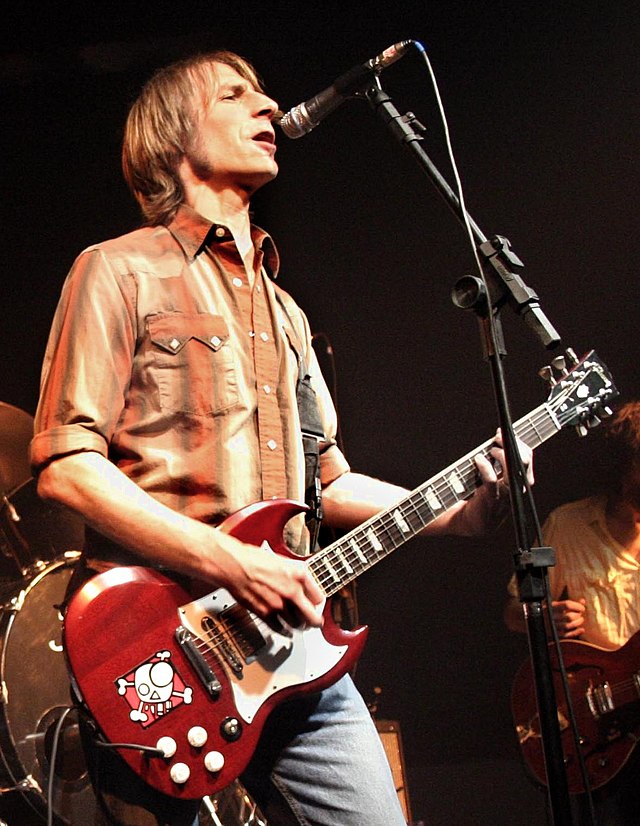
Mark Arm
American singer and songwriter
14
APPEARANCES
13
PODCASTS
Aug 26, 2026


Josh JonesHOST
Do you think further funding could be or, or should be forthcoming? And if it was on a national level from government, would that be transformative for the outlook of the species?
Mark ThomasGUEST
It's not if we had extra money, we could do this or we could do that, because we don't have the birds.
Mark ThomasGUEST
If we got to a stage like in Holland where we had 50 breeding pairs or 70 breeding pairs, we would need a small army of volunteers then, and those army of volunteers would be replicating what we've been doing on this small scale across the whole of the UK.
8 MINS LATER
Josh JonesHOST
Gi- given the events of this summer, what are your overall thoughts now on the plight of Montagu's harrier in the UK a- as we go forward? I suspect your outlook has changed considerably in the space of a couple of years.


Mark ArmGUEST
I mean, I can remember like kind of major and minor chords and stuff like that, but I don't really keep it up.
Mark ArmGUEST
And I had such an aversion to it because it was like classical music was just being hammered down my throat and I was...
Mark ArmGUEST
Like my mother was, she'd wanted to be an opera singer, but that trajectory got interrupted by World War II.
6 MINS LATER
Nathan JollyHOST
What about elsewhere in America? Were there other scenes that were kind of adjacent and that you could tour because they had a similar kind of fan base?

Mark ThomasGUEST
So it's a basic concept that no offender will serve the full length of their sentence.
Mark ThomasGUEST
They're either released at the 40% mark, so having served 40% of their sentence, at the 50% mark, having served half of their sentence, or for the most serious offenders, they're released having served two-thirds of their sentence.
Mark ThomasGUEST
When someone is released, they are released on license, meaning that they're subject to conditions that are set by the probation service.
Mark ThomasGUEST
If they comply with those conditions, then they will remain out of prison for the remainder of their sentence, so they're essentially serving their sentence in the community.

LozHOST
Can you tell us the story behind this?
Mark ThomasGUEST
And I just got this confirmed last night because some of these tails can grow legs up here in the Adelaide Hills.


Mark ThomasGUEST
In 18 months' time, there's going to be a report that comes out that's gonna make certain findings.
Mark ThomasGUEST
Those are just indicators of what the commission believes the state of play to be.


Jonathan EvisonHOST
So take me back to the very beginning of your musical curiosity, like pre-punk rock.
19 MINS LATER


Mark ThomasGUEST
So what the commission is doing is they're looking into the sector, they're looking into these business models, and they're trying to see how the entire sector is structured, how the financing is structured, who's participating, who's not participating, how can you get more historically disadvantaged persons to participate in this sector.
Mark ThomasGUEST
So what'll happen over the next 18 months is gonna be a set of public inquiries, questions from the commission, whole bunch of interactions, and at the end, only at the end, after 18 months, do they generate a report.
Mark ThomasGUEST
And in that report, and as we've seen from the past, there's a lot of legal debate about what comes out.
Mark ThomasGUEST
And I think one of the first points I wanna make is that this doesn't necessarily mean it's just a South African issue and a South African public participation process.
Mark ThomasGUEST
So what the commission is doing is they're looking into the sector, they're looking into these business models, and they're trying to see how the entire sector is structured, how the financing is structured, who's participating, who's not participating, how can you get more historically disadvantaged persons to participate in this sector.
Mark ThomasGUEST
So what'll happen over the next 18 months is gonna be a set of public inquiries, questions from the commission, whole bunch of interactions.
Mark ThomasGUEST
And in that report, and as we've seen from the past, there's a lot of legal debate about what comes out.

18 MINS LATER

Rick PlunkettHOST
Would you lead us in the prayer of bringing someone who could be seeking Jesus, doesn't know Jesus, into salvation?


Marc McLaughlinGUEST
So, I mean, that also just, it steps it up, you know, working with, yeah, Thomas was an engineer in there, but even just funding to do, like pay someone to make artwork and make music videos.
Marc McLaughlinGUEST
And I think that is a pretty, It separates the previous project where even the artwork, I dabble in.
14 MINS LATER


Mark ThomasGUEST
And then they had, you know, a mixture where they had Perennial ryegrass, they had white clover, red clover, alfalfa, plantain, chicory, and the difference in animal performance was almost, I mean their gains were almost 2x what they were on monocultural perennial ryegrass.
Mark ThomasGUEST
And so that's one of the things I've noticed, you know, out here where we run a lot of cattle on, you know, stockers on wheat.
Mark ThomasGUEST
And so they'll gain on wheat, but it takes them a while to adjust to that kind of diet.
15 MINS LATER

NathanHOST
Walk me through, how did that start? Did you initially form the business together or did you know each other beforehand?
Mark ThomasGUEST
I joined the business, it had a different name then in 2009, and I'd previously worked in a business selling websites to corporate, had a back injury.
Mark ThomasGUEST
lost that job and then went and found this job and i was able to approach it because while i was while i was getting better and recovering i just learned how to do google ads and ran a few ads and my first dollar ever nathan was on a finance company adwords campaign that i was just running in america randomly so i'm just thinking of you um so i got the job and and dylan was an employee there this business at the time was it had um maybe ten staff that had won a Telstra Business Award and I was able to invest a little bit of money into the company and support some of its growth and I got to know Dylan.
Mark ThomasGUEST
So over the first four or five years Dylan and I worked next to each other and I got to know each other, what our what our style is, what our ethics are, how we operate.
NathanHOST
how you're able to integrate that?

Scott GoldfineHOST
You know, what was it like in the, in the household in terms of music and how you guys gravitated toward it?
Mark ThomasGUEST
You familiar with the group called The London Folk, Continentals and The London Folk? I think you might remember them if, uh, we were r- real young dudes and, uh, our uncle passed away at 17.
33 MINS LATER

Mark McLaughlinGUEST
So the crux of the assignment was that, um, I was given an assignment and you had to compare and contrast two, um, types of interventions for a particular scenario.
Mark McLaughlinGUEST
So how do we used to do things, and how do we do things now? That was the assignment.
Mark McLaughlinGUEST
Um, the assignment was, for me, compiled, um, and researched in the same way that I had researched every other assignment for the last three years, and that is with the tools given to us by Murdoch University, um, a set of guidelines on how to use those tools by Murdoch University.
Mark McLaughlinGUEST
And then once I had done that and submitted it, that was then a few days later that I received an email from, um, the unit coordinator saying, "Look, you've been flagged for AI.
7 MINS LATER

Tegan TaylorHOST
What are the kind of, uh, attitudes a- with-- among your fello- fellow students about AI?