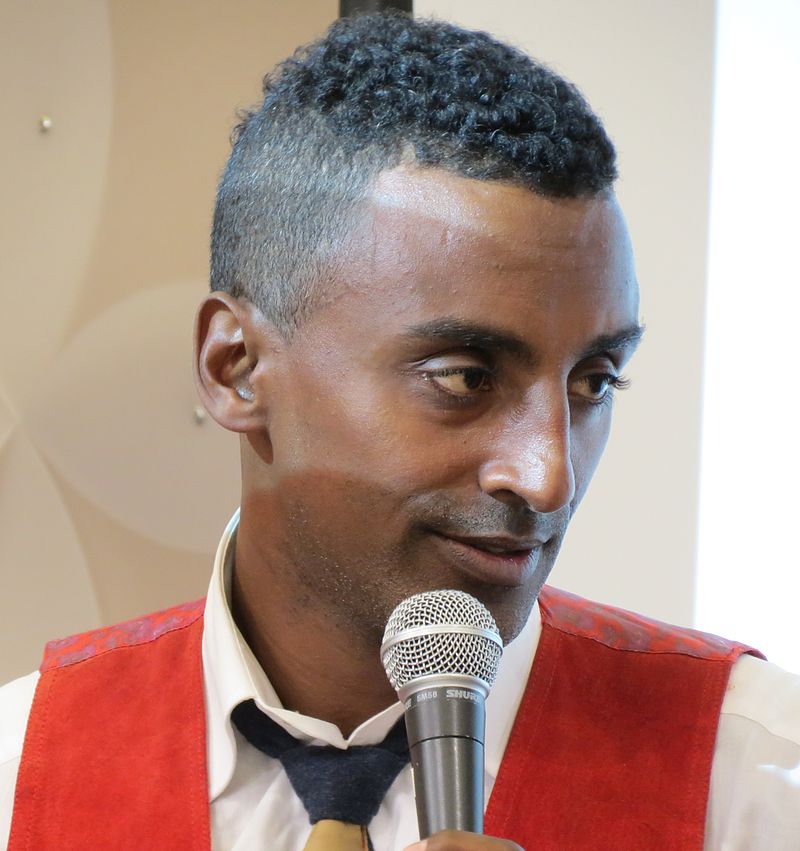
Marcus Samuelsson
Ethiopian-Swedish chef
30
APPEARANCES
22
PODCASTS
Nov 4, 2026

Marcus SamuelssonGUEST
She's like, we need to move to America, right? But there's so many things that enters to, you know, we see it on a blog or we see it on Whole Foods or whatever, and now it becomes accepted.
Elizabeth MooreHOST
How did you learn? Did you learn just through coming up as a chef? Did you work with a nutritional consultant?


Marcus SamuelssonGUEST
would say, Jason, you know, I think I've gone through Almost like post-traumatic growth twice in my life, right? Right post 9-11, the shock, and then I just started to think and grow a lot.
Marcus SamuelssonGUEST
But I had time to think about what I've added to the food industry or what can I do more of and can I be better, even more supportive of women in the workspace and set them up for leadership.
10 MINS LATER

Jason LeeHOST
Did you feel the weight of that history of Harlem and New York City and all of that when you were opening it, or what was your thought process?

Marcus SamuelssonGUEST
And chef is, you know, like just going through it like, OK, Marcus, go home, go home to your parents, come back in three months.
Marcus SamuelssonGUEST
We got a job for you at the three star in the southern part of France, which for me was an incredible offer.
Dan SouzaHOST
For someone who hasn't heard it, can you sort of outline for me how you were a child in Sweden and some of that? Because it's really remarkable.


Michael StrahanHOST
But how do you, now what's the trick to making sure that the chicken's well coated?


Michele NorrisHOST
How did your family navigate that to make sure that you could fit in, that you did feel comfortable, that you in some way were able to hold on to some tendrils of your culture?
Marcus SamuelssonGUEST
So, like, we were raised with black music, African music, and African-American music.
Marcus SamuelssonGUEST
It was also English class, you know what I mean? And it was also image class, style class, because when you open an LP and you look at a Prince or a Stevie and a Bob Marley, there's aesthetic.
Marcus SamuelssonGUEST
Blackness is not monolithic, right? You know, looking at your dad's Miles Davies records are very different.
13 MINS LATER


Marcus SamuelssonGUEST
"Come and check the note." But, you know, I also feel like the days when I'm not doing that, like, this is why I got into food.
Marcus SamuelssonGUEST
I love cooking, and I love thinking about this in different ways, right? And I always said that to myself, "The day I don't f- like, get excited about getting up and cooking, I should do something else." I've been very fortunate in my life.
Marcus SamuelssonGUEST
I think a lot about food tech, like where do we, in this fast-moving space, how can we use tech to really improve and get more people have access to better food and better choices.
Marcus SamuelssonGUEST
So I think about that a lot, and like, where do we fit in as chefs for that, not just on the high-end level, but actually on an everyday level, too.
Marcus SamuelssonGUEST
... it's not something that you-- it's not like 100-meter dash that you win and then it's taken away.
Marcus SamuelssonGUEST
I always put up goals, and once we got the second three-star review from New York Times, I felt like, okay, this is a different journey.


Dani NierenbergHOST
Can you talk about why food education is so important to your work right now?
Marcus SamuelssonGUEST
Well, I mean, CCAP is an incredible program founded by Richard Kraussman, today led by Chris Gurdjieff, who's sitting right here.
Marcus SamuelssonGUEST
We're in, you know, where we are teaching life skills through culinary in public schools, high schools, and started as an idea 35 years ago, and today it's in 11 states? Eight states.
Marcus SamuelssonGUEST
And Richard has been part and CCAP, the family of CCAP has really been part of transforming so many young people into the culinary space, then, you know, we have great examples of professionals that are still in the industry or own their own businesses or are just contributing and then maybe not in culinary anymore, but that like really got the foundation from CCAP.
Marcus SamuelssonGUEST
And I would say, you know, we were talking about in the back with Karen as well, it's like, you know, my foundation for me growing up in public school in Sweden, we take for granted and still, that you get a hot meal every day.
12 MINS LATER
Dani NierenbergHOST
What would it take for every young person, not just the lucky ones, to be part of something like CCAP?

Marcus SamuelssonGUEST
Like you can now, you know, a lot of my chef friends, they're going to Lagos to learn about food now, the way they used to go to France or Italy, right? That wasn't possible 15, 20 years ago.
Marcus SamuelssonGUEST
there's always been a back and forth between the continent of Africa and black excellence.
Marcus SamuelssonGUEST
You think about music, right? Think about how Fela and all the African-American musicians used to go to Africa, Stevie, everybody went to Africa to learn.

Marcus SamuelssonGUEST
Well, I think because, I think a couple of things, internet and opportunity to link and bridge.
Marcus SamuelssonGUEST
Like you can now, you know, a lot of my chef friends, they're going to Lagos to learn about food now, the way they used to go to France or Italy, right? Right.
Marcus SamuelssonGUEST
And I think about, there's always been a back and forth between the continent of Africa and black excellence.
Marcus SamuelssonGUEST
You think about music, right? Think about how Fela and all the African-American musicians used to go to Africa, Stevie, everybody went to Africa to learn.
Marcus SamuelssonGUEST
And now you have, you know, Afrobeats, and you have hip-hop that takes influence from that.

Marcus SamuelssonGUEST
Like you can now, you know, a lot of my chef friends, they're going to Lagos to learn about food now, the way they used to go to France or Italy, right? That wasn't possible 15, 20 years ago.
Marcus SamuelssonGUEST
there's always been a back and forth between the continent and Africa and black excellence.
Marcus SamuelssonGUEST
You think about music, right? Think about how Fela and all the African-American musicians used to go to Africa, Stevie, everybody went to Africa to learn.


Marcus SamuelssonGUEST
And when people see me, they need to receive that joy, and I can see it in the eyes, right? If s- there's joy is gone, we shouldn't be doing this anymore.
Marcus SamuelssonGUEST
[laughs] There's other people I can im- I can have impact in other different ways.
Marcus SamuelssonGUEST
Uh, so for me, understanding more the intersection between technology and hospitality, learning how that can empower small business owners and have them reach more customers, looking even more locally to see how we can discover more islands here, for example.
5 MINS LATER
34:06
As we celebrate this incredible five-year milestone of the Marcus brand here at Baha Mar, as we look forward to year five of our Bahamas Culinary and Arts Festival, is there any words that you wanna leave with guests who've supported you here at Baha Mar over the years, and the team, um, that has helped them to dine with you over these years?


Marcus SamuelssonGUEST
Well, I can tell you that I've been an immigrant six times, so I'm comfortable of not being comfortable, right? And so the place I go to when I have that emotion is through food.
Marcus SamuelssonGUEST
Um, I look at the fact that I've traveled and experienced and seen rituals and tasted food from all over the world.
Marcus SamuelssonGUEST
Like from last night, I've been thinking about this roasted carrot dish that I wanna smoke the carrot and rub them in fermented, uh, butter with berbere and roast them, and then shave them, and then maybe put some cucumber right next to it and serve it with this cured hamachi or really nice fatty, um, chutoro or toro.
Marcus SamuelssonGUEST
And then I know how to build this mustard vinaigrette that I wanna build through simmer the mustard seeds, and then you add in pickled lemons and olive oil and a little bit of soy.
Marcus SamuelssonGUEST
And then you just do your chicharrones through fried chicken skin, and you scrumble, you crumble that on top, and then you do fresh...
10 MINS LATER
Marcus SamuelssonGUEST
Well, I think because, I think a couple of things, internet and opportunity to link and bridge.
Marcus SamuelssonGUEST
You know, a lot of my chef friends, they're going to Lagos to learn about food now the way they used to go to France or, or, or, or Italy, right? That wasn't possible 15, 20 years ago.
Marcus SamuelssonGUEST
And I think about there's always been a back and forth between the continent of Africa and Black excellence.
Marcus SamuelssonGUEST
You think about music, right? Think about how Fela and all the African-American musicians used to go to Africa.
Marcus SamuelssonGUEST
Stevie, everybody went to Africa to learn, and now you have, you know, Afrobeats and you have hip-hop that take influences from that.
17 MINS LATER
Marcus SamuelssonGUEST
You know, a lot of my chef friends, they're going to Lagos to learn about food now, the way they used to go to France or, or, or, or Italy, right? That wasn't possible 15, 20 years ago.
Marcus SamuelssonGUEST
And I think about, there's always been a back and forth between the continent of Africa and Black excellence.
Marcus SamuelssonGUEST
You think about music, right? Think about how Fela and all the African-American musicians used to go to Africa.
17 MINS LATER
Marcus SamuelssonGUEST
Well, I think because, I think a couple of things, internet and opportunity to link and bridge.
Marcus SamuelssonGUEST
You know, a lot of my chef friends, they're going to Lagos to learn about food now the way they used to go to France or, or, or, or Italy, right? That wasn't possible 15, 20 years ago.
Marcus SamuelssonGUEST
And I think about there's always been a back and forth between the continent of Africa and Black excellence.
Marcus SamuelssonGUEST
You think about music, right? Think about how Fela and all the African-American musicians used to go to Africa.
Marcus SamuelssonGUEST
Stevie, everybody went to Africa to learn, and now you have- You know, Afro beats and you have hip hop that takes influences from that.
17 MINS LATER


Marcus SamuelssonGUEST
I got a peach marmalade here, a little bit of, think about a little bit of hot sauce we're gonna add in here.

Alice ChengHOST
So after you spent your time in France, did you come immediately over to, uh, Aquavit as the executive chef?
Marcus SamuelssonGUEST
I came as a sous chef, and, uh, I think as, uh, all the people that are gritty and work hard, and you get ready for something, if you stay ready, you never know when that opportunity's gonna come calling, and to me, it came very early.
Marcus SamuelssonGUEST
I was asked just to take over before they found a chef, and eventually, um, they, they picked me.


Marcus SamuelssonGUEST
I started to understand the essence of taste just through my grandmother's meatballs.
Marcus SamuelssonGUEST
We have school lunches, and then we had the lunch or dinner I got at home by my parents, and then I got the lunch or dinner I got by my grandparents.
Marcus SamuelssonGUEST
The school lunch, you were lucky to find meat in the meatballs, but they were perfectly round, not that tasty.
Marcus SamuelssonGUEST
My mom, that was super busy, her meatballs could be one giant patty that we had to cut up ourselves as kids.
9 MINS LATER
speaker_3NARRATOR
[percussive music] The move opened Marcus up to thousands of new stories.

speaker_4UNKNOWN
[laughs]
Marcus SamuelssonGUEST
So once I got to Aquavit, the, the, the guy in charge, after a couple of months, passed away, and then I became, like, the junior guy that kind of was running the place.
Marcus SamuelssonGUEST
I gotta go and get a chef." I was like, "Yes, I'm 23 years old, do not, I don't wanna close this place, I don't want, I don't want anything bad to happen." It's like four months later he came back and said, "Hey, I found a chef." I was like, "Yes." Little bit less responsibility.
speaker_4UNKNOWN
That's insane.

speaker_10UNKNOWN
Why you put orange juice in, Zion? He's like, "I don't know."
speaker_10UNKNOWN
It's amazing.

Rushion McDonaldHOST
Why has there been such an explosion of, uh, of the, um, African menu in America?
Marcus SamuelssonGUEST
Like you can now, you know, a lot of my chef friends, they're going to Lagos to learn about food now the way they used to go to France or, or, or, or Italy, right? That wasn't possible 15, 20 years ago.
Marcus SamuelssonGUEST
And I think about, there's always been a back and forth between the continent of Africa and Black excellence.
Marcus SamuelssonGUEST
You think about music, right? Think about how Fela and all the African-American musicians used to go to Africa.
Marcus SamuelssonGUEST
Stevie, everybody went to Africa to learn, and now you have-You know, Afrobeats and you have hip hop that take influences from that.
17 MINS LATER


Marcus SamuelssonGUEST
the good and the bad and the ugly in that story, all of it, it speaks to New York City's hospitality in the 90s, right? Because it talks about mentorship.
Marcus SamuelssonGUEST
Jan was all of those things, right? And I remember one thing, and I've never out of respect for him done this dish, but he showed me a dish, very simple.
6 MINS LATER


Marcus SamuelssonGUEST
I mean, I was only 23 years old when I came, but I, I, um, felt that I knew my food 'cause I was always writing.
Marcus SamuelssonGUEST
And at that point, you know, I'd been doing stages and worked for six, seven years at that point, you know, I started 17, 18, and I travel a lot.
Marcus SamuelssonGUEST
I'd been to Singapore, which was, like, profoundly sort of, um, important places for me in terms of food because, you know, of course, working in three-star Michelin in France was important, working in Switzerland, but the food I fell in love with was in Asia.
13 MINS LATER
Marcus SamuelssonGUEST
Present, how we're doing now and where is Harlem heading? So people truly care, not just care a little bit, truly care, right? So that, you know, for me, was, okay, if you go to a church, what's the food afterwards? And, you know, what is the history about this? But actually taking notes, right? Um, I remember one pivotal moment.
Marcus SamuelssonGUEST
I was invited into this lady's, uh, brownstone and she said, "If you open a restaurant, this is the quality that I- I'm demanding from you." Um, and I was, uh, you know, she did a, a children's concert, classical music.
Scroll for more appearances