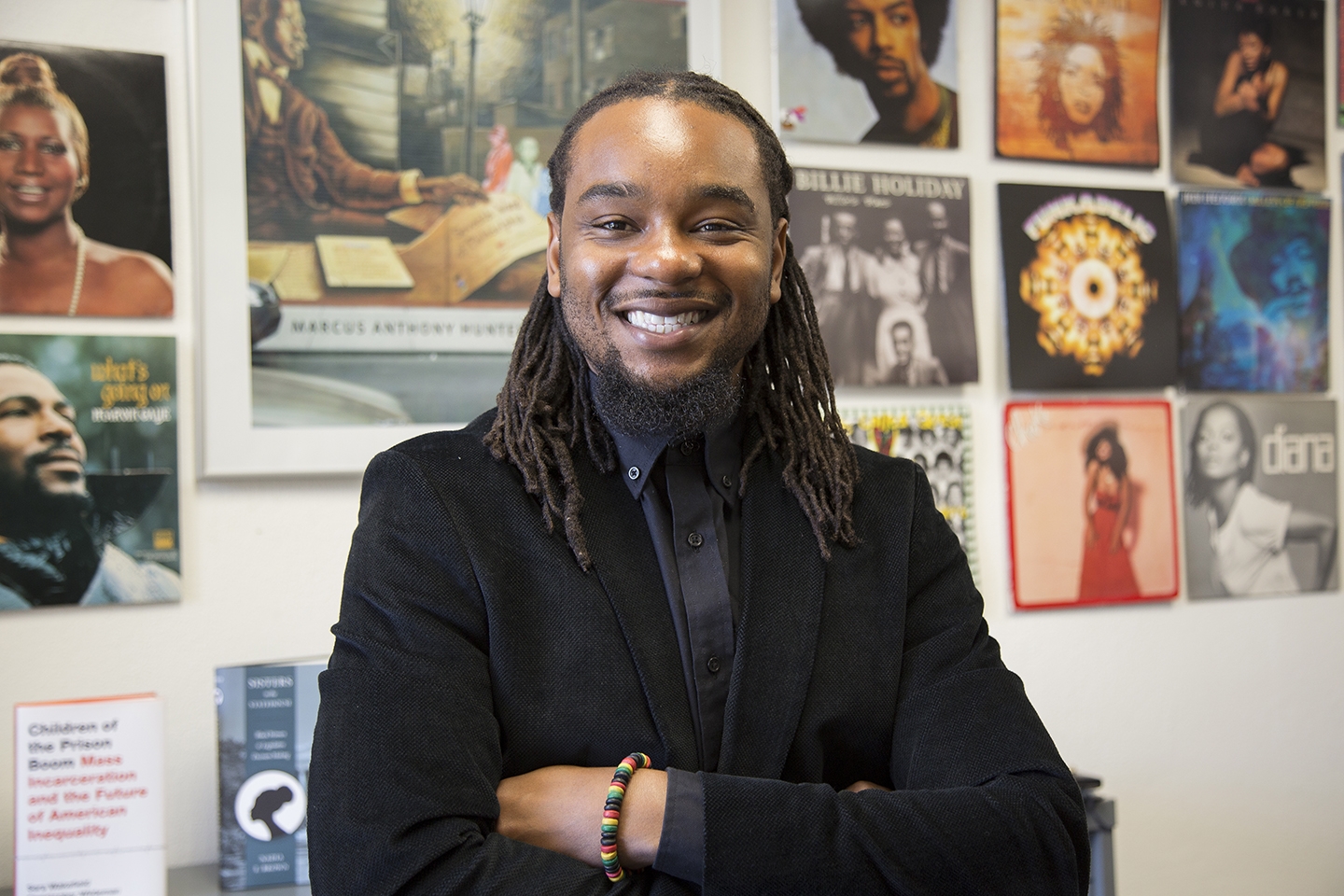
Marcus Anthony Hunter
Sociologist
12
APPEARANCES
5
PODCASTS
Sep 28, 2026

David JohnsHOST
What's the lesson? What do people do now to get over, to claw back some power, to move further in this journey of life and love.

29:54
Meaning that a lot of times when we say, you know, these are the worst times ever, we've never seen.
30:01
The other problem with that is that it distorts our ability to appreciate where true power lies, which is in now.
30:07
So if you're telling me now is the worst, then I'm more likely to not select into it as a place of power.
30:17
Meaning the problems may be there and also we are present now with an opportunity to embrace.
18 MINS LATER

9:48
Because as you know, before leaving the Smithsonian, he helped bring the National Museum of African American History and Culture into being.
14 MINS LATER

Tavis SmileyHOST
I'm not taking shots at Lonnie, but I am thinking about when Donald Trump attacks black leadership in a variety of places and spaces, if we walk away from the fight, I don't know how we protect the institutions, Marcus.

19:56

Do you find that when you're talking with an MSNBC or a CNN, a Washington Post, that your work, Radical Reparations, Healing a Nation, your book, and your scholarship in this area is approached differently than it was, say, five or even ten years ago?
20:24
I think when I experienced the different forms for this conversation, I would say just in the time since the book was first released in 2024, I've seen a shift.
20:39
I was able to participate, for example, in Black Books Matter Festival that Mahogany Books has out in the DMV area.
8 MINS LATER
8:48
Shout out to Congressman Green for exactly that point, because in preparation for today, this story and all the ones we will discuss is really about who is power serving.
8:59
So when we're talking about speaking about power, what we are also hearing first is that Secretary Hegseth is showing up somewhere where there's a request for $1.5 trillion, and he is effectively giving them his butt to kiss.
9:26
I mean, when I had to ask my grandmother as a kid for $5, I certainly did not give her my butt to kiss.
6 MINS LATER
Tavis SmileyHOST
But when you have no plan, you have no exit strategy and it goes on and on and on and congress votes the second time the house votes the second time to tell you to stop this and you keep rolling over them and your defense secretary goes up to the hill and essentially cusses out to marcus's point tells a senator to kiss his behind essentially this is what you get i'm rambling i'm gonna stop if any of that makes sense pick up and run with it marcus
16:56
... get uplifted? And what we're seeing in this is that they have creativity and, and ability to pool funds forward, taxpayer dollars in specific, and to create a fund that somewhat exists outside of congressional oversight.
17:09
And it is for people who instead cr- committed crimes against the government, rather than what it should be for, which is for people who are holding the government accountable for crimes it committed against the citizens and the population.
17:24
And I think if we fast-forward, like we do when we think about January 6th and the insurrection, one of his presidential promises is, "If you elect me, you will get pardoned," and he did that, basically on the same day as the inauguration.
17:39
He is effectively telling people, "If you vote for me or whoever I say should be in charge, you got $1.776 billion on the other side of that vote." So we should also understand it as a political tool inasmuch as it's also a moral inversion of reparations.
12 MINS LATER

speaker_0ADVERTISER
Learn more at amahealthvshype.org. That's amahealthvshype.org.
0:37
Hi, I'm Dr. Marcus Anthony Hunter, a board member of the National Black Justice Collective.
0:49
One of the things that I think is important is as the National Black Justice Collective, that we see one of our major priorities as educating the public about the presence of the community from the community's inception and also about the major contributions that the community members have made in the cooperation and struggle for overall liberation and equality for all people.
1:12
About two years ago, MBJC, along with a number of other organizations, joined together to unify around reparative justice and issues of equity.
1:21
And that led to the creation of National Equity Week, which happens for a whole week in June in Washington, D.C., the nation's capital.
1:30
in my part as a professor, I've brought now upwards of a hundred students from UCLA to DC to advocate for a lot of the public policies and legislation that we know is circulating, but doesn't always have a voice.


18:16
It got so popular, though, that, you know, six years later, that bank was doing better than many other actual banks.
18:23
And so the Congress becomes relaxed and amends the charter, which allows it to give credits and loans.
18:31
White managers then basically leveraged Black money on white dreams and possibilities.
5 MINS LATER
speaker_1ADVERTISER
And
31:09
Prince spent his life fighting for control over his music, his masters, his names.
31:13
And in many ways, that is a reparation story, and it's about reclaiming what was always yours.
31:18
And so in the case of Washington, it is a move forward with legislation and a call to do a reparation study, making it the third state in the nation to enter into this work.
31:31
And one of the challenges that's happened has been that the process that was adjudicated by the Department of Commerce in procuring a bidder who would do this research has a number of procedural issues, many of which I applied as a bidder.
31:53
And through that process, not only did I discover a series of procedural irregularities, but also any attempt to try to get any sort of correction was met with no, even all the way up to the former director of the Department of Commerce, a man named Joe Winn.
6 MINS LATER
22:26
It is very much giving MAGA is matter, making America delusional again.
22:31
So even as he's saying it, some of what people are reporting are actually people with inside the MAGA movement saying that they don't like this, that they are actually anti-war and have a certain level of xenophobia and They are very anti-international in terms of how they want their government working.
22:49
And he's like, where are you hearing that? We definitely want to support certain allies.
Tavis SmileyHOST
If the American people in every poll, survey and study overwhelmingly oppose what Donald Trump is doing in Iran, how and why does he think he can put boots on the ground and see American soldiers come back home in body bags for a war we don't support?
7:34
so the policy still pervades, even if the tactic, as it took to Minnesota and Minneapolis, is now shifting.
7:41
The other part is that the political activity created a political headache.
7:47
And so what we see in some ways, the ending of the surge is managing public activity.
7:58
I think one of the things that will come up later, and this is for our constitutional lawyers, is around the 10th Amendment and whether the federal government can force its enforcement priorities onto states and sanctuary policies.
8:10
And so we've seen, for example, in Los Angeles, Mayor Bass signing an executive order around trying to protect sanctuary for folks and also disallow federal entities to disrupt whatever the local policy is.
17 MINS LATER
38:43
One of the big things that was important to me to try to bring together in the article, which is in CalMatters, is to say that there are two things that happened in California that were remarkable, but not for ways that I think are the best.
38:59
And one is that a scholarship program at UC San Diego that was around people who have been impacted by racial terror and receive scholarships as a part of that for college.
39:11
Now, that program was reconfigured so that any student can receive that scholarship.
39:17
alongside then the veto that Governor Gavin Newsom did against AB7, which Assemblymember Isaac Bryan had been putting forward, which effectively would have given language for institutions of higher education to make special considerations for folks who are descendants of enslaved Africans in America.
Tavis SmileyHOST
for that ceremony people are clapping and applauding as he's talking about this 250 million dollar spend on remodeling the east room again while we are in the midst of a government shutdown and people ain't getting their checks speaking of running me my money people ain't getting their checks but he's talking about this and people are just giggling and laughing so so talk to me about how anybody in this moment could be tickled could be humored by donald trump
9:28
Yeah, I think part of it is, you know, he was and is a brand that proceeds and now overlaps with the president.
9:35
And so, for example, I often and you've heard me say this here before is, you know, I used to watch The Apprentice and a lot of what he does and says, if you go back through those seasons, he's really doing it again.
9:49
And it was entertaining in the context of an NBC show that is staged and all these other things.
9:55
It's a whole other story when you're actually the president of the United States, often called the leader of the free world.
19 MINS LATER