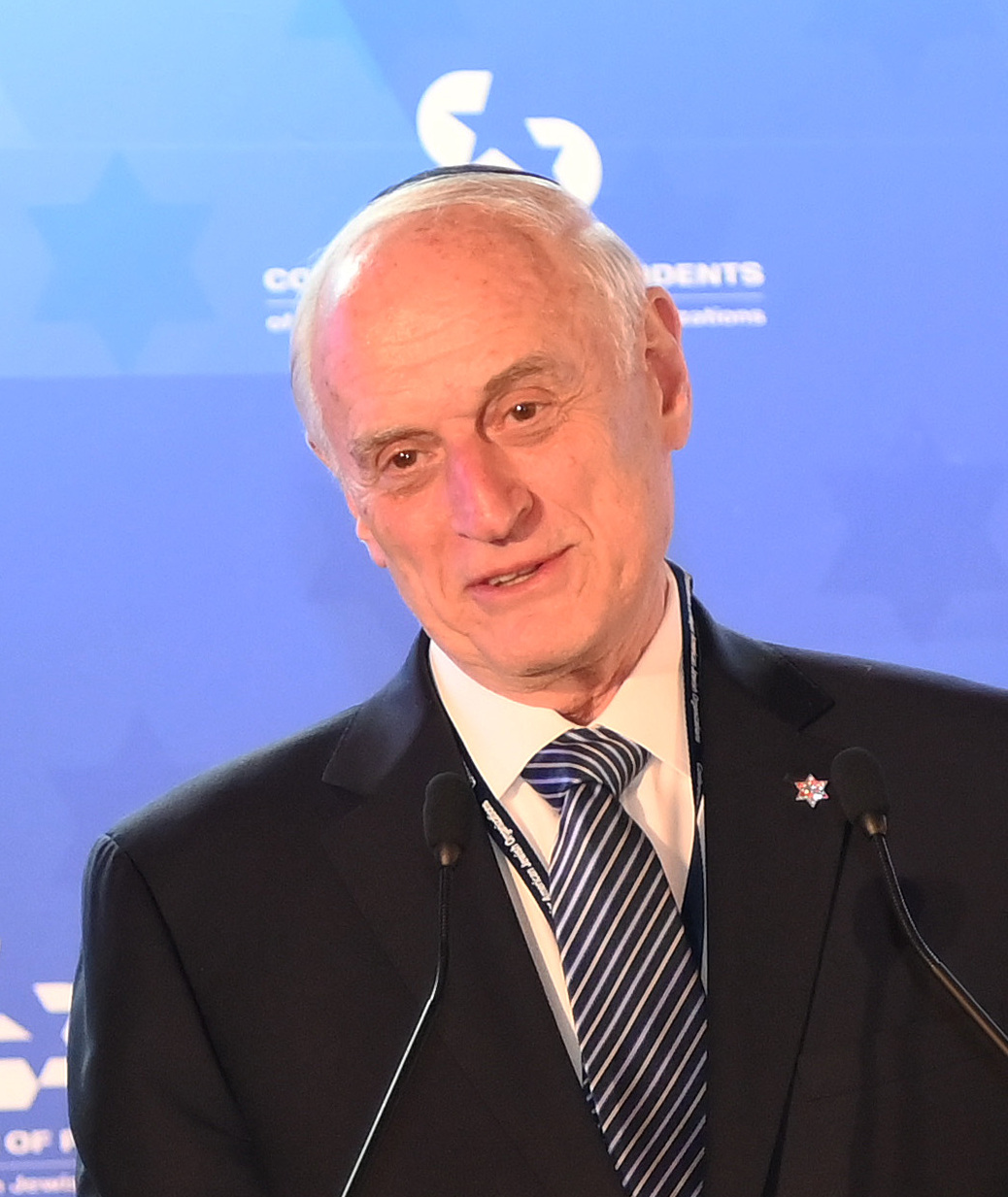
Malcolm Hoenlein
American activist
93
APPEARANCES
1
PODCASTS
Aug 31, 2026


Malcolm HoenleinGUEST
Despite the events of the world and the virus situations you described, I'll try to run through it quickly, though it's...
Malcolm HoenleinGUEST
Obviously, very complex, being as Iran is a large country, very important one and facing real challenges.
Malcolm HoenleinGUEST
Iran is, in fact, negotiating now to join the BRICS Bank, which could make a difference.
Malcolm HoenleinGUEST
There are 11 countries in there, including Brazil, China, Egypt, etc., Saudi Arabia and Russia.
Malcolm HoenleinGUEST
But their new development bank, known as the BRICS Bank, is created to fund infrastructure, and they want to get into it.
5 MINS LATER
Aug 25 · 20m
Malcolm HoenleinGUEST
Despite the times we're living in, and this is one of the breaking stories of the last few days, is this weekend for Israel.
Malcolm HoenleinGUEST
And we remember that before October 7th, there was a series of balloons that were fired, often carrying incendiary devices that set forest fires and the fields on fire in big numbers, as well as the kites.
Malcolm HoenleinGUEST
Kites that were sometimes used to transport people, some of the attackers of October 7th.
Aug 18 · 17m
Malcolm HoenleinGUEST
As you know, we have a ceasefire agreement between Iran and the United States, which ends actually today, I think.
Malcolm HoenleinGUEST
And the president has put additional pressure on that, There's a separate agreement that was reached with the creation of the Board of Peace, which is chaired by Nikolai Mladenov, a former official from, I think, Romania or Bulgaria.
Aug 11 · 17m
Malcolm HoenleinGUEST
the Prime Minister, uh, Prime Minister Netanyahu, uh, and it's sort of a distorted representation of the position that he took.
Malcolm HoenleinGUEST
At the cabinet, he said that they will not withdraw first, but that's not what, what the agreement required.
Malcolm HoenleinGUEST
Hamas has insisted and said, "We will live up to the 15 points," but Israel has to withdraw first.
Malcolm HoenleinGUEST
That is not what the Board of Peace agreement was, and the head of the Board of Peace, Mladenov, former ambassador of, um, uh, Romania, uh, uh, I think Foreign Minister of Romania too, uh, he said I- I- Israel should not be concerned because it'll take ten years to clear out the tunnels and, you know, clean up the act.

John BatchelorHOST
What are the-- What is it that they want when they gi- give out non-negotiable demands that are impossible?
Aug 4 · 16m
Malcolm HoenleinGUEST
And one of the things that they have done is to move the executions into public places, obviously to dissuade the public.
Malcolm HoenleinGUEST
And it was passed by Parliament in last year after the nationwide protests.
Malcolm HoenleinGUEST
So to raise these charges... and expanding the scope of charges of espionage in cooperation with hostile states and mandating the death penalty for such offenses.
John BatchelorHOST
Tell me, Malcolm, what is their mission? To assassinate or to undermine or to threaten? What is it they're hoping to achieve?
Jul 28 · 7m

Thaddeus McCotterGUEST
Moving around the region, what can you tell us? Can you give us an update on Lebanon?
Malcolm HoenleinGUEST
We had the first deployment of the Lebanese army coming into these humanitarian zones where Israel withdraws after trying to clean up the Hezbollah operations, which, frankly, again, I know I've talked about it before, it's just astounding to see the infrastructure that they built, tunnels that run hundreds of kilometers, like in Gaza, with tremendous infrastructure.
Jul 28 · 10m
Jul 21 · 6m
Malcolm HoenleinGUEST
As part of the initial phase, the Lebanese armed forces are supposed to enter the southern Lebanese villages of Firoun and Kvairdounin, and they have done so.
Malcolm HoenleinGUEST
Both villages are located outside the yellow zone, the area that Israel declared for its own protection for the border, along the border, the deployment zone.
Malcolm HoenleinGUEST
follows the talks in Rome between Israel and Lebanon and talks in Washington between them.
ThaddeusHOST
What was it about?
Jul 21 · 11m
Malcolm HoenleinGUEST
So democracy reigns supreme, although one can certainly raise that doubts about that in the case of the P.A., where Abbas, at age 91, is in the 21st year of his four year term and goes through the mockery of calling elections periodically, in this case, parliamentary elections for November 21st.
Jul 14 · 6m
0:56
Yes, Malcolm, we are seeing mixed results regarding anti-Semitism in the United Kingdom, aren't we?
Malcolm HoenleinGUEST
We've seen how the PEN organization has discussed and is exposing the not just in Britain, but in general, in the literary world, the amount of anti-Semitism, people boycotting Israeli authors, Jewish authors demanding that they include genocide in the language of the books or not publishing them.
Malcolm HoenleinGUEST
But we're also seeing the rise in anti-Semitism, so much so that the government this week allocated 250 million pounds, which I think is $330 million, if I'm not mistaken, to fight and to protect the communities better.
Malcolm HoenleinGUEST
But they also designated the IRGC as a terrorist organization, which is important because they have been active in London as they have been in Europe.
Jul 14 · 11m
6:39
Yes, Malcolm, can you tell us about Saudi Arabia's recent attacks on the Houthis?
Malcolm HoenleinGUEST
Unfortunately, we've seen a distancing of Saudi Arabia from Israel from the work that Senator Graham had done to try to bring them together and to expand the Abraham Accords.
Malcolm HoenleinGUEST
Now, we see that one of the goals of October 7th was to drive a wedge between Saudi Arabia and Israel, and that has happened.
Malcolm HoenleinGUEST
We've seen Saudi Arabia now talking about a new rail link to Turkey going through Israel.
Malcolm HoenleinGUEST
Originally, they had supported the IMEC train, which India and others had backed, including Saudi Arabia.
John BatchelorHOST
Are the Houthis stepping aside? Do they have a new explanation for their violence?
Malcolm HoenleinGUEST
This is really subject of a whole another show on a book and a lot of reports are coming out that I've seen FDD, others who have been really mapping Qatar's hundreds of billions of dollars being poured into the United States.
Malcolm HoenleinGUEST
Some say it could be a trillion and a half or a trillion and a quarter dollars that were invested here.
Malcolm HoenleinGUEST
And even the White House has made estimates about the amount of money and are beginning to monitor.
Malcolm HoenleinGUEST
It could take a long time to answer, but I'll try to give just some of the highlights.
Malcolm HoenleinGUEST
I hope people are following it, if they can make any heads or tails out of it, because it's very hard.
6 MINS LATER
Malcolm HoenleinGUEST
What we learned just recently is that another billion dollars was transferred to Hezbollah by Iran in 2025.
Malcolm HoenleinGUEST
We think that they're still trying to transfer money and resources to to them.
Malcolm HoenleinGUEST
When a new government was formed in Lebanon last year, Hezbollah was enabled by its top political allies, Nabil Berry and the Speaker of the Parliament and others, to take control of key elements.
Malcolm HoenleinGUEST
Now, though there's a lot of resentment amongst the people, the fact is that the situation in Lebanon continues to deteriorate.
Malcolm HoenleinGUEST
The people will pay the price for it, and there's a lot of anti-Hezbollah feeling amongst the people, but the government still with limited ability to exercise control in its army to counter the continued attacks by Hezbollah.
John BatchelorHOST
Your measure of Iran and the Islamic Republic of Iran's IRGC, are they at this point dangerous in what direction? Are they at risk of firing another barrage of ballistic missiles at Israel? Are they at risk of closing down the state of Hormuz individually and collectively? What is your measure right now, Malcolm, at this point of the war? Good evening.
Malcolm HoenleinGUEST
It's a very good question because nobody really knows the answer to that because nobody knows who's really in charge.
Malcolm HoenleinGUEST
Is Mushtaba, the son of the Supreme Leader and supposedly new Supreme Leader, really alive and well and functioning and giving orders? Things come from him, signed allegedly by him, but there's no proof.
Malcolm HoenleinGUEST
But i- inasmuch as nobody has seen him, nobody knows if he's, in fact, signing orders, capable of signing orders, even still the rumors that he was killed.
Malcolm HoenleinGUEST
Uh, that is absolutely right, and Iran has introduced Hormuz Safe, which is a digital maritime insurance platform for ves- vessels, uh, transiting the Straits of Hormuz.
Malcolm HoenleinGUEST
This platform, which their Ministry of Economy did, um, uh, and i- issues marine insurance policies and financial liability certificates for cargo moving in and out.
Malcolm HoenleinGUEST
And there are designated routes and fees for specialized services, and this is a, a formal mechanism for them to generate revenue, um, and, uh, faster, uh, bypassing sanctions resistance transactions, uh, exactly what they're planning for, for afterwards.
Malcolm HoenleinGUEST
As you said, they, they have been getting, uh, more equipment and trying to, to import.
Malcolm HoenleinGUEST
Their exports for, for 28 days has been zero, um, of oil, and this is beginning to, you know, to really hit because of the economic implications, um, uh, they, uh, that are, um, evident.
Malcolm HoenleinGUEST
But also we see that the Saudis, um, have introduced this, uh, a, a land route to get fertilizers and other things out.
John BatchelorHOST
Can you help me, Malcolm? And in this significance here, this has happened before, and I don't know what the remedy is, but in any event, it's good to get the information out.
Malcolm HoenleinGUEST
But this is, I think, a very important story And it is important because it's representative of what we've seen happen.
Malcolm HoenleinGUEST
As you mentioned, the New York Times reports to be the newspaper of record, and that the timing of the release, it was actually the same day that the report came out on the barbaric behavior and the attacks, the assaults, the nature of what was done to the hostages and the people that were kidnapped from from Israel along the border with Gaza on October 7th.
Malcolm HoenleinGUEST
And yet, the New York Times, using a two-time Pulitzer Prize winning author, writes a story about And there are several aspects, which I think is important, because people say, look, it wasn't at times we read it, you know, and it remains with me because now becomes a matter of record after Al Jazeera in English and then newspapers throughout the Middle East and the world then run the story as if it is a factual account.
Malcolm HoenleinGUEST
The photos that came out and that Israel built a secret base deep inside the Iraqi desert in to support the iran air campaign to be able to do rescue missions if necessary it was built before the war began in late february As a logistical hub to support the Israeli Air Force, remember, it's very long distances.
Malcolm HoenleinGUEST
There were also special forces troops that were housed there and search and rescue teams.
Malcolm HoenleinGUEST
And they launched several airstrikes against Iraqi forces who nearly discovered the place in early March.
John BatchelorHOST
And therefore, the fate of the Iranian people, is it critical to IRGC? Do they take it into consideration? Are they afraid of the people or not?
Malcolm HoenleinGUEST
There was a meeting going on with generals today where they're supposed to assess the situation.
Malcolm HoenleinGUEST
We know that we've been told Project Freedom would be reinstituted or not reinstituted.
5 MINS LATER
John BatchelorHOST
Malcolm, what can you tell us about that 30 days? Is it part of the conversation on the American and Israeli side? And is it something that we should worry about, or are they thinking ahead?
Malcolm HoenleinGUEST
And there are deadlines even shorter than that, including the that there's running out of the all the parties but especially running out of storage space for the oil that they are producing you can only you only have limited amount of storage and some of those on karg island which is inaccessible or filled and the iranians it could be a matter of two or three days when they have to start considering stopping production and once you try to stop a well you can poison it you can destroy it it's very hard to bring it back very expensive to bring them back online So that's why the deadline loops so large.
Malcolm HoenleinGUEST
And when you're talking across an area that provides 20 percent of the oil to the to the West, it becomes even it looms even larger.
Malcolm HoenleinGUEST
The OPEC plus countries agreed this week to increase by one hundred eighty eight thousand barrels per day.
Malcolm HoenleinGUEST
S- there's so many aspects to this, and things are changing by the minute, so keeping up to date and, and the confusion and the distortions because the media doesn't have ready access to a lot of the information.
Malcolm HoenleinGUEST
So what we have seen is the operation or Project Freedom or w- the name keeps seem to change, was working.
Malcolm HoenleinGUEST
The, the, uh, Iranians had already started firing on, uh, Abu Dhabi and Dubai on, on the UAE.
Malcolm HoenleinGUEST
They're setting the port on fire, which is their major, uh, also oil storage port, and that could bur- burn for quite a while.
6 MINS LATER
Malcolm HoenleinGUEST
On, on, on a, a rational level, it makes perfect sense, and it also i- is an argument that's hard to rebut in the sense that M- Mr. Trump does not want to commit political suicide.
Malcolm HoenleinGUEST
And h- h- his position, his, his, um, place in the firmament is the most important thing in, in his life and in his world, and he's not going to jeopardize that, so one might think.
Malcolm HoenleinGUEST
There's another benchmark, of course, and that's the, the hard, um, sort of schedule when it comes to energy.
John BatchelorHOST
And I would accept the argument, "Listen, I need to get this done because I won't have the power to do it after in January of '27, so therefore, here's the deal." And I think the Republican Party would go, "Sure, fine," and move on and forget and stop talking about it.
Malcolm HoenleinGUEST
They bombed the synagogues and other, um, fac-- Jewish facilities, but also government facilities in, in Azerbaijan.
Malcolm HoenleinGUEST
And, um, we had seen earlier reports of this, but now it's been confirmed this is a part of a terror cell backed by Iran, uh, which of course covets, uh, Azerbaijan and, you know, thirty million Azeris live inside of, of Iran, so it's very sensitive for them.
Malcolm HoenleinGUEST
And, uh, so the Azerbaijanis, uh, s-secret service and others working together with, uh, others because we're finding these cells now everywhere, Europe, Argentina, everywhere that the, the Iranians are w-moving, including the UAE, where that they arrested twenty-seven people in an Iranian-backed Hiz, uh, Hezbollah network, uh, working to undermine the government, uh, and to...
John BatchelorHOST
As well as, Malcolm, how does the Abraham Accords extend across the Atlantic? How do they do this?
3:07
Yes, Malcolm, can you give us any insights into what it's like to be an average Iranian inside the country right now?
Malcolm HoenleinGUEST
Uh, I am in touch with people in Iran and, uh, have had relations with them, relationships with people there for the last two decades and more.
Malcolm HoenleinGUEST
Um, so number one, there's still the water shortages, the electricity shortages, and some exacerbated by virtue of, of the conflict.
Malcolm HoenleinGUEST
But Israel, um, in its bombing raids, and the United States as well, did not-- tried to avoid hitting any infrastructure, including the electricity production, uh, so that the people wouldn't bear the brunt of it.
Malcolm HoenleinGUEST
There's always some collateral damage, but the, uh, numbers of the people that were killed, the vast majority, seventy, eighty percent, both in Lebanon and in, in, in Iran, were, were people affiliated with the terrorist, uh, operations, um, or victims who lived in the same building because they were very targeted.
Scroll for more appearances