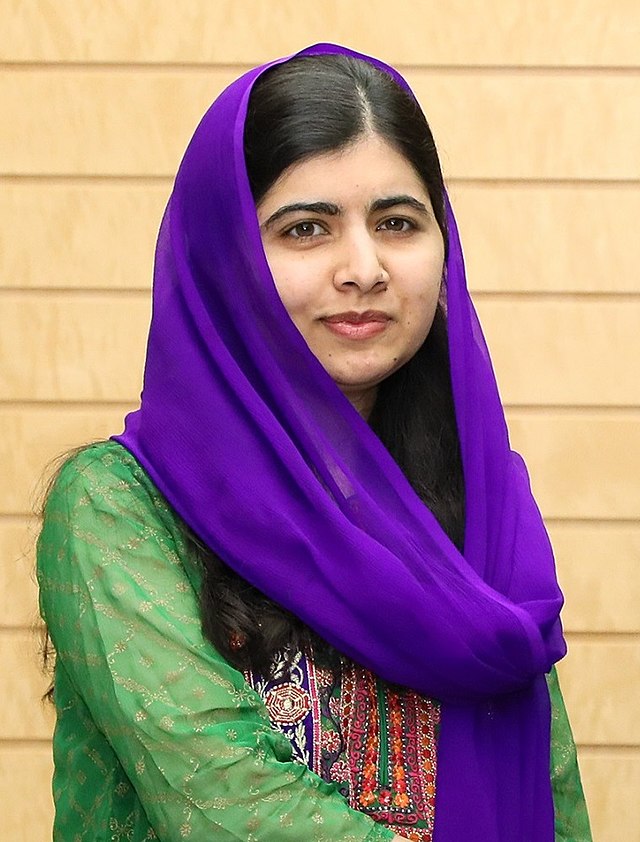
Malala Yousafzai
Pakistani education activist
39
APPEARANCES
28
PODCASTS
Aug 12, 2026


Maria SharapovaHOST
Is there a recent victory that you had, um, where you really had to keep your eyes on the prize?

Malala YousafzaiGUEST
They were evacuated when the Taliban took over, because the Taliban were, like, breaking into their houses and finding proof if these girls had played sports.
Malala YousafzaiGUEST
So the girls had actually buried their uniform and hidden their trophies so the Taliban would f- not find any proof.
Malala YousafzaiGUEST
And despite all of those challenges, uh, you know, for them, the only way to have some hope was to be able to play football, soccer.
27 MINS LATER


Yin KhvatHOST
The reason why you were closer to your father, was it something to do with the deep historical constraints actually placed on your mother in
Malala YousafzaiGUEST
society? I think it's partly true because my mother grew up in a very conservative culture.
Malala YousafzaiGUEST
She joined a local primary school, but she realized she was the only girl in that classroom.
Malala YousafzaiGUEST
So my mother now in her 50s is going into this adult learning center and she's learning again.
Malala YousafzaiGUEST
She's very committed to her education now, but this is an opportunity that she did not get as a girl growing up.
18 MINS LATER


Malala YousafzaiGUEST
And, um, yes, you know, I'm technically not on the advisory board of, uh, NWSL, but I sort of, like, joined those incredible group of people to go and show my support for the game.
Malala YousafzaiGUEST
And, uh, you know, I, I- I'm really interested in, um, supporting NWSL, but also, like, you know, we're looking at a wide range of sports, uh, in the US, in Europe, and globally because for me it is making a difference in the women's sports ecosystem.
16 MINS LATER


Malala YousafzaiGUEST
For me, it has always been about expectations, and it was not what people expect from me, but what I personally was expecting from myself.
Malala YousafzaiGUEST
And I had always felt this pressure that I am responsible for ensuring that every girl can get to go to school.
Malala YousafzaiGUEST
These things happened in my life so early that I had an idealist view of the world.
Malala YousafzaiGUEST
I thought that when people call you an activist or a change maker, it means you have power, and it means you can go and change things.
Malala YousafzaiGUEST
I was told that, you know, when you receive these titles and awards like the Nobel Peace Prize, and you get invited to meet presidents and prime ministers, you're supposed to change things.
Malala YousafzaiGUEST
So I always had felt this pressure that I am supposed to be at every place.
16 MINS LATER


Malala YousafzaiGUEST
in a profession, in a job earning for themselves, be out as active participants in the community or in public life because there were no role models.
Malala YousafzaiGUEST
So for me, like, I could finally understand that yes, like, my mom could just think like, "Okay, you know, like, maybe, you know, well, how could it be different for my daughter?" She-- They could not see that pathway.
Malala YousafzaiGUEST
Things are slowly changing, but how much could it be different? In the end, it might be just the same thing, marriage and having a, a slightly supportive husband so you don't have to face the terrible things.
10 MINS LATER


Marco WermanHOST
How did Mack's story resonate with you and your own experiences growing up in Pakistan?
Malala YousafzaiGUEST
The gunmen who shot me were told that I was not belonging to Islam or to their culture, that I was somebody alien to them, and I think that's where hatred and division begins.
Malala YousafzaiGUEST
You know, these are the things we need to address because when you connect with people from different backgrounds, from different cultures, faiths, you realize that there is shared humanity.
Malala YousafzaiGUEST
I survived that attempt, and the same thing happened in Mack's life as well, where he decided to attack hundreds of people, uh, Muslim people.
Malala YousafzaiGUEST
But, uh, it changed, and I think there is something powerful that changed that, and that is love, that is kindness, that is compassion, and I'm glad that Mack had the willingness to welcome that love.
Malala YousafzaiGUEST
And on the other hand, I'm just so happy that the people who he wanted to attack, they actually, even after knowing that Mack had planned all of this, they decided to invite him over for dinner and have a conversation with him.


Abby WambachHOST
Like you both have been such inspirations, but really what gets you out of bed in the morning today?
Malala YousafzaiGUEST
I always think about the girls who still do not have equal opportunities as us.
Malala YousafzaiGUEST
And I know we have come a long way and there's so much to celebrate, but I think about the 120 million girls who do not have access to education.
Malala YousafzaiGUEST
It makes me think about the 11-year-old girl, once I was, who simply wanted to be in school, but education was banned for her.
Malala YousafzaiGUEST
And in the past five years, it has been the stories of Afghan women and girls that keep me up at night.
Malala YousafzaiGUEST
Because what's happening in Afghanistan is also like a wake up call to all of us that if it can happen in one part of the world, it can happen anywhere.
Malala YousafzaiGUEST
An extremist group like the Taliban are punishing and they're like putting women in prison for daring to speak out.


Terry GrossHOST
And you weren't expecting that, right? You didn't think that you would be a target.
Malala YousafzaiGUEST
I, I knew that the Taliban could do anything, and I used to wonder, like, could I save myself? Like, you know, how could I make them understand that I'm actually not a threat.
10 MINS LATER
Terry GrossHOST
And you weren't expecting that, right? You didn't think that you would be a target.
Malala YousafzaiGUEST
I, I knew that the Taliban could do anything, and I used to wonder, like, could I save myself? Like, you know, how could I make them understand that I'm actually not a threat.
27 MINS LATER
Terry GrossHOST
So, um, what is the lesson for you about how difficult change really is in terms of what you can contribute to change?


Malala YousafzaiGUEST
I would tell the people in charge all of my problems, and they would fix them.
Malala YousafzaiGUEST
I know how naive this sounds now, but at nine or ten years old, it made sense to me.
Malala YousafzaiGUEST
The prime minister was more than a hundred miles away from me in the capital city.
Malala YousafzaiGUEST
He couldn't see the trash polluting our rivers or our broken school bus or hospitals with outdated equipment.
7 MINS LATER
speaker_4SOUNDBITE_SPEAKER
[audience clapping]


Malala YousafzaiGUEST
So, like, I have constantly felt this pressure that I don't deserve any of this recognition until I see the day when the last out-of-school girl enters a classroom.
Malala YousafzaiGUEST
So, like, you know, to me, I thought, this is now a lot of responsibility on my shoulders, where I have to prove, you know, myself and also ensure that we-- like, I see this dream come true in my lifetime.
Malala YousafzaiGUEST
And because I was very, very young, like, I wanted to see things change immediately, and I knew that a lot of presidents and prime ministers at the time wanted to meet with me.
Malala YousafzaiGUEST
So I thought, you know, when they say that they care about girls' education, and they are so inspired by my story, and they want to do something for girls' education, I felt that they, they mean it and that, like, tomorrow, like, things will look different, and all girls would be in school.
Malala YousafzaiGUEST
Of course, it's been a long journey for me, and I have realised that it requires a, a lot of work.
28 MINS LATER


Malala YousafzaiGUEST
Less so the noise out there, and it's really hard to separate both because the, what we hear, what we see, it affects us a lot, and I'm as human as everybody else.
Malala YousafzaiGUEST
I have those emotions, too, but I want to ensure that I am listening to myself, and I'm being true to myself.

Malala YousafzaiGUEST
Um, no, because I believe that whatever happened, bad or good, it's really important to focus on future and learn from your past, but in order to go forward, you have to focus on your future.
Malala YousafzaiGUEST
And if every day for the last three years, if I would have cried that why it was me, why it was me, nothing would have been done.
Malala YousafzaiGUEST
But instead of saying that, I said, "Okay, I, even though I was shot, but I'm not just the only girl who, uh, becomes victim of discrimination in society, or being attacked in terrorism, or getting deprived of education.
Malala YousafzaiGUEST
There are millions of girls, and the best way to fight against terrorism is to educate girls, is to empower them, is to raise their voices." And in those last three years, I made, um, trip to, to Jordan to speak out for Syrian refugees, and to went to Lebanon-

Oprah WinfreyHOST
And so is courage something that you think other people can develop or give to themselves, this belief system that allowed you to stand up for what you believe was the right thing for girls to be able to go to school? Are other people able to have that?
Malala YousafzaiGUEST
Well, um, so there's, like, this fight between courage and fear, and sometimes we choose fear because we want to protect ourselves, but we don't realize that by choosing fear, we put ourselves in a situation that has really bad impact on us.
Malala YousafzaiGUEST
So if I would have kept silent in Swat Valley, and my father would have kept silent, and all of us would have kept silent, then there would not have been that moment when change would have come in our s- in our valley.
Malala YousafzaiGUEST
I mean, growing up I had seen many girls lose the opportunity to complete their education, and, uh, and, you know, t- just their dreams to become a doctor or engineer because they were married off.
7 MINS LATER

Tonya MosleyHOST
How do you hold both of those truths about your parents, being fiercely brave, but also very concerned with the opinions of others?


Malala YousafzaiGUEST
So, you know, in college, I was just trying all those exciting things that students are supposed to try.
Malala YousafzaiGUEST
And then one night the kids were trying bong and I had never seen it before.
Malala YousafzaiGUEST
It took a very sharp and dark turn for me because I had never done it before.
Malala YousafzaiGUEST
Like, you know, it froze me and it took me back to the flashbacks of the Taliban attack.

Jenna Bush HagerHOST
You write about your mental health and making sure you took care of yourself, which I think is so important, you know, and therapy did change your life in many ways.

Malala YousafzaiGUEST
... uh, exploring and experimenting things, but that became my first and last bong experience [laughs] because it just didn't turn out, uh, how I expected it to be.
Malala YousafzaiGUEST
We were just chatting about college life, and we were in the college gardens.
Malala YousafzaiGUEST
And they showed me bong, and I said, "Oh, like, what is this?" They said, you know, "It's sort of weed.

Rich RollHOST
Because you thought that that would mean that you were weak or because, uh, it was going to be so much work to, uh, get to the other side of it?


Malala YousafzaiGUEST
Like, I would try to have a conversation with, with people and it just, like...


Malala YousafzaiGUEST
It's, you know, it's, it's quite rare to be called a Nobel Peace Prize laureate and an education activist when you are still a teenager.
Malala YousafzaiGUEST
I have to be a perfect daughter, a perfect person, I cannot get anything wrong, and that I'm supposed to know the answer to everything in my life, that I can't make mistakes.
Malala YousafzaiGUEST
Uh, but I realized that, you know, that was not the true me, that I didn't have to sacrifice friendship and so much of my normal life.
Malala YousafzaiGUEST
And there was this whole controversy on social media calling me out and saying that I had brought shame to the country and I was more like westernized and I was no longer representing my culture.
Malala YousafzaiGUEST
And I remember having this conversation with my parents who were like freaking out, and I told them that "I'm in college for studying to be a normal student.
Malala YousafzaiGUEST
Uh, but in this new book, Finding My Way, I actually talk about my mom a lot more.
Malala YousafzaiGUEST
She, um, grew up in a very patriarchal community, and you know, she had a very different upbringing.
12 MINS LATER

Jon StewartHOST
You see yourself as, "Look, I'm an ordinary girl, maybe representing thousands and thousands of ordinary girls, whose courage is the same in Pakistan and all over the world, as they just try for an education." I- is that how you feel about it?
Malala YousafzaiGUEST
I think I have this opportunity to raise my voice, and I believe that it's not just...
Malala YousafzaiGUEST
I'm not representing only myself, but I am speaking up for all girls who are deprived of education.
Malala YousafzaiGUEST
And sometime people do think that it has been forced upon me, or I haven't chosen this life, but the reality is that I have chosen this life, and if I wouldn't have liked it, I could have said no after that take, and would have said, "I don't want to come out and speak again." But I do feel a responsibility, and I do feel that it's my duty to say what's right.
Malala YousafzaiGUEST
Sometimes we wait for others and think that a Martin Luther should raise among us, a Nelson Mandela should raise among us, and speak up for us, but we never realize that they are normal humans like us, and if we step forward, we can also bring change, just like them.
Jon StewartHOST
This is really the first generation in many of these areas that have ever been exposed to this.


Malala YousafzaiGUEST
But I still carry optimism within me, because I, I, I work together with Afghan women activists and I have seen their bravery and resilience.
Malala YousafzaiGUEST
So when I look at that, I'm like, "No, there, there's still some hope." And, and it's a reminder, I think, to women and girls everywhere, that this world of gender equality that we were promised is actually very fragile, and maybe it's not that real as we think.
Malala YousafzaiGUEST
If the whole country of Afghanistan can ban girls' education, and that is something that we have sort of, um, normalized, that means it can happen anywhere else as well.
11 MINS LATER


Malala YousafzaiGUEST
I took a Taliban bullet when I was a child, and since then I, I just have one, one truth in front of me, and that is no child should take a bullet for daring to be in school, and no, no girl should be left behind for daring to be in a classroom.
Malala YousafzaiGUEST
Um, yeah, I think it's, it's just, you know, like when you go through a physical pain-... yourself, you just do not want it to happen to anybody else.
Malala YousafzaiGUEST
I have become, um, more open to, you know, u- uh, understanding other people's emotions and, um, yeah, I just, you know, it's, it's just this dream that can this world be a peaceful place? Can we, can we stop wars, can we stop violence, and can children have a life in peace where they can be in schools and have a future and can have a life that they can live in dignity?
5 MINS LATER


Malala YousafzaiGUEST
... and how, you know, lucky those of us are who get the opportunity to get an education and to follow our dreams because the Taliban denied all of that to women and girls in my hometown.
Malala YousafzaiGUEST
The moments I had, uh, in, in Swat Valley before the Taliban took over, we were surrounded by beautiful mountains.
Malala YousafzaiGUEST
But, you know, even, even during the Taliban time, when we would secretly go to school, hide our books, and-


Emily MaitlisHOST
... people start losing their shit about it, or you're wearing a headscarf and the Daily Mail says, "Why are you a slave to, you know, f- traditional roles of women in Islam." I just don't know how you coped with that.
Malala YousafzaiGUEST
I was shocked that people would be commenting about me wearing jeans or they would have a problem with me wearing a headscarf, but it's just a reminder that women are constantly scrutinized and it's not easy for us, but at college I just wanted to be a normal student, I was not there to represent any culture or do some campaign for a specific cause.
Malala YousafzaiGUEST
I remember receiving this call from my parents after the whole jeans backlash happened where they were really concerned and they s- asked if I would, like, defend myself or issue a statement and I told them that, "I am not going to say anything because, um, why is it that always girls are targeted?" When my brothers moved to the UK, they immediately switched their dress code, they were wearing jeans and tops, but nobody criticized them, there was no controversy, but only when I decided to wear jeans it became a whole controversy.
Malala YousafzaiGUEST
I would always worry wha- uh, about what I say in the public, what I wear, who am I upsetting this time, but I also realize that there's no ideal world in which everybody would be happy with you, I need to stay focused on my mission and that is helping girls get their education so I wanna stick to that, but I also want to be (laughs) myself.
Malala YousafzaiGUEST
You know, I- I'm still a young person who's navigating her way and why am I not allowed to explore different things, whether that is what I want to wear and how I want to experience my life? I had to challenge myself in having this very fixed view about how I was supposed to live, and because I became an activist at a young age, I thought that I was supposed to live my life in- in one way.
Malala YousafzaiGUEST
And then I realized that I'm not even gonna grow if I don't allow myself to have these experiences, like, I don't even know who I am (laughs) and somehow I have to make sure that nobody is saying a- a bad comment? Like, if that is the way I determine my life, I will not be true to myself.
18 MINS LATER
Malala YousafzaiGUEST
A very beautiful valley in the north of Pakistan, and we had a pretty normal life until this extremist militant group took over our valley and the Taliban started imposing restrictions on women and girls, including a ban on girls' education.
Malala YousafzaiGUEST
It affected my education directly, it affected the education of all of my female friends because girls could no longer go to school.
Malala YousafzaiGUEST
They were punished if they dared to even learn, and it was very scary, dark time, and that's when my journey of activism began.
Malala YousafzaiGUEST
It's not like I was passionate about doing something for my community from a very early age, but circumstances changed, so the way I became an activist was simply because I was responding to this new reality where I could not have a future without an education, and I knew I have no choice but to speak out.
40 MINS LATER
speaker_7UNKNOWN
Yeah.
Malala YousafzaiGUEST
... learning about cells, or I have to do an essay for my English subject or solve some math problems, that I somehow need to be able to address policymakers about their budgets for girls' education.
Malala YousafzaiGUEST
And I need to have the correct opinion about every political issue out there.
Scroll for more appearances