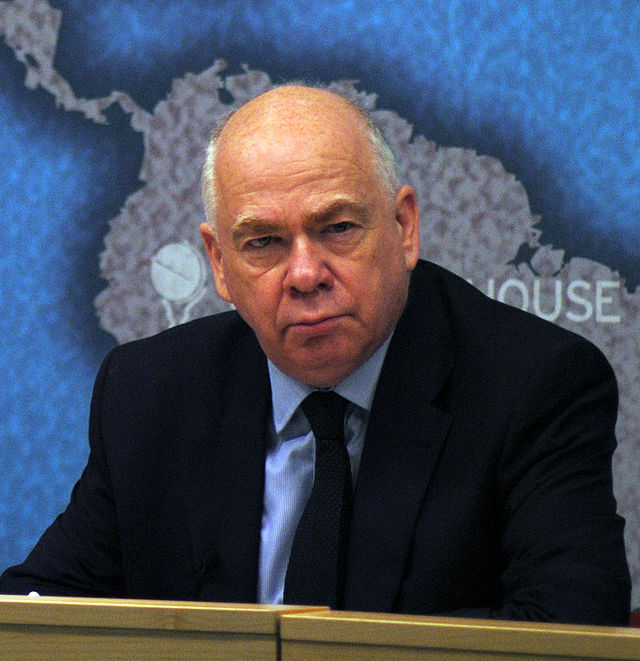
Lawrence Freedman
British academic and historian
14
APPEARANCES
14
PODCASTS
Sep 29, 2026

speaker_1ADVERTISER
T's and C's apply.

Lawrence FreedmanGUEST
I think there's a sort of worry among some of the primes in NATO countries that Ukraine's going to get their business.
Lawrence FreedmanGUEST
You know, The British, I think, and others are trying to be quite sensible in working as closely as possible with Ukraine.
Lawrence FreedmanGUEST
And in return, Britain has given Ukraine details of how to build storm shadows and so on.
9 MINS LATER


Lawrence FreedmanGUEST
And if you look right through the 19th century, strategy, John Minney called it war on the map, was about how to get your forces into position to fight the battle.
Lawrence FreedmanGUEST
The problem with that... was, as became increasingly evident late in the 19th century, was It's fine if you thought that everything could be decided by a single battle or a series of battles.
13 MINS LATER

John BruniHOST
Lawrence, do you think that Trump has caused significant, if not irreversible damage to the Western Alliance generally? Do you think that there's going to be a time at which, you know, Trump goes either through natural means or political means and we all go back to where we were before Trump 45? Or are those days completely over because now the trust has been broken?


Dan Kurtz-PhelanHOST
What, what are you looking for here? What is your kind of theory of how, how this might, uh, proceed if you're trying to be optimistic from a Ukrainian perspective? And is that the kind of best theory of victory that we can come up with for the Ukrainians at this point?
Lawrence FreedmanGUEST
But the basic idea that, that, that it's not clear how either side wins in the way it wants to win, and they're both hurting in the process, that's true.
Lawrence FreedmanGUEST
So I think one of the f- first things I wrote on the, um, full-scale invasion, not for my Substack, not for you, was, uh, I said this is a war Putin can't win because I just couldn't see how he could occupy and subjugate all of Ukraine, and that remains the case.
Lawrence FreedmanGUEST
And it's still the case that even if he achieved the immediate military objectives, you have to wonder what sort of prize the Donbas is now.
Lawrence FreedmanGUEST
But Putin believes somehow that this is, um, this is a thing that he has to win because failure to do so will undermine the credibility of him as a leader.
12 MINS LATER
Dan Kurtz-PhelanHOST
What do you think that will mean in terms of the, the, the role of nuclear weapons?


John LoughHOST
But do you think there is any chance that there could be a pause in this war at some point in the near future, perhaps towards the end of this year or beginning of next year?
Lawrence FreedmanGUEST
The peace settlement is very difficult because there are numerous issues that have to be addressed.
Lawrence FreedmanGUEST
Peace settlements are never negotiated quickly, and ceasefires seem quite simple, but they're actually quite difficult.
Lawrence FreedmanGUEST
Where actually is the line of contact at the moment? You can imagine all sorts of arguments if you try to draw the line a- as to the, where there's Russians on the one side and Ukrainians on the other, 'cause a lot places they're intermingled.
16 MINS LATER
John LoughHOST
Laurie, to, to finish up, I want to ask you as a historian, and of course we have history in the making here, how do you assess Zelenskyy's wartime leadership so far?

1:02

What were you working on? What drew you into setting up the British Foreign Policy Project, and what was the mood like in that period?
Lawrence FreedmanGUEST
I was at, uh, IISS at the time working on a history of nuclear strategy, which I carried on working on all the time I was here, and what attracted me was first that this seemed a slightly more secure job than the one I had.
Lawrence FreedmanGUEST
Secondly, I'd worked for my PhD and at IISS largely on American and nuclear issues, and I wanted to broaden it a bit.
Lawrence FreedmanGUEST
Also, the deputy director at Chatham House at the time was Ian Smart, who had been at IISS, who I knew and admired, and I thought it would be fun working with him, so I applied.
Lawrence FreedmanGUEST
As far as I am aware, I gave a pretty poor interview, but they decided on me nonetheless.
Lawrence FreedmanGUEST
The other member of the team, there were only two of us, was Josie Statler, and she'd already been appointed, and she really handled the administrative side, which was quite heavy, of the project.
22 MINS LATER


Lawrence FreedmanGUEST
I'm reasonably positive about where it's gone, but I think the problem for anybody who follows this war is you're almost scared of optimism.
Lawrence FreedmanGUEST
You know, we've been here before when, especially at times during 2022 when the, when the Russians really seemed to have screwed things up and were on the run, and they recovered.
Lawrence FreedmanGUEST
The Ukrainians have hung on, but the sort of optimism that led you to think that they could really push the Russians back has been in pretty short supply.
Lawrence FreedmanGUEST
What I think has happened, really over the last six months, is a number of things have come together, and they weren't wholly unanticipated.
18 MINS LATER

Maria SnegovayaHOST
So essentially, could you explain your thinking here? Is this strategy really for Ukraine going forward, and how, uh, will it impact our overall understanding of the war?


Francis DearnleyHOST
First of all, before we get into your book and the essays that you've written on Ukraine, I have to ask, what's your strategic assessment of where we are in the war in Ukraine as 2026 properly gets going?
Lawrence FreedmanGUEST
So until a few weeks ago, you'd have simply said in a far better place than at a similar time in 2025.
Lawrence FreedmanGUEST
I think the Ukrainians have held back a sustained Russian offensive that's actually been going for well over two years now.
Lawrence FreedmanGUEST
Russia did advance, but not sufficient to breach Putin's basic objectives, which is to show that he can control Donetsk, uh, even if the Ukrainians don't hand it over.
Lawrence FreedmanGUEST
I think the negotiation trackers was coming to an end or, or was petering out.
Lawrence FreedmanGUEST
But what's changed over the past year is that the US doesn't have that much leverage over Ukraine anymore 'cause it provided with so little, which is a bad thing.
12 MINS LATER

Lawrence FreedmanGUEST
You will recall last June, uh, the United States claimed to have, uh, removed the bulk of, uh, Iran's ability to enrich its uranium.
Lawrence FreedmanGUEST
Uh, and indeed in his opening announcement, President Trump said it had been obliterated.
Lawrence FreedmanGUEST
Uh, and also Witkoff's account does not accord with other accounts of these talks.
Lawrence FreedmanGUEST
There are issues about the, um, the amount of en- already enriched uranium, um, that nobody quite knows where it is, but suspects is buried deep in, in one of the facilities that was b- uh, bombed last June.
8 MINS LATER

Deborah BeckerHOST
So, so what do you think this instability then means, really? What, what will be the, the long-term effect, and what, or what should the strategy be, uh, to make sure that that instability does not break apart a-alliances and cause more damage?


Venetia RaineyHOST
I'm wondering, there are obviously a lot of dissimilarities, but I'm wondering what lessons you think America, and I suppose to a lesser extent the UK, have learned from Iraq in terms of the prosecution of this war.
Lawrence FreedmanGUEST
I mean, when we started the Iraq inquiry, I was kept on being asked about lessons and, you know, the obvious one is don't do it again, or at least think through what you're going to do.
Lawrence FreedmanGUEST
And I think this is-- I mean, this is different in a number of ways from Iraq two thousand and three.
Lawrence FreedmanGUEST
One of the big differences is that the administration does not want to send ground forces.
11 MINS LATER

Roland OliphantHOST
I- if that is true, how do Britain and other Western allies in that position navigate this new world?

John HopkinsHOST
With her blue suits, pearls, and resolute poise, she has already won a reputation for steely conviction, promising tough economic reforms and a firm hand against strikes and public unrest.
Lawrence FreedmanGUEST
When the Thatcher government came in in 1979, the Foreign Office managed to persuade them that it was probably unwise to leave this too long and should try and do a deal.
Lawrence FreedmanGUEST
And they did agree a sort of deal with the junta, which involved leaseback.
Lawrence FreedmanGUEST
That is, the British would transfer sovereignty, but then sort of lease the islands back so that the population could carry on as they were.
Lawrence FreedmanGUEST
First, how long would the leaseback be? Secondly, could Argentina put its own people on the islands as the freeholder? And third, what about the wishes of the islanders, going back to the 1968 commitment? So what happened was that the minister in charge in the Foreign Office, Nicholas Ridley, went to the Falklands in late 1980 and was somehow trying to convince the islanders that it would be their idea to go for leaseback, and they weren't at all convinced.
Lawrence FreedmanGUEST
And even less so was the Commons convinced when Ridley came back and tried to explain what he was up to.
John HopkinsHOST
Galtieri and Anaya believe that in the current circumstances, their plan to retrieve the Falklands could be achievable.

Justin WebbHOST
Do you, Lawrence, when you look at Reagan in total, when you look at his contribution in total, does it fit into earlier American presidents a kind of sense for you of strands of American foreign policy? How, how radical is it? Was it?
Lawrence FreedmanGUEST
it?I think at the time it was seen to be very radical in terms of the tendency in the East-West relations, if you like, since the early sixties.
Lawrence FreedmanGUEST
Now in retrospect, first, in a way, he was vindicated by the end of the Soviet Union, and one could debate how much he was responsible for that, po-possibly not as much as his supporters claim.
Lawrence FreedmanGUEST
But he, he saw the way things were going when his advisors were assuming that the Soviet Union was there forever, and its influence would be there forever.
Lawrence FreedmanGUEST
His two terms are very different as well on this same issue, because he started off with, with apparently very belligerent rhetoric, and then in the second term was the one who became pally with Gorbachev, had this extraordinary summit in, uh, nineteen eighty-six in, in which the two of them almost agreed to full nuclear disarmament.
Lawrence FreedmanGUEST
So he ended up looking more, much more like a peacemaker than he did when he started.
Justin WebbHOST
They're actually all doing the same thing, but Donald Trump is honest about it, and Reagan maybe was less so.


Paddy O'ConnellHOST
Can you help us understand why we talk about a new world order, the rules gone? Why is it all happening, Sir Lawrence?
Lawrence FreedmanGUEST
I mean, the Ukraine situation is more or less as it was all of last year, with Russia pushing on, but only making slow progress at high cost and regularly battering Ukrainian cities.

Laura KuenssbergHOST
So how do you account for the Trump factor versus the power of these long term trends?

Lawrence FreedmanGUEST
Well, we should have seen it in one sense, that the buildup was pretty clear and the pressure was pretty clear leading up to the 3rd of January.
Lawrence FreedmanGUEST
So it's not so much the fact of going after Venezuela, but the way it was done.
Lawrence FreedmanGUEST
On the one hand, a pretty cleverly executed mission to take out and extricate to the U.S., Mr. and Mrs. Maduro.
Lawrence FreedmanGUEST
And you can do that on the basis of the Department of Justice indictments and so on.

Hannah WhiteHOST
So is it a shift of posture and approach or is it a more tactical thing, would you say?


James O'BrienHOST
It- i- in a nutshell, um, Trump has sort of simultaneously realized that Putin has been playing him all along and doesn't really have an exit strategy from- from that continuing con.
Lawrence FreedmanGUEST
Yeah, well, he realizes that he's been played along, and then each time he hears something which gives him hope, um, he- he act as if there is a real prospect of some sort of deal.
Lawrence FreedmanGUEST
Um, and I think the- the- the heart of this story is the fact that he uses this chap Steve Witkoff as his main negotiator, not only on this, but on Iran and Gaza and so on.
Lawrence FreedmanGUEST
So that, in this particular case, first he thought that Putin had agreed to meet with Zelenskyy, uh, as well as Trump-