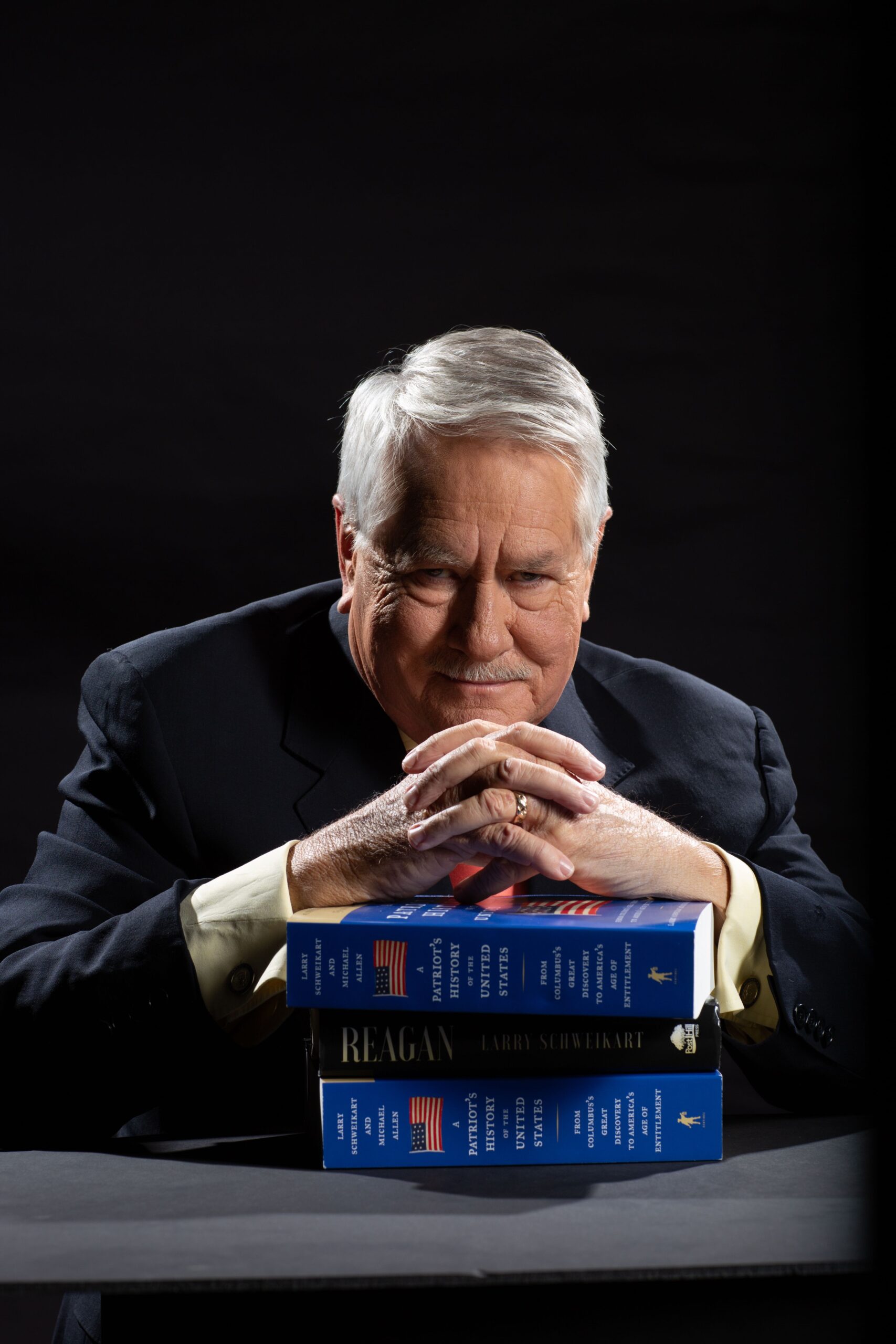
Larry Schweikart
American historian and retired professor
22
APPEARANCES
8
PODCASTS
Oct 7, 2026


Larry SchweikartGUEST
... how that works? So between the, let's use the lower number, two million, and the immigration dep- deportation number of one million, that's three million right there that the, the Democrats are short.
Larry SchweikartGUEST
Then you have another 1.5 million voter registration changes that I've been documenting forever, since November 2025.
Larry SchweikartGUEST
So that's anywhere from 3.5 to 4.5 million who are not gonna be on the voter roll list for Democrats.
22 MINS LATER

Larry SchweikartGUEST
... how that works? So between the, let's use the lower number, two million, and the immigration de- deportation number of one million, that's three million right there that the, the Democrats are short.
Larry SchweikartGUEST
Then you have another 1.5 million voter registration changes that I've been documenting forever since November 2025.
Larry SchweikartGUEST
So that's anywhere from 3.5 to 4.5 million who are not gonna be on the voter roll list for Democrats.
22 MINS LATER


Larry SchweikartGUEST
Trump obviously decided over a year ago that, that Iran constituted such a threat of having a nuclear weapon, it could never, ever be allowed, no matter what.
Larry SchweikartGUEST
And all of those people, you know, it's surprising, it shouldn't be, but it's always surprising that people say, we want somebody, a principal, who won't just stick his finger in the wind and see which way things are blown.
Larry SchweikartGUEST
And as soon as you get somebody like that, they go, oh, we didn't mean to do that.
Larry SchweikartGUEST
So I think Trump is committed to ensuring, however he needs to do it short of nuclear weapons, that Iran never gets a nuclear weapon.
Larry SchweikartGUEST
That said, that is affecting his coalition, which has a lot of the America first, who interpreted America first as being no foreign engagements anywhere, anytime, which is not what America first meant.
17 MINS LATER


Larry SchweikartGUEST
But, um, y- you know, we, we've seen a leftward shift in the Democrat party that is, uh, truly historical.
Larry SchweikartGUEST
And I've been predicting for over a year, historically speaking, looking at parties such as the Federalists or the Whigs, that they are on a path to extinction And, uh, one of my secondary little jobs here is I've been following voter registrations very closely for over 10 years.
Larry SchweikartGUEST
And, uh, every, uh, state where we can track voter registrations over the past year and a half, uh, back to the election of 2024, has moved, uh, substantially, uh, to the right with Republicans taking an active voter lead in such states as North Carolina, uh, collapsing the 1 million Democrat lead in Pennsylvania in 2016-
6 MINS LATER
Larry SchweikartGUEST
concerns?I think what you've seen is, uh, the, uh, blooming of, of a lot of roses here that are gonna start coming up.


Bill O'ReillyHOST
Um, Doctor, you know, we are living in a divided country, as you well know, and, uh, this is gonna play out in the midterm elections with the people that are interested in their gas- gasoline bill, as opposed to the people who really say, "No, we gotta take out Iran now." Do you have any kind of a sense of which way the nation is leaning?
Larry SchweikartGUEST
Well, uh, Bill, the great Rush Limbaugh used to always say that the issues that define an election don't appear until about September or October, and I think that's gonna be the case here.
Larry SchweikartGUEST
If they're really low, a lot of people are not, not going to think things are going badly.
Larry SchweikartGUEST
Um, but, uh, I don't think we've yet seen the real crucial issues that are going to define how people vote.
Bill O'ReillyHOST
What about the mentality of the, uh, MAGA people, Make America Great Again, Trump supporters, and the communist socialist movement that seems to be gaining strength, uh, in certain areas? That seems to be a breach that is gonna take a while to heal.
Bill O'ReillyHOST
What about the mentality of the, uh, MAGA people, Make America Great Again, Trump supporters, and the communist, socialist movement that seems to be gaining strength, uh, in certain areas? That seems to be a breach that is gonna take a while to heal.
Larry SchweikartGUEST
heal.Yes, it very much resembles where we were in the 1850s, uh, leading up to the Civil War.
Larry SchweikartGUEST
But you see what I think is a, a, uh, decline on a path toward extinction of the Democrat Party i- if they don't get it together.
Larry SchweikartGUEST
We've seen this in voter registration statistics that I followed closely for the past 18 months, and until this month, they have been uniformly moving to, uh, Republicans.
Larry SchweikartGUEST
We're talking about something along the lines of 1.4, 1.5 million net Republican voters over Democrats.

Larry SchweikartGUEST
Off of Wild World of History or Wild World of Politics, either one, depending on your bent, whether you're a homeschooler or whether you're interested, interested in politics.
Larry SchweikartGUEST
Uh, last we heard, the, uh, book was at its 46th printing, but they authorized a new 25th anniversary edition that will be out in 2029, meaning Mike and I are gonna have to get to work on cutting down the existing book so we can put new stuff in for 2029, very soon.
Larry SchweikartGUEST
And, and this is in the, the new book, America in the 21st Century, but AI can go one of four ways.
42:26
You s- decided to tell the story of the 21st century through the lives of some of the most significant people in the 21st century, correct?
Trevor Sykema and Mike YamADVERTISER
wildworldofhistory.com. or Wild World of Politics.
Larry SchweikartGUEST
Either one, depending on your bent, whether you're a homeschooler or whether you're interested in politics.
Larry SchweikartGUEST
Last we heard, the book was at its 46th printing, but they authorized a new 25th anniversary edition that will be out in 2029, meaning Mike and I are going to have to get to work on cutting down the existing books so we can put new stuff in for 2029.
Larry SchweikartGUEST
I've always said AI can go, and this is in the new book, America in the 21st Century, but AI can go one of four ways.

Steve BannonHOST
You decided to tell the story of the 21st century through the lives of some of the most significant people in the 21st century, correct?
Larry SchweikartGUEST
The guy not only served eight great years, he, he avoided war, getting us into a new war with Britain and France.
Larry SchweikartGUEST
Most important, though, every single act that Washington took, he did so with the future in mind, with the future presidents in mind.
Larry SchweikartGUEST
How will another president be put in a situation like this? What will they be able to do? What should they do, and what should they not be able to do? So that was foremost on his mind in every action he took, uh, and every precedent he, he set.

Larry SchweikartGUEST
The guy not only served eight great years, he avoided war, getting us into a new war with Britain and France.
Larry SchweikartGUEST
Most important, though, every single act that Washington took He did so with the future in mind, with the future presidents in mind.
Larry SchweikartGUEST
How will another president be put in a situation like this? What will they be able to do? What should they do? What should they not be able to do? So that was foremost on his mind, every action he took and every precedent he set.


Larry SchweikartGUEST
... which has lost almost 1 full percent of its Democrat lead in the last, uh, year and a half.
Larry SchweikartGUEST
You can't find one state where Democrats are consistently putting up any winning numbers.
Larry SchweikartGUEST
They're all moving to Republicans, to the point that in North Carolina, that state became a red state last month, which it's astounding.
9 MINS LATER

Andrew KolvetHOST
Are you optimistic? Are you pessimistic? What are you thinking? What are you seeing?
Larry SchweikartGUEST
Well, I think a lot of concern is over the 2026 midterms, and I'm not concerned.
Larry SchweikartGUEST
Now, last year, a whole bunch of Republicans announced their retirements, and I'm not sure why.
15 MINS LATER
Andrew KolvetHOST
you think we're going to be at 210, 212 safe Republican districts? And are those really safe? Because I hope those models aren't looking at like, you know, Hispanic votes from 2024, because we're losing, we've lost a little bit of ground off those numbers.
1:33
Ah, you know, how long did it take you to do the research? When do you stop researching and start writing?
Larry SchweikartGUEST
Um, we found after the last edition of Patriot's History of United States came out in 2018, that Sentinel was not interested in doing a 20th anniversary edition or updating it in any way.
Larry SchweikartGUEST
Um, it, it is in its, uh, 45th printing and, phew, just last week I think we sold 1,700 copies.
Larry SchweikartGUEST
But since then, I've been researching stuff in case I ever had another edition.
Larry SchweikartGUEST
And then last year I decided, well, I'm gonna write two more chapters that will bring everything up to 2025 and make them free, available, uh, to anyone who emails me.
34 MINS LATER
Larry SchweikartGUEST
You know, I had the privilege of introducing William F. Buckley at a speech in Santa Barbara, and, uh, me and the, uh, female president of Young Republicans there, and, uh, Buckley came on stage and he said, "Well, uh, Mr. Schweikart proves that, uh, the term, uh, young intellectual conservative is not an oxymoron." (laughs) And people of course are flipping through their dictionaries to figure out what he meant.
Larry SchweikartGUEST
But, um, yeah, there were a number of people who I thought, "Surely they would just look at the evidence." And it wasn't whether or not you agreed with Trump's policies, which I did, but I was trying to convince them, "Look, all you have to do is look at the polling, look at the voter registration, and, and you'll see he's going to be the candidate." I said this over and over in 2015 and, um, e- even when Trump took the lead there, I think it was in June or so, and never gave it up except for one two or three-week period to Ben Carson in October, he never lost the lead in the entire Republican primary the rest of that time, and it was usually a very big lead.
Larry SchweikartGUEST
I said, "No, easily he's gonna be the nominee." And I believed at that time most Republicans could have beaten Hillary Clinton, but I came to change my mind, and I came to understand that politics had changed a great deal from Ronald Reagan's day to Donald Trump's day.
Larry SchweikartGUEST
You know, I, I make a point to my students that Abraham Lincoln with his high screechy voice and his long-winded speeches would never have made it on radio because his voice wouldn't have been a voice for radio.
Larry SchweikartGUEST
But Franklin Roosevelt had a perfect voice for radio, but he never would have made it in the age of television in the '60s or '70s because there was still a bias against handicapped people.
38:33
What had ch- had changed in the country, the underlying historical forces?
Larry SchweikartGUEST
You know, I had the privilege of introducing William F. Buckley at a speech in Santa Barbara.
Larry SchweikartGUEST
And Buckley came on stage and he said, well, Mr. Swigart proves that the term young intellectual conservative is not an oxymoron.
Larry SchweikartGUEST
And people, of course, are flipping through their dictionaries to figure out what he meant.
Larry SchweikartGUEST
But yeah, there were a number of people who I thought were Surely they would just look at the evidence.
Larry SchweikartGUEST
And it wasn't whether or not you agreed with Trump's policies, which I did, but I was trying to convince them, look, all you have to do is look at the polling, look at the voter registration, and you'll see he's going to be the candidate.
Steve BannonHOST
How long did it take you to do the research? When do you stop researching and start writing?
Larry SchweikartGUEST
We found after the last edition of Patriots History of the United States came out in 2018 that Sentinel was not interested in doing a 20th anniversary edition or updating it in any way, and I felt an obligation to our readers to keep the book current.
Larry SchweikartGUEST
It is in its 45th printing, and just last week I think we sold 1,700 copies, and it just continues to be a a best-selling book all the time.
Larry SchweikartGUEST
But since then, I've been researching stuff in case I ever had another edition.
Larry SchweikartGUEST
And then last year, I decided, well, I'm going to write two more chapters that will bring everything up to 2025 and make them free available to anyone who emails me.
Larry SchweikartGUEST
So if you're out there and you want the new chapter 23 and the new chapter 24 that go from 2018 to 2025, email me at larry at wildworldhistory.com, and I'll send you the free copies.
39 MINS LATER
Steve BannonHOST
The conversion of that in this concept we call the singularity, which on this side of that point is Homo sapiens, and on the other side of that point is Homo sapien 2.0. Are you as concerned about that, and do you think that changes the entire – is that a line we're crossed that everything beforehand Larry Shrek would say, this is human history or Homo sapien history, everything post that is Homo sapien 2.0 history? Yeah.
1:33
Ah, you know, how long did it take you to do the research? When do you stop researching and start writing?
Larry SchweikartGUEST
Um, we found after the last edition of Patriot's History of United States came out in 2018, that Sentinel was not interested in doing a 20th anniversary edition or updating it in any way.
Larry SchweikartGUEST
Um, it, it is in its, uh, 45th printing, and just last week I think we sold 1,700 copies.
Larry SchweikartGUEST
But since then, I've been researching stuff in case I ever had another edition.
Larry SchweikartGUEST
And then last year I decided, well, I'm gonna write two more chapters that will bring everything up to 2025 and make them free, available, uh, to anyone who emails me.
34 MINS LATER
Larry SchweikartGUEST
You know, I had the privilege of introducing William F. Buckley at a speech in Santa Barbara, and, uh, me and the, uh, female president of Young Republicans there, and, uh, Buckley came on stage and he said, "Well, now Mr. Schweikart proves that, uh, the term, uh, young intellectual conservative is not an oxymoron." (laughs) And people of course are flipping through their dictionaries to figure out what he meant.
Larry SchweikartGUEST
But, um, yeah, there were a number of people who I thought, "Surely they would just look at the evidence." And it wasn't whether or not you agreed with Trump's policies, which I did, but I was trying to convince them, "Look, all you have to do is look at the polling.
Larry SchweikartGUEST
Look at the voter registration, and, and you'll see he's going to be the candidate." I said this over and over in 2015 and, um, e- even when Trump took the lead there, I think it was in June or so, and never gave it up except for one two or three-week period to Ben Carson in October, he never lost the lead in the entire Republican primary the rest of that time, and it was usually a very big lead.
Larry SchweikartGUEST
I said, "No, easily he's gonna be the nominee," and I believed at that time most Republicans could have beaten Hillary Clinton, but I came to change my mind, and I came to understand that politics had changed a great deal from Ronald Reagan's day to Donald Trump's day.
Larry SchweikartGUEST
You know, I, I make a point to my students that Abraham Lincoln with his high screechy voice and his long-winded speeches would never have made it on radio because his voice wouldn't have been a voice for radio.
38:33
What had ch- had changed in the country, the underlying historical forces?
Steve BannonHOST
Spain, France, and th- the, uh, then, and England that fought over this for so long, leading up to our own revolution.
Larry SchweikartGUEST
Well, the French, um, as I said, saw Canada as a wealthy ground for trade of all sorts of pelts, beaver, um, uh, was the most popular at the time, but of course, deer, elk, uh, all sorts of m-...
Larry SchweikartGUEST
Uh, and so they established a very large empire running all the way down the, uh, part of the Mississippi River.
Larry SchweikartGUEST
The Spanish had come in, uh, 100 years earlier into the Mexico region after defeating the Aztecs, and they started, uh, a series of farming, um, plantations and haciendas where they rewarded their conquistadors with, uh, with, with land, and they were moving northward and ou- out of Mexico eastward and out of Florida northward as well.
Larry SchweikartGUEST
So when war broke out in Europe, obviously, these colonies were going to be at war with each other in, in North America.
23 MINS LATER
Steve BannonHOST
A conservative history of the United States?" You guys had the idea because you were teachers of history, right? And, and y- you couldn't find a textbook that actually told the true story of the United States, sir.
Larry SchweikartGUEST
Mike Allen and I met at a Western history conference, and we were lamenting how bad the traditional textbooks that were out there were.
Larry SchweikartGUEST
You know, it's interesting that they started off many of these, like, The National Experience or American Pageant, weren't terrible, but over time, uh, especially as they took on more co-authors and younger writers, they got to be extremely liberal.
Larry SchweikartGUEST
So by the early 1990s, Mike and I couldn't find anything to teach from, and as an instructor, it's a pain to have to argue against the textbook all the time.
Larry SchweikartGUEST
So we said, "Why don't we write our own?" So around 1999, we started writing this book.
Larry SchweikartGUEST
And by the way, it was not a direct response to Howard Zinn's People's History.
41 MINS LATER
Steve BannonHOST
You guys had the idea because you were teachers of history, right? And you couldn't find a textbook – that actually told the true story of the United States, sir.
Larry SchweikartGUEST
Mike Allen and I met at a Western history conference, and we were lamenting how bad the traditional textbooks that were out there were.
Larry SchweikartGUEST
You know, it's interesting that they started off, many of these, like the National Experience or American Pageant, weren't terrible.
Larry SchweikartGUEST
But over time, especially as they took on more co-authors and younger writers, they got to be extremely liberal.
Larry SchweikartGUEST
And as an instructor, it's a pain to have to argue against the textbook all the time.
37 MINS LATER
Steve BannonHOST
How and why did Squanto actually not just know English, but he spoke it pretty well, didn't he?
Steve BannonHOST
Talk to me about the three geopolitical Spain, France and then in England that fought over this for so long leading up to our own revolution.
Larry SchweikartGUEST
Well, the French, as I said, saw Canada as a wealthy ground for trade of all sorts of pelts.
Larry SchweikartGUEST
Beaver was the most popular at the time, but of course, deer, elk, all sorts of foxes and bears, everything else.
Larry SchweikartGUEST
And so they established a very large empire running all the way down the part of the Mississippi River.
Larry SchweikartGUEST
The Spanish had come in 100 years earlier into the Mexico region after defeating the Aztecs, and they started a series of farming plantations and comiendas where they rewarded their conquistadors with land.
Larry SchweikartGUEST
And they were moving northward and out of Mexico eastward and out of Florida northward as well.
21 MINS LATER