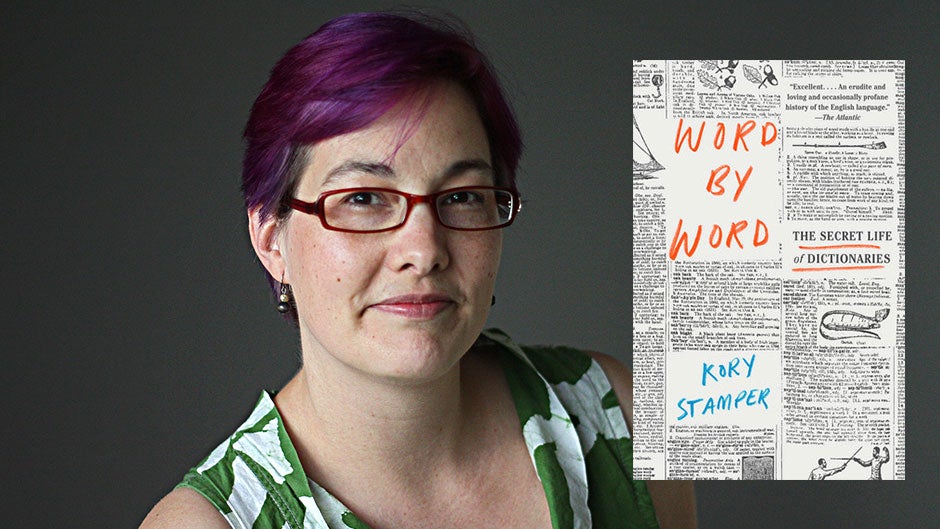
Kory Stamper
Lexicographer
10
APPEARANCES
7
PODCASTS
Sep 24, 2026


Maiken ScottHOST
These challenges really started with the switch from natural dyes to synthetic dyes and colors.

Kory StamperGUEST
Dyes became a byproduct of attempts at chemical experiments in the 1800s, really.
Kory StamperGUEST
Dyes became chemistry as opposed to something that, you know, your local dyer did with plants in the backyard.
Kory StamperGUEST
And as that happened, then any sort of main center of academic chemical inquiry became a place where color was made.
Kory StamperGUEST
Germany's dyes were synthesized in such a way that they were very bright, they were color fast, they were light fast.
Kory StamperGUEST
And the synthetic dyes also just had this range of colors that was really difficult to get out of natural dyeing.
11 MINS LATER
Maiken ScottHOST
Godloff was already working on a new system for the Color Council, but this was about big picture integration.

12:17
And he says, "I hope that some readers will read them as they were written, slowly and with more patience than effort." What do you think he means by that, more patience than effort?
Kory StamperGUEST
Oh, I think even though I love language and I love hearing language read, there is a particular, there's poetry voice.
Kory StamperGUEST
Uh, I just used poetry voice, right? There's this particular cadence that people use when they read poetry, and, and it's not a natural speaking cadence.
Kory StamperGUEST
Poetry can feel very, a little too highfalutin for some people, right? There is this idea that people have in their minds that like, to read poetry I need a book, and I need to be in a, you know, beautiful Victorian setting, and I need to have the time, and I...
14 MINS LATER


Kory StamperGUEST
And said, and said, "This is all very complicated," but didn't actually define much.
Kory StamperGUEST
As I said in the first episode, he died suddenly in the middle of defining, and that's where we get our second major and hidden color definer, and that is his wife, Margaret Godlove.


Kory StamperGUEST
I would create compound adjectives out of moist, so we've got moistful or moisty.
Kory StamperGUEST
It's so gross." And, like, uh, if you wanna go find the studies that have been written on why people don't like the combination of sounds that result in the word moist, you can, but I just think, like, you know, sometimes moist is the word you need to use.
Kory StamperGUEST
So there was a blockade between, you know, German boats couldn't leave, couldn't export anything, and dyes ended up being used in so many different places that when German dyes were no longer available on the worldwide market, suddenly you had all of these problems.
10 MINS LATER
Maiken ScottHOST
Godlove was already working on a new system for the Color Council, but this was about big picture integration.

Kory StamperGUEST
Well, the Third was a really pivotal dictionary in the history of North American dictionaries.
Kory StamperGUEST
It was, as you mentioned, released in 1961, and it marked a huge difference in how dictionaries were written and the kinds of information that dictionaries conveyed to the public.
Kory StamperGUEST
So prior to the Third, dictionaries were kind of like combination dictionaries and encyclopedias, so they'd have lots of extra information about not just what color the flower sweet William is, but where you can find it, who developed the cultivars, where it grows well.
Kory StamperGUEST
And the Third, when the managing editor for the Third, whose name was Philip Babcock Gove, came in to Merriam-Webster, he said, "We can't afford the space, first of all, for all of this extra information, but also language really needs to be structured, consistent, and we need to make sure that we're defining things as if we are objective observers of the language, as opposed to people who just read a lot and have a general idea of what something means." So that means the definitions in the Third are very dry.
Kory StamperGUEST
Um, if you've read a dictionary, you know, published since 1961, you've probably encountered some of the types of language that the Third introduced, like the state or condition of.
speaker_2UNKNOWN
[laughs]
Kory StamperGUEST
So the first lethal chemical weapon used on the battlefield, which was chlorine gas, was made by dyestuff manufacture.
Kory StamperGUEST
The second lethal chemical weapon, phosgene gas, which replaced chlorine gas, was also a byproduct of dyestuff manufacture.
Kory StamperGUEST
So after World War I, when all of this came to light, America did not wanna be caught on the back foot again technologically.
Kory StamperGUEST
So they poured tons of money into areas of scientific and technological research that they felt they needed to have to maintain world peace and national security.
Kory StamperGUEST
And because dyes had been weaponized, they reasoned that they needed to be able to understand as much as they could about the manufacture and storing and applications of color as possible.
17 MINS LATER
Kory StamperGUEST
Because in order for people to be able to latch onto those definitions, they need to know what the colors that those definitions are in comparison to are.
Kory StamperGUEST
And this is really where this whole thing breaks down because color names and their popularity change dramatically from year to year, decade to decade.
Kory StamperGUEST
And so when the third was being written, these definitions used colors that were pretty familiar to folks.
Kory StamperGUEST
But by the time the third was published, after all these definitions were done, lots of those colors had fallen out of use, and new colors were not just being used, but new colors had been developed that weren't even on this space.

Kory StamperGUEST
But what happens when someone has impaired color vision? Or what happens when the color that I wanna show you is on something, paper, let's say, that is going to be a different medium than the thing I need you to match it to? If I show you a paint chip and I say, "I would like you, uh, Mr.
Kory StamperGUEST
Mike Carothers, to mix me a gallon of paint in this beautiful color that's called rejuvenate," and you say, "Great.
Kory StamperGUEST
Is that going on your bathroom wall?" And I say, "Yes." And then you say, "All right.
Kory StamperGUEST
Would you like that in eggshell, satin, matte, semi-gloss, or gloss finish?" And I say, "Semi-gloss.
14 MINS LATER
Mike CarruthersHOST
It was horrible, but it sounded great, and the little chip looked great, but on a whole room it was terrible.


Daniel MidgleyHOST
Is that why we do lots of colors have German names like Prussian blue? I know that's not Germany, but.
Kory StamperGUEST
And in fact, most of the colors that Germany exported at that point were all like they had chemical names.
Kory StamperGUEST
So azo dyes, for instance, or aniline green, which doesn't mean anything to anybody unless you're a chemist and you work in aniline dyes.
Kory StamperGUEST
But during World War I, suddenly the dye works, which couldn't export dyes anymore.
Kory StamperGUEST
And so the U.S. government got very nervous because if you can make something lethal out of something as simple as, you know, a black dye, then we need to get our little governmental mitts into all of these areas.
22 MINS LATER