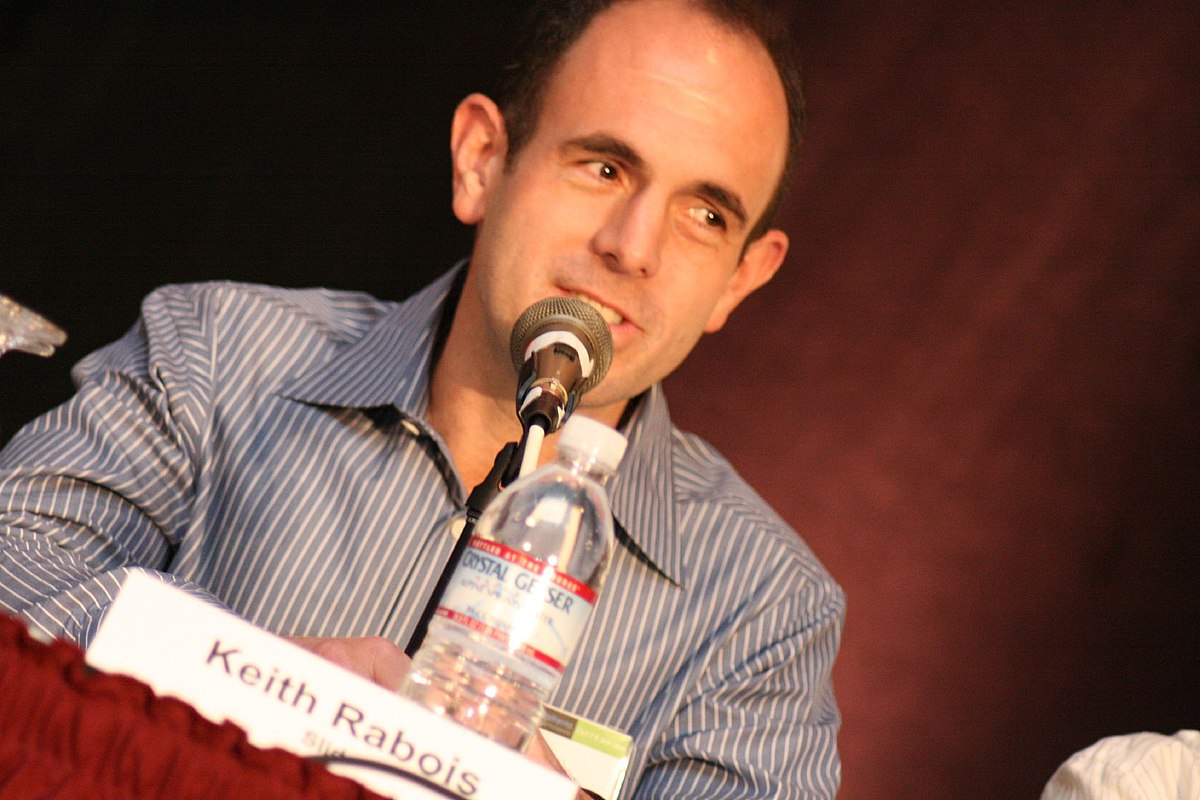
Keith Rabois
Managing director of Khosla Ventures
26
APPEARANCES
18
PODCASTS
Oct 28, 2026


Luke SophinosHOST
And if we could expand a little bit on it, because I'm just, I'm curious, any specific, like you guys, I think you did Spellbook, right, Keith? How do you view that versus like a Harvey and which one, how does that size up in your framework here?

Keith RaboisGUEST
I think Spellbook, you can see, there's probably more of a crisper evolution of the difference that you can see sort of in the public domain right now.
Keith RaboisGUEST
So that's on our core of our website is what we do is we make contracts happen almost instantaneously and with less mistakes, less pain and less cost than humans.
Keith RaboisGUEST
There's no reason 90 some odd percent of contracts in the United States require a human lawyer.
8 MINS LATER


Connie LoizosHOST
What are you thinking? What are your friends thinking or talking about in reaction?
Keith RaboisGUEST
I mean, personally, I'm a tech optimist, and I don't think you should be in this profession unless you believe that tech is this magic wand that improves society.
Keith RaboisGUEST
I give people capital and sometimes useful advice and ask them to take the magic wand of tech and fix things.
Keith RaboisGUEST
And anybody who doesn't believe that tech is generally good and that tech can improve all of our lives, our kids' lives, my kids' lives, shouldn't be in tech.
Keith RaboisGUEST
They shouldn't be investing, and they shouldn't be an entrepreneur, and they shouldn't be working at a company that's building things through tech.
Keith RaboisGUEST
Fortunately, there's enough talented people that believe in the optimistic view of the world that almost all human progress for the last four centuries has been driven by technology.
18 MINS LATER
Connie LoizosHOST
What makes somebody more superhuman, and where have you made a mistake on that front?


Keith RaboisGUEST
But if you work backwards from 2030 and say, "Which of these companies are gonna be sustained? Which ones have durable advantages?" As I like to talk about it or communicate it, through accumulating advantages, that's less clear.
Keith RaboisGUEST
The ability to go to 100 million in revenue from, you know, two years or so, or hundreds of millions in four years, basically unprecedented.
Keith RaboisGUEST
But you still do have to ask questions about what's the sustainability of that revenue, uh, not just because customers may or may not change their mind, or there may be new competitors, but, like, different...
Keith RaboisGUEST
The way the ecosystem evolves around AI is not at all easy to forecast, so we struggle with this and debate this in our partner meetings constantly.
Keith RaboisGUEST
The, the, the founders are impressive, the teams are impressive, the revenue and the adoption is impressive, and even the usage often is impressive.
5 MINS LATER

Jordi HaysHOST
And when you have both sides of the political aisle that are realizing, "Hey, I can get points for pushing back here," then it's hard to imagine that there isn't, like, very real friction, uh, ahead.


Vidit AgarwalHOST
Tell me about, I read the other day on Twitter, you said in quotes, I insisted on avoiding an EA for the first decade in tech, and it was mostly wrong.
Keith RaboisGUEST
And so all through my days at PayPal and LinkedIn and beginnings of Square, I never had one, never wanted one.
10 MINS LATER

Keith RaboisGUEST
... like, building a team, hiring, assessing people, you would think that there should be some library somewhere of insights that you can read, and I have not found it.
34 MINS LATER

Louisa NicolaHOST
I want you to tell me something that nobody knows, that you haven't spoken about publicly, about how to be in the position you are today with gut in- instincts and being able to make the decisions that you can today.


Lenny RachitskyHOST
And so from the companies that you are closest to that you see are best at attracting the best talent, what have they figured out? What are they doing differently? What are some creative things they do?
Keith RaboisGUEST
The most important lesson I learned when I was working at Square from my board was Vinod Khosla was on my board, and he said, "The team you build is the company you build." And that adage is the most important thing when you're creating a startup.
Keith RaboisGUEST
People get distracted with the market, with customers, with the product, with technology.
Keith RaboisGUEST
If you have the right people-Everything else will be easy, and if you have the wrong people, everything else is gonna be difficult.
Keith RaboisGUEST
So I actually learned this be-- Vino distilled it, but I actually learned this back in my PayPal days.
1 HR LATER
Lenny RachitskyHOST
Is there just something they are doing, the way they operate, that is different from companies that are not as successful?


Keith RaboisGUEST
The, the basic concept is, a lot of people you say: "Are you interested in politics?" More than the majority of Americans say, "No." But most Americans have an issue or two that they care about, a lot about, like, it could be taxes, or it could be abortion, or it could be some foreign policy, Israel, Iran, what- whatever the case is.
47 MINS LATER


AmirHOST
Tell me about that like four years at Stanford.
Keith RaboisGUEST
So, yeah, I went to Stanford in the late 80s, finished in the, you know, sort of early mid 90s and studied political science.
Keith RaboisGUEST
You know, on the Cold War stuff, interestingly enough, we were covering a lot of my majors was political science and strategic political science.
Keith RaboisGUEST
And we were covering a lot of debates about realism and idolism and liberalism and how those are.
Keith RaboisGUEST
How it should be applied to military doctrine in the Cold War, political doctrine and political competition with the Soviet Union.
Keith RaboisGUEST
Obviously, a lot of that got obviated a few years later, although the structural strategic planning elements of political science, Clausewitz, etc., are not.
30 MINS LATER
AmirHOST
As a Silicon Valley investor for the last 20 years, why make the move to Miami?
speaker_5UNKNOWN
The Ernest Acker.
Keith RaboisGUEST
... and you're in the basement or you're in the garage, you write the code, and then you put it on the internet and everyone shows up and your elegant algorithm just produces Google and then you create a trillion dollars in value.
Keith RaboisGUEST
And it's because you're the PhD scientist, you're the mathematician, that you get rewarded.
Keith RaboisGUEST
And now it feels like you can maybe make it in Silicon Valley, maybe not caring so much about the technical aspects, but instead about the deals, putting pieces together.
10 MINS LATER
JordyHOST
Yeah.
Keith RaboisGUEST
It's a little bit like Paul Graham had this epic, uh, blog post about, you know, if someone, um, unfortunately, like, meets someone, you know, and sexually assaults them at a grocery store, like Safeway.


Erik TorenbergHOST
What is your mental model of OpenAI as a company? What is it doing right now? How do you sort of see it going forward?
Keith RaboisGUEST
it is transforming how everybody, every normal person, basically does their work, runs their life.
17 MINS LATER
Erik TorenbergHOST
Why did Opendoor lose its way? What were the mistakes that were made? And let's talk about how we're going


Molly O’SheaHOST
But for you, I asked Deleon, like, what should I ask Keith? And Deleon, he said, he told me to ask you, what do you see in certain young folks that convinces you to spend so much time mentoring? It's the
Keith RaboisGUEST
What you want to find is someone has a non-zero chance of changing an industry of the world.
Keith RaboisGUEST
And it's the same, you're scouting for professional sports, you're scouting for music labels.
22 MINS LATER
Molly O’SheaHOST
But I have noticed, like, since joining Coastal again, your contrarian takes have, I mean, I'm not going to say they dulled down, but, like, you have gotten a little bit more mellow.
Molly O’SheaHOST
How did we get here with Opendoor? You mentioned back in 2015, things started to go south?
Keith RaboisGUEST
We were almost, we were just, I think we hit 20 billion as a market cap company for at least a day or two.
Keith RaboisGUEST
We were We were minting $500 million to $1 billion of free cash flow when we were public.
7 MINS LATER
Molly O’SheaHOST
What's the difference between Opendoor, Zillow, and Rocket Mortgage? How does this fit in? There's


Sara EisenHOST
Yeah, but wasn't always the thing that once the housing market turned, then the company was stuck with a lot of mispriced inventory? It didn't work so well when the housing market was weak.
Keith RaboisGUEST
So the Federal Reserve raised interest rates six times with unprecedented speed.
Keith RaboisGUEST
And that did create a cohort, i.e. one cohort, one month to maybe a quarter of mispriced homes.
Sara EisenHOST
But really, I mean, isn't it a play on trying to sell the most, like volumes, sell the most homes? And that's been part of the problem is that the business has shrunk so much in terms of these inventories and how much you're going to sell.
JohnHOST
It's not going anywhere.
Keith RaboisGUEST
Well, I think ChatGPT is the fastest-growing consumer app of all time, and as long as that continues, Google's significantly threatened.
Keith RaboisGUEST
I think normal people are substituting, uh, what used to be searches and queries into prompts, and that really does threaten Google.
Keith RaboisGUEST
Even if they have top-tier AI talent, they have yet to productize it in a way that undermines the trend towards ChatGPT.
Keith RaboisGUEST
If Google were to fuse together all the information they have about you, your Gmail, your YouTube, et cetera, and make everything personalized out of the box, that'd be interesting.
Keith RaboisGUEST
We'll see if they can shift that product, um, internally, uh, substantively, and whether it resonates with users.
17 MINS LATER
JohnHOST
Mm-hmm.


Jessica LessinHOST
What are founders and their boards talking about as it relates to AI and startups?
Keith RaboisGUEST
Yeah, so I observed that the primary topic at most of the board meetings I've attended in the last week or so was about how AI is not just transforming the product and the user experience and the value proposition, but actually transforming the culture and the way of building companies.
Keith RaboisGUEST
And there's a couple of things that are obvious in the public domain, and then there's a lot more important subtle things.
Keith RaboisGUEST
Everybody's paying attention from the president on down to these grants that Ben and other people are offering AI-grade researchers.
Keith RaboisGUEST
uh the president quipped about it everybody it's entered pop culture they're being paid more than you know professional sports athletes now the downside to that or the flip side is meta pretty coherent strategy better mince money startups basically by definition do not virtually no startup actually is profitable um including some of you know the highest profile startups open ai anthropic etc So if you have, if you're losing money, and you want to compete for AI grade researchers, if you're going to spend that money, and you can debate whether you should and how and when and how many of those people, but if you're gonna spend any of that money, you need to substitute from somewhere else.


Keith RaboisGUEST
And that they're actually now, with Grok having the avatar, kind of leaning into this concept of personality.
Unknown podcast
Winning the AI Race Part 1: Michael Kratsios, Kelly Loeffler, Chris Power, Shyam Sankar, Paul Buchheit, Jake Loosararian
Jul 23 · 1h 34m

Jason CalacanisHOST
What are your thoughts on the government's role in maybe juicing up this onshoring, specifically in categories where maybe China has dominated for a couple of decades?
Keith RaboisGUEST
Well, as Kelly pointed out, the government is actually not extending the loans, the community banks in America are extending the loans.
Keith RaboisGUEST
If you think about it, AI is really this rocket fuel to turbocharge small businesses and entrepreneurs, at least in three dimensions.
Keith RaboisGUEST
Typically, if you're starting a business, you have to compete with very large incumbents that have expertise in market research, marketing, legal, accounting.
Keith RaboisGUEST
Now, top of your fingers, your voice, you have the same expertise that all these large companies have.
7 MINS LATER

David FriedbergHOST
These are very often small warehouses that were turned into a small manufacturing facility, and we could recreate that in America across all of these great states where people are looking for economic expansion opportunities.
Keith RaboisGUEST
As you get in non-LLM-based, uh, models, you may be totally right, but almost no one's really using non-LLM-based models at scale.
Keith RaboisGUEST
On driving specifically, Travis is totally right, that humans are actually really good drivers except when they get distracted.
7 MINS LATER
Unknown podcast
Grok 4 Wows, The Bitter Lesson, Elon's Third Party, AI Browsers, SCOTUS backs POTUS on RIFs
Jul 11 · 1h 30m
Keith RaboisGUEST
But if you think about LLMs being the most important unlock in AI, LLMs are all trained on human writing.
Keith RaboisGUEST
So someone wrote every piece of data that every LLM used, a human wrote at some point in history.
Keith RaboisGUEST
So yes, it's true that they've shocked everybody, including OpenAI's original team, on the implications, the broad implications, the general applicability to almost every problem.
31 MINS LATER
speaker_2UNKNOWN
Yes.
speaker_0HOST
Yeah.
Keith RaboisGUEST
Um, there's maybe one or two, it's up to the speaker, you know, if they don't want to share certain things.
Keith RaboisGUEST
Um, so, you know, Eric talked about how they built Ramp, and John, uh, gave a dif- slightly different perspective on building Stripe.
Keith RaboisGUEST
And then I interviewed actually Garry Tan of YC to talk about the origins of founder mode, the lessons from, you know, thousands of companies that, you know, they've invested in for 20 years.
9 MINS LATER
speaker_0HOST
Mm-hmm.
Keith RaboisGUEST
Without- without the ability to attract one of the top 40 people you can sell into, let's say, defense oriented stuff, three letter agency stuff, I think it's really dangerous.
Keith RaboisGUEST
Um, so, I think that's more critical sometimes than the technical breakthrough.
speaker_1HOST
Yep.
Keith RaboisGUEST
Secondly, if we can cut 1% from the federal bud- budget, just 1%, the Federal Reserve can lower interest rates by 1% safely and allow people to afford mortgages, allow the economy to grow-

Stan ChristensenHOST
As you think about negotiation as part of teams or just an overall philosophy, if someone were going to ask you, what's your philosophy of negotiation? What have you learned about working with teams? What comes to mind?
Keith RaboisGUEST
What do you want? Like, what's the goal? It's very straightforward, but people gloss over that.
Keith RaboisGUEST
Then there's the tactical question of how do you get there? And then we talk about why and how.
Keith RaboisGUEST
And typically, you know, when I'm working on a negotiation, it's usually on behalf of the smaller entity with less leverage than a large entity.
Keith RaboisGUEST
Startups typically are negotiating with the big powers that be, the government, large in comments, distribution deals.
Keith RaboisGUEST
And so the most important thing is to figure out why should the large entity care? What's in it for them? And what you really need to do is align the goals that you have for your organization with the top three priorities for that CEO.
26 MINS LATER
Stan ChristensenHOST
In my class at Stanford, I counsel people generally don't go into business with your family for a bunch of reasons, but what's your view of that?
Keith RaboisGUEST
i think it's wonderful to be a pre-product market investor is very few people can do it so like as you point out as companies grow up as founders mature Many, many investors can figure out that these people are excellent, this company's excellent, the P&L's amazing, et cetera.
Keith RaboisGUEST
So the only way to produce great returns that are impressive to LPs is you have to have an alpha.
Keith RaboisGUEST
And so mine is to find founders when they have nothing but a keynote deck because there is nothing else for people to go on.
51 MINS LATER


Keith RaboisGUEST
In 2016, I predicted the only person publicly, as far as I know, in the entire world, that Trump was going to win the electoral vote and lose the popular vote.
Keith RaboisGUEST
In 2020, I missed his popular vote by 80 basis points, which is moderately significant error.
Keith RaboisGUEST
And then this year, I said, you're guaranteed he wins in a landslide and he'll get between 4% and 6% more popular vote than he did last time.
34 MINS LATER
Scroll for more appearances