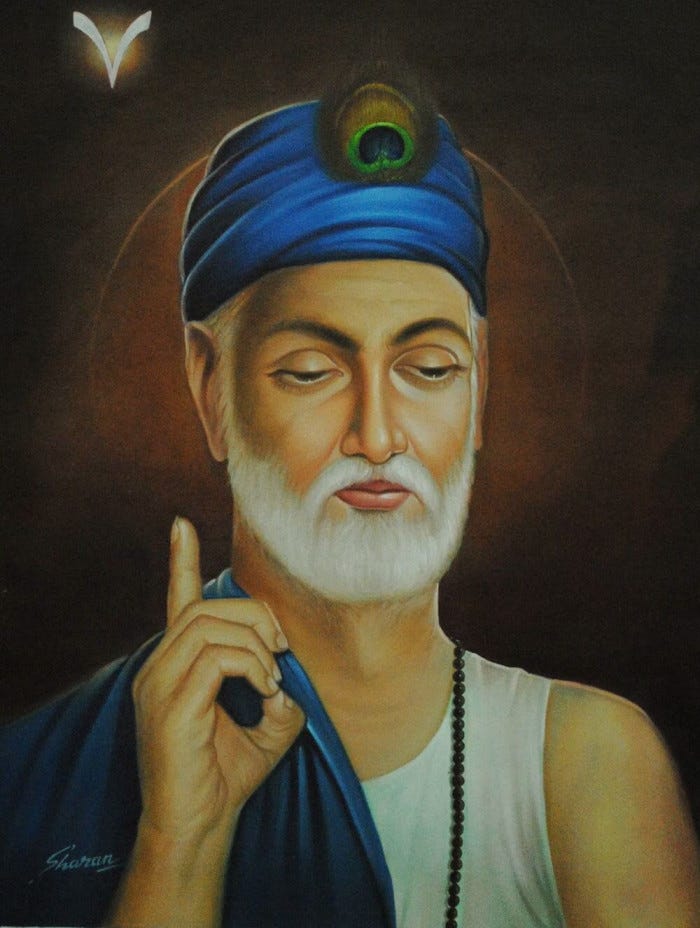
Kabir
Indian mystic and poetWikipedia
67
MENTIONS
27
EPISODES
24
PODCASTS
Search complete. 67 mentions across 27 episodes found for "Kabir".
Sep 12, 2026

Sathya Sai BabaSOUNDBITE_SPEAKER
What is the reason? It is because of divinity.
S. BhagavantamSOUNDBITE_SPEAKER
It is in this context of the negative and the positive being together or recognizing the aspect of the divine as well as the worldly aspects that people like Jayadeva, like Kabir, like Ramadas, like Tulasi, like Valmiki, like Vyasa, so many people like that have their names engraved eternally on our memory because They had also taken the divine aspect while dealing with the worldly aspects Therefore, you must serve the world, simultaneously earn the grace of God.
S. BhagavantamSOUNDBITE_SPEAKER
This is very necessary in the service of the world to do it in the name of God and earn the grace of God.
S. BhagavantamSOUNDBITE_SPEAKER
For youth, this is most essential.
6 MINS LATER
PremHOST
Swami continues speaking about the importance of gaining a name and reputation that stays on.
PremHOST
And Swami goes on to give examples of other great saints and Mahatmas.
PremHOST
Swami spoke about Kabir, Jai Deva, Gauranga, Ramakrishna Paramamsa, Vyasa, Valmiki and so on.
Sai PrakashHOST
So in all these examples, Swami says that they led their lives primarily with the faith and the belief that God exists.

Vasant SwahaHOST
I just look.
Vasant SwahaHOST
Kabir says, It is the mercy of my Guru that has made me know the unknown.
Vasant SwahaHOST
I have learned from him how to walk without feet, to see without eyes, to hear without ears, to fly without wings.
Vasant SwahaHOST
Without eating I have tasted the sweetness of nectar, and without water I have quenched my thirst.
Vasant SwahaHOST
Kabir says, The Guru is beyond any world and supreme is the good fortune of the disciple who comes.
Vasant SwahaHOST
Aum Shanti.
Vasant SwahaHOST
May everyone find peace.

Dale BorglumGUEST
Okay.
Dale BorglumGUEST
You can meditate and get a better personality and you can calm down a little bit, right? But until you really know that you're going to die, that this moment is precious, then it's just kind of fluffing the pillows and rearranging the bedclothes, like that Kabir poem says.
Dale BorglumGUEST
If you're dying, why waste time just rearranging the bedding? Let's get out of it here, right?
Cliff DunningHOST
Yeah.

Jaya RowGUEST
Mm-hmm.
Jaya RowHOST
And even Sant Kabir, um, he's, he speaks about how the fish ...
Jaya RowHOST
It's like being a fish and being thirsty des- despite being surrounded by water.
Jaya RowHOST
Uh, and in the same way, us as human beings, we are surrounded by divinity but yet whe- whether consciously or unconsciously, uh, whether through material pursuits or spiritual pursuits, we are going from pillar to post seeking that which is actually right there within us.

Neale LundgrenGUEST
But it didn't thrill me.
Neale LundgrenGUEST
like even the poet Hafiz and Rumi and Kabir and a lot of these poetry that sings when the word sings.
Neale LundgrenGUEST
But I'm a musician, you know, I mean, I'm a musician by nature and by profession, one of my past lives and this life.
Neale LundgrenGUEST
And so I can resonate with song and with poetry much more than I can.

Mahmood FarooquiGUEST
The world of Sanskrit, the world of Persian, the world of Urdu, the world of medieval Hindi and we bring all that together in the spoken word.
Mahmood FarooquiGUEST
For instance, you know, in Banaras, for instance, it's not uncommon for people to be quoting Ramcharitmanas and Kabir and Ghag and Gang, these medieval poets.
Mahmood FarooquiGUEST
It's not uncommon for people in Delhi to be quoting Mir and Ghalib or people to be quoting Shakespeare.
Mahmood FarooquiGUEST
But these things don't necessarily come together on stage in a single presentation.

Swami SarvapriyanandaHOST
Now, the story goes this way.
Swami SarvapriyanandaHOST
Because he didn't understand Sanskrit or, um, didn't understand the intricacies of logic and all, his guru told him, he gave him a teaching from Kabir Das.
Swami SarvapriyanandaHOST
«Khule nain dekhun sahab ko.» "With open eyes I see my Lord." So he told him, his guru told him that, "You see God in the Himalaya and the Ganga." Then he quoted from the Vedas, from the Rig Veda: «Pashya devasya kavyam yo na jiryati na ma- na mamara.» "Look upon the poetry of the Lord, the great poet.
Swami SarvapriyanandaHOST
Poetry which neither decays nor dies." What is the poetry of the Lord? This universe, and especially something as spectacular and spiritual as the Himalayas.

Swami SarvapriyanandaHOST
Now, the story goes this way.
Swami SarvapriyanandaHOST
Because he didn't understand Sanskrit or, um, didn't understand the intricacies of logic and all, his guru told him, he gave him a teaching from Kabir Das.
Swami SarvapriyanandaHOST
«Khule nain dekhun sahab ko.» "With open eyes I see my Lord." So he told him, his guru told him that, "You see God in the Himalaya and the Ganga." Hmm.
Swami SarvapriyanandaHOST
Then he quoted from the Vedas, from the Rig Veda.

Joel LeveyGUEST
The next axiom is what gets fired gets wired, which is essentially where attention goes, energy flows, and neural connections grow.
Joel LeveyGUEST
So to appreciate that through continued practice, through curiosity and inquiry and sitting in the fire, there's a line from Kabir where he says, the secret one is slowly growing a body.
Joel LeveyGUEST
that through our Dharma practice, that the neural circuits required to sustain and maintain clear presence and continuous attention, the neural circuitry necessary to open our hearts to love and compassion for ourselves, for others, for all beings, that we increase our capacity through rewiring the nervous system and the energy system and the chakra system and the energy meridians, slowly over time, where our attention goes, energy flows, and those connections are made within the nervous system and the energy system.
Joel LeveyGUEST
And the final axiom is that the inner work that we're doing leads to the outer work that we do and that our every action of our body, speech, and mind creates ripples of influence that extend boundlessly through time and space and across generations.

Artem ZenHOST
Welcome to Elevating Consciousness.
Artem ZenHOST
I'm your host, Artem Zen, and our guest is Kabir Khadr, the Executive Director of Open Field Awakening, a nonprofit initiative exploring how wisdom, human development, and collective practice can help humanity navigate the metacrisis.
Artem ZenHOST
For more than two decades, he has worked in the intersection of organizational leadership, contemplative inquiry, and social transformation.
Artem ZenHOST
Quadriplegic since a spinal cord injury in 2002, Kabir brings a deeply embodied perspective to questions of interdependence, vulnerability, care, and human flourishing.
Artem ZenHOST
His work is informed by a longstanding meditation practice and a commitment to translating spiritual and developmental insight into meaningful service.
Artem ZenHOST
In this episode, we explore the 2002 car accident that left Kabir quadriplegic and took the lives of two of his companions, and a notable absence of the grief, depression, and survivor's guilt that convention promises.
Artem ZenHOST
We talk about how the demands of a spinal cord injury forced him into intimacy with others, further dissolving the delusion of a separate self.
Artem ZenHOST
What he took from his teacher, Dan Brown, that the end of suffering is available right now and that it means the end of generating suffering for others rather than any kind of escape.
17 more episodes mention Kabir.
Create an account to see the whole feed, search across every transcript, and follow the entities you care about.