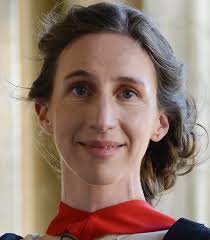
Judith Wolfe
Professor of Philosophical Theology at the University of St Andrews, soon Boston College's Joseph Chair, and expert on eschatology, apocalypticism, and AI's religious resonances.
3
APPEARANCES
1
PODCASTS
Jul 22, 2026

48:24

I spoke to eschatologist Judith Wolfe about how theologians view these concepts Judith is a professor at St. Andrew's University, and she is also the author of a fantastic book called The Theological Imagination.

Judith WolfeGUEST
I think probably what theologians would emphasize would be the goodness of material creation.
Judith WolfeGUEST
What Christian theologians will generally emphasize is that the Judeo-Christian, the Jewish and Christian creation narrative is fundamentally different from other ancient creation myths, in which the material world is often the result of the tearing apart of some divine body, or it's, as for Plato, a sort of a fall into something that's inherently corrupt from which we have to be lifted back up into a spiritual realm, or, you know, as in Stoicism, it's kind of, uh, the, the temporary manifestation of something that will fall back into the logos.
Judith WolfeGUEST
So there are a lot of creation myths in which the physical creation is in some sense either a fall or a blemish or the result of a catastrophe, whereas in the, uh, in the Hebrew Bible, in the Old Testament, physical creation is in a sense the word of God.
Judith WolfeGUEST
And so physical creation is something fundamentally good, which is why Christianity and later Judaism believes not in an immortal soul, but in a resurrection of the dead.
16:12
Okay, back to Judith, who from this inevitable apocalyptic tradition distinguishes between two distinct lines of thought and how they relate to artificial intelligence.
Judith WolfeGUEST
Throughout our entire history since the dawn of Christianity, our expectation has always been for developments for...
Judith WolfeGUEST
Okay, so can I go into this in a little more detail? This is actually really interesting.
Judith WolfeGUEST
Okay, so I think what we have in the Western paradigm is a really interesting duality or tension between the messianic and utopian.
Judith WolfeGUEST
The first is what we might call utopianism, but on the one hand, a basic sense that the world is moving towards an end in a benign sense, so a, a sense of almost teleology, uh, a sense that history has a purpose.
Judith WolfeGUEST
History is moving towards a fulfillment, a new creation, which in some sense is the fulfillment or the consummation of the purpose that was already, always already inherent in the world.
47 MINS LATER
64:04
How have we not learned anything in two thousand-- or learned enough in two thousand-plus years that we might actually now be bringing about a man-caused global flood?
Judith WolfeGUEST
Um, I think what's so fascinating about eschatology is that it points us precisely to the, to the limits of our knowledge because this is all about things which neither speculation nor experience can really give us a clear sense of.
Judith WolfeGUEST
These are not things that we can wholly answer either from out of experience or from out of rational deduction.
Judith WolfeGUEST
It becomes a question of what are the constitutive limits of human knowledge? And in the face of these sort of radical limits of human knowledge about things which are nevertheless hugely significant for humans, how do we live in that, uh, how do we live in and out of that kind of n- unknowing?
8 MINS LATER
40:53
So what has it been like for you as you've been in this field of study as a new potential apocalypse agent has come into being? Has this been a, a- another radical shift, or is it sort of an evolution of the previous one?
Judith WolfeGUEST
We have never created something that has put us in the position both of creator in some way and the potential inferior of, uh, of something that we've created.
Judith WolfeGUEST
But on the other hand, uh, I think this is a version of something that has happened over and over again in Western history.