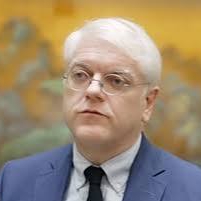
Joseph Gregory Mahoney
Professor of Politics and International Relations at East China Normal University in Shanghai, specializing in Chinese politics, Marxism, and comparative politics.
5
APPEARANCES
3
PODCASTS
Sep 25, 2026


Xu QingduoHOST
That says a lot about the Chinese idea of pushing forward a substantially stable and peaceful relationship between the two countries.

9:06
But let me try to add a frame that I've been developing as I've been studying these two sides.
9:13
You know, for a long time, the United States basically was able to impose its will on much of the world and not entirely on China.
9:21
But, you know, China did sort of set its sails for many decades, according to what it thought it needed to do in order to...
9:29
yet to accommodate right now that changed and that and and that's been changing over the past over the past 10 years but i think we can absolutely date uh the seo meeting last year and the summit the previous summit this year as there is now absolute parity between the two sides now china is still trying to take those concrete steps forward its idea of progress is making those concrete steps forward the u.s is still trying to come to terms with the fact that it can't do business the way it used to.
10:03
Now, its whole system is designed to do business that way, but it has come to the realization that it can't do business that way with China yet.
Xu QingduoHOST
So in what area, what more area, what more can the two sides do probably to lengthen the list of cooperation so as to lay probably more solid foundation for future


Dou HongyuHOST
How has the SEO evolved in responding to the changing regional and global landscape?
3:34
Over the last 25 years, the SCO has moved from a relatively focused security mechanism among six founding members to the world's largest regional organization by geography and population.
3:45
It now has 10 full members and a broader SCO family of roughly 27 countries across Eurasia and beyond.
3:53
Now, it's steadily expanded its agenda Security cooperation against the so-called three evil forces remains central, but economic connectivity, digital, green, and people-to-people cooperation have grown substantially.
4:10
In a period of rising lateralism, protectionism, and uncertainty, The SCO has offered a practical non-block model of partnership.
4:21
It has shown that it can adapt by adding new members, creating new institutions, including the four security centers decided in Tianjin last year, and focusing on both traditional and emerging challenges while keeping the emphasis on consensus and mutual benefit.
Dou HongyuHOST
So why are these new areas increasingly important for this organization? And where do you see the greatest potential for cooperation?
6:28
Well, development has always been central to the SEO, but the character of development is changing.

Xu YawenCORRESPONDENT
What does this latest meeting with US Ambassador to China, David Purdue, tell us about the current state of China-US relations?
15:01
You know, I think it shows that both sides recognize the relationship remains at an important, uh, uh, juncture, and that high-level political guidance is still essential.
15:10
Now, Wang Yi stressed that under the strategic guidance of the two heads of state, the two countries are working to build a constructive relationship of strategic stability.
15:21
At the same time, he was clear China-US relations still face various risks and challenges.
15:28
Now, the key message was that the two sides must earnestly implement the important consensus already reached, focus on a positive agenda, properly manage differences, and, crucially, remove disruptions and overcome obstacles to high-level exchanges.
15:48
It indicates that from Beijing's perspective, the conditions for smooth high-level interactions are not yet fully in place.
7 MINS LATER
Xu YawenCORRESPONDENT
In your view, how much could this issue complicate efforts to stabilize the bilateral relationship? And do you think the two countries can manage strategic competition while maintaining enough cooperation to address shared global challenges?

LovisHOST
you had an increasing number of
32:56
Chinese who were going to Japan because they wanted to figure out what Japan had figured out.
33:03
And as they got into Japan, they started encountering a lot of Western ideas.
33:14
And because the Japanese would translate these concepts into kanji, and because kanji had originated in the Chinese characters, a lot of these concepts start getting brought into China through the Japanese kanji.
33:35
And this was sort of the first introduction of some of the Marxist ideas.
54 MINS LATER
LovisHOST
were saying when you consider what works, it's important to consider what works for whom,
Xu QingduoHOST
What do you think of its longevity, you know, endurability for the past, not only the past decades, but I would say the past 105 years?
9:43
And as you've noted, more than 100 million members, the largest political organization, political party in the world, and by far the most successful in terms of being able to to fundamentally transform and lead a nation forward, not just up from the dregs, but to the forefront of nations.
10:00
I think one of the things that we've seen through time is that while policies have changed, principles have pretty much remained the same.
10:12
But it remains a political organization that has a very clear sense of direction, a very clear sense of principles, a very clear sense of helping liberate the people and serve the people through time.
10:25
We see this, of course, in the early first generation of leadership being expressed precisely by things like serve the people, the mass line from the people to the people, all the way up to the present day where we emphasize people-oriented approaches.
11 MINS LATER