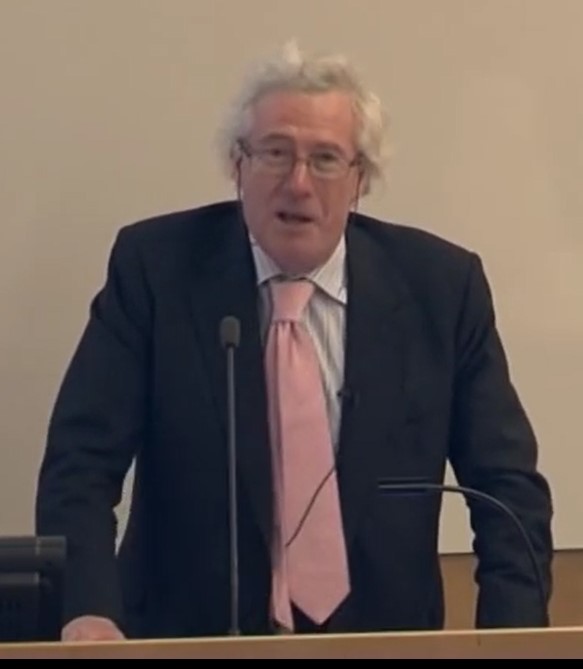
Jonathan Sumption, Lord Sumption
Author and former Justice of the Supreme Court of the United Kingdom
7
APPEARANCES
7
PODCASTS
Oct 16, 2026


Isabel HardmanMODERATOR
Here to speak against the motion is Lord Sumption, and you have seven minutes as well.

Jonathan SumptionGUEST
[audience clapping] We need to start by asking what we mean by free speech.
Jonathan SumptionGUEST
What I mean by free speech is a situation where the state does not seek to control the content of what we say or write.
Jonathan SumptionGUEST
Now, freedom of speech is perfectly consistent with some controls over where and how you exercise your freedom.
Jonathan SumptionGUEST
We are free, uh, to denounce immigration or immigrants, uh, regardless of government policy on the point, but we are not free to incite a howling mob to burn down asylum hostels.
Jonathan SumptionGUEST
We are free to demonstrate against Israel's conduct in Gaza, but we are not free to demonstrate by breaking the windows of banks who deal with Israeli companies.
12 MINS LATER
Isabel HardmanMODERATOR
I'm just gonna kick off this discussion by turning to Jonathan and saying, how can you listen to Kelly Jay's experience and argue that we have free speech in this country? [audience cheering] [audience applauding]


Jonathan SumptionGUEST
Uh, the re- the reason why that's a rational position, uh, is that we all have, uh, our own lists of views that we regard as intolerable.
Jonathan SumptionGUEST
And if it's a sufficient ground for banning an opinion that it's intolerable, then frankly, because we all have different views about what's intolerable, we end up with no free speech at all.
Jonathan SumptionGUEST
The great advantage of the traditional legal view about this matter, that it's, the limitation should be confined to occasions where you are liable to provoke the, a breach of the peace Is that it's a principle which doesn't privilege, uh, some people's views about what's intolerable o- over other people's views.
13 MINS LATER

Charles CotilloHOST
Why, in your opinion, has there been in the past 10 years a, quote, crisis of the party system and in particular a crisis of the conservative party, unquote?
Jonathan SumptionGUEST
Well, that's a reference to the state of politics in the United Kingdom, which is where I come from.
Jonathan SumptionGUEST
It's the result of the collapse of the center, which one can see in the United States, in France, and in a number of other advanced democracies.
Jonathan SumptionGUEST
Brexit has basically taken over the Conservative Party, which is Britain's oldest and historically most successful party.
Jonathan SumptionGUEST
The result has been that the basic problem has been that the The Conservative Party has lost votes at both ends of the spectrum.
15 MINS LATER


Charlie FalconerHOST
Let's not talk about genocide to start with, but can one talk, first of all, when one is engaged in something that might loosely be described as war, what are the international law limitations on the state conducting that war?
Jonathan SumptionGUEST
First of all, there are breaches of treaty law, which essentially means the Fourth Geneva Convention of 1949, which confers extensive protections on civilian populations affected by a war.
Jonathan SumptionGUEST
Secondly, there's a growing category of offenses against customary international law, there is a protocol which Israel has not signed up to.
Jonathan SumptionGUEST
There's a protocol to the Fourth Convention, which essentially codifies what had already become recognized when the protocol was agreed as offences against customary international law.
Jonathan SumptionGUEST
There is finally a broad category which is entirely based on customary international law, a rule about proportionality in war.
27 MINS LATER

Helena KennedyHOST
But, I mean, how do you feel about those courts? Do you hold them in high regard? Well, I

Catrin GriffithsHOST
So Christian and I asked him for his reaction to the president's targeting of law firms.
Jonathan SumptionGUEST
You've got to look at it against the background of other things that Trump has been doing.
Jonathan SumptionGUEST
I mean, for a start, pardoning some 1,500 thugs who had been lawfully convicted of of trying to stage a violent coup on his behalf in January 2021.
Jonathan SumptionGUEST
Then there are the vendettas against officials of the Justice Department who performed their duty by trying to bring him to book for egging them on.
Jonathan SumptionGUEST
There are public figures whom he doesn't like and from whom he has removed all personal protection in a country which is full of guns.
8 MINS LATER

Richard SimmonsHOST
I mean, for those firms that have done deals, how do you see that this should be handled from now on? Has the horse bolted for the profession?


Jonathan SumptionGUEST
Well, clearly, the fact of any constitution, not just the UK's, but the United States as well, depends on conventions about the use of power in order to work.
Jonathan SumptionGUEST
So in that respect, the United Kingdom is neither particularly strong nor particularly vulnerable.
Jonathan SumptionGUEST
But I think that the critical point here is that the United Kingdom has a parliamentary system, whereas a presidential system operates quite differently under the US Constitution.
Jonathan SumptionGUEST
The entire public service is responsible to the President and not to Congress.
Jonathan SumptionGUEST
The President is not responsible to Congress except by way of impeachment and obviously by virtue of the fact that he depends on Congress to vote him the necessary funds for what he wants to do.


Jonathan SumptionGUEST
But I don't necessarily agree that the problem is that they pursue their own interests.
Jonathan SumptionGUEST
I think the problem about representation is a different one, which is that the representatives are bound to differ quite a lot from the people who elected them.
18 MINS LATER
26:59
So why are populist leaders getting somewhere when any long-term experience of them whatsoever is going to presumably show what you're saying, that they don't represent everybody's will, they represent their own? Well, I don't think it's true that they