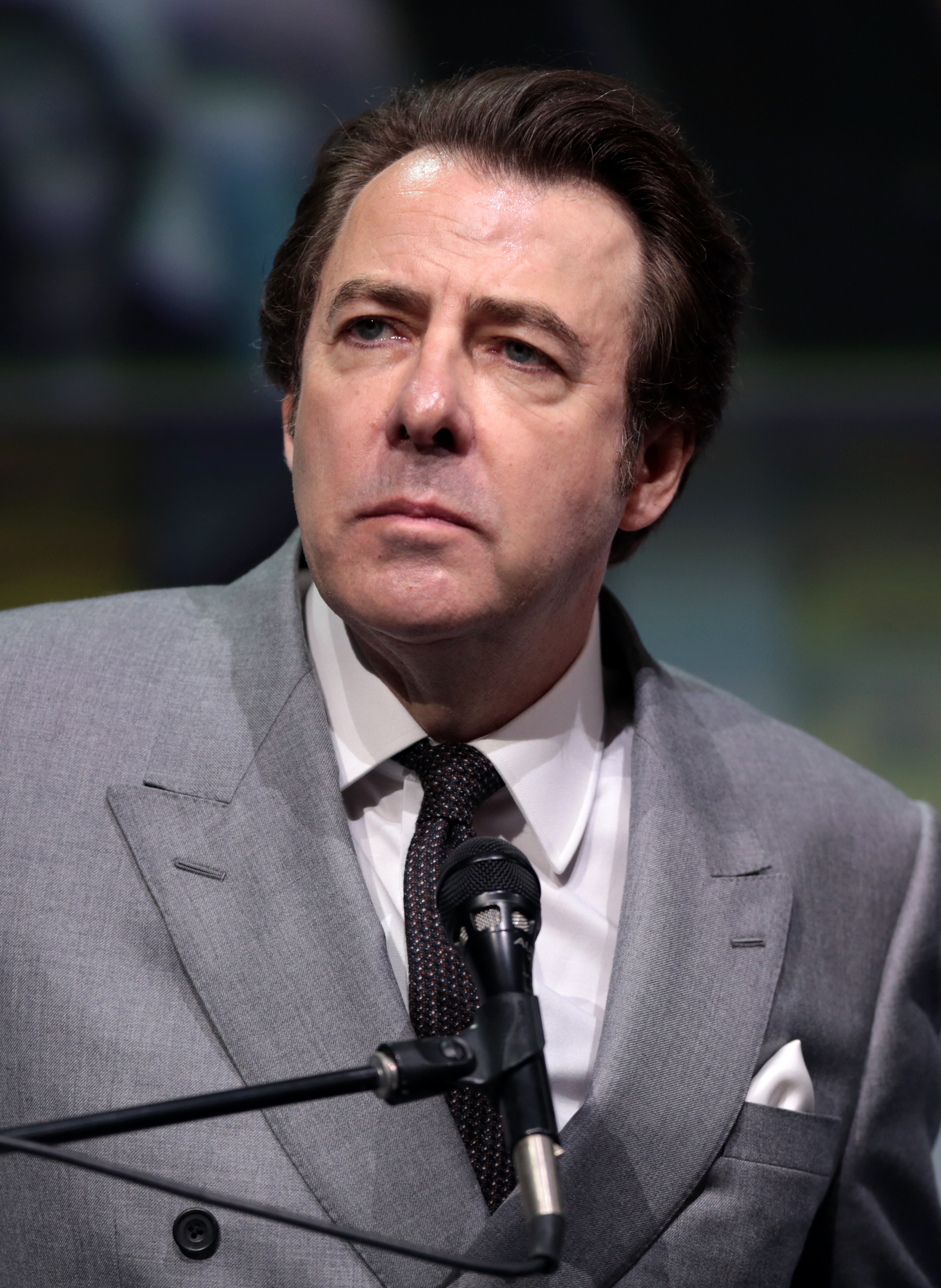
Jonathan Ross
Broadcaster and TV personality
9
APPEARANCES
7
PODCASTS
Oct 26, 2026


Jonathan RossGUEST
He said you do not talk about fight cover you don't talk and then he says there No, please really don't Thank you and then punches the guy but those first ones there that no shirts no shoes no weapons That's not fight.

speaker_8ADVERTISER
I think he liked it.


Stephen MerchantHOST
What, what's going on here then? I, I mean, why are you dropping off tickets?
Jonathan RossGUEST
Well, because, you know, in the, in the spirit of the N- the Comedy Awards, we like to have the rising young stars of the British Comedy Awards.
Jonathan RossGUEST
And I, I wanted to deliver the tickets personally, so there's no excuses if he doesn't turn up later.

Jonathan RossGUEST
We were already struggling to keep up with what we needed to implement 'cause this was pre...
Jonathan RossGUEST
We had to write a, a very special compiler in, that had never been written before that didn't require human beings to write what are called kernels.
Jonathan RossGUEST
No one had ever done this, and our architecture didn't work with kernels the way everything else worked.
14 MINS LATER

David SenraHOST
Like, I don't think we've done a good enough job of telling, like, a more positive story.


Jonathan RossGUEST
IBM is going to have their sellers sell Grok SKU, and so now you'll be able to directly access our speed.
Jonathan RossGUEST
The advantages that we offer, you could think of it a little bit like offering broadband in the era where dial-up wasn't fully rolled out and people were still trying to connect to the internet.
Jonathan RossGUEST
Just imagine if you were to offer broadband and you charged more per bit of data that was sent over the line, it would be uneconomical.

Caroline HydeHOST
Jonathan, does this capacity already exist? Or are you supply constrained still? You've got to go out and build it, either in Saudi, Finland, here in the States? Yes.

Jonathan RossGUEST
I think one of the problems in building your own chip, first of all, everyone thinks that building the chip is the hard part, and then as you do it, you start to realize building the software is the hard part, and then as you do it, you realize keeping up with where everything is going starts to become the hard part.
Jonathan RossGUEST
I have no doubt that eventually Anthropic will be building their own chips, that every hyperscaler will build their own chip.
Jonathan RossGUEST
I had this experience when I was at Google where I got a lab tour, and this was before AMD was doing a great job, right? AMD was struggling for a little while and now they're doing great, but they had built 10,000 servers, and those 10,000 servers of AMD chips, I was walking through the lab, and they were pulling the servers out of the racks, taking the AMD chip, popping it off, and throwing it in a trash can.
Jonathan RossGUEST
The funny thing was, it was almost preordained because everyone knew that in that generation Intel was gonna win.
Jonathan RossGUEST
So, why did Google build 10,000 servers? Because they wanted to get a discount on the Intel chips they bought, and when you're at that scale, the cost to design your own server, 'cause they had to design their own motherboard in order to fit the AMD chip, and to build that out and test it, versus the discount that you get, totally worth it.
6 MINS LATER

Harry StebbingsHOST
... possible, and then minimize operating cost so that you can shed less performant chips faster.

JohnHOST
Mm-hmm.
Jonathan RossGUEST
The trade-off we have is memory capacity, but GPUs have a memory bandwidth issue.
Jonathan RossGUEST
So, what the researchers do to improve the memory bandwidth issues always improve the memory capacity issues for us, um, so we can run all the same models with the same context length.
Jonathan RossGUEST
Um, you can think of us a little more as a nuclear reactor instead of thinking of us as a diesel generator.
Jonathan RossGUEST
Whereas GPUs, you can take just eight GPUs and use them, uh, for a model, we need a lot more of our LPUs.
Jonathan RossGUEST
But when we're running that model, very much like a nuclear reactor, we get much better cost and it's better for the environment 'cause we...
13 MINS LATER
JohnHOST
Um, can you give me, uh, your, uh, retrospective but also your current take on just Moore's Law broadly?
Jonathan RossGUEST
It's possible, but if I was them, I would avoid it because I wouldn't wanna give the customers of mine...
Jonathan RossGUEST
It would be like being a, um, automotive, a, a, a car company and then creating your own taxi service.
Jonathan RossGUEST
You're now competing directly with your customer, right? And I think tech companies love to do this.
12 MINS LATER
Harry StebbingsHOST
Is he losing a step by being so focused on safety when bluntly his competitors are talking about product?
Harry StebbingsHOST
And so can you just help me and help the audience understand, what is distillation in this regard, and how have DeepSeek been using distillation to get better quality output through OpenAI data?
Jonathan RossGUEST
It's a little bit like speaking to someone who's smarter and getting tutored by someone who's smarter.
Jonathan RossGUEST
You, you actually do better than if you're speaking to someone who's not as knowledgeable about the area or giving you wrong answers.
Jonathan RossGUEST
First of all, before we get into any of this, I, I need to start with the scaling laws.
Jonathan RossGUEST
These are like the physics of LLMs, and there's a particular curve, and the more tokens, which are sort of the, sort of the syllables of an LLM, they don't match up exactly with human syllables, but kind of.
31 MINS LATER
Harry StebbingsHOST
And the MoE approach, just so I understand, is, like, the segmentation of where information goes, so it's routed to, like, the optimal point of the model.