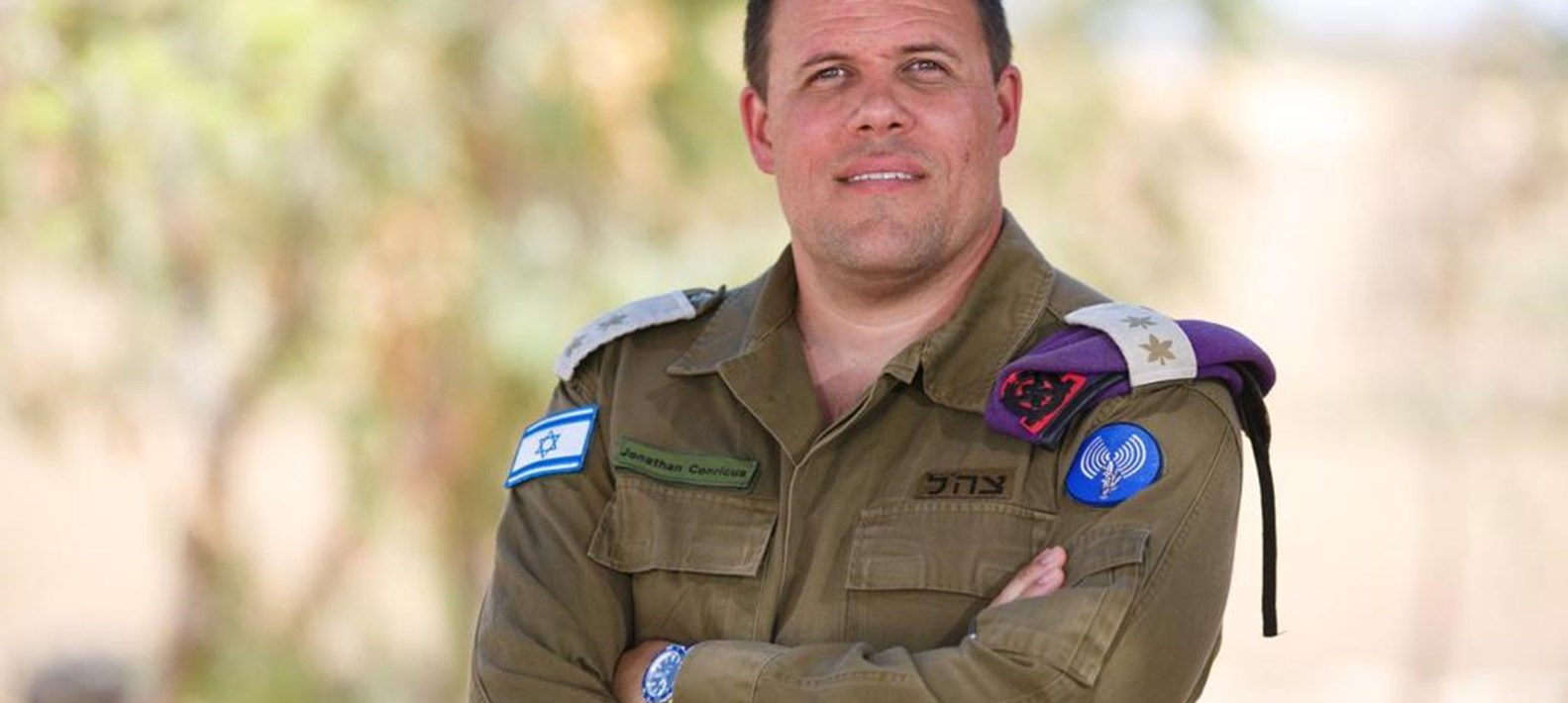
Jonathan Conricus
Swedish-Israeli spokesperson
53
APPEARANCES
20
PODCASTS
Sep 25, 2026


Nick FerrariHOST
To those who are saying this was really a speech aimed more at the domestic audience in Israel than a global audience, because Prime Minister Netanyahu has those elections coming up, how fair is that? Good morning.
Nick FerrariHOST
But what is the point, Mr. Connery, because you would want to get out concerning Hamas for my listeners here in the United Kingdom?


Jonathan ConricusGUEST
They are people who either, uh, uh, fought through October 7 and the aftermath of October 7, or saw everything happen and have heard what our neighbors intend for us, what Hamas intends for us, and what Hezbollah and, uh, Shiites in Lebanon, what the Iranians intend for us.
Jonathan ConricusGUEST
You're, by the way, speaking about the age of my children, and I have two of my kids, they will be voting for the first time in Israel.
8 MINS LATER


Jonathan ConricusGUEST
Uh, what I will say is, uh, not ag- not directed against Muslim, uh, private citizens.
Jonathan ConricusGUEST
It's more related to the political structure and the core tenets of Islam, um, and the mindset, the very aggressive and imperialistic mindset which we in the Middle East are at the receiving end of when it comes to Islam.
Jonathan ConricusGUEST
I think that shortly put, this is today the biggest threat to Western civilization.
Jonathan ConricusGUEST
I think it is much more dangerous than Nazism and communism were at the time, for the main reason that the threat is more dynamic, it is clever and deceptive, and it's not so clear to distinguish, and you really have to pay attention if you want to understand what the threat is.
Jonathan ConricusGUEST
Uh, in the seventh century when Islam conquered about half of the known word- world or q- or a third of a known world, uh, by force, by the power of the sword, it was jihad and conquest with the power of the sword.
Jonathan ConricusGUEST
In the 21st century, what's happening in Europe is that it is a slow, relatively peaceful, relatively legal conquest by immigration and then by birth rate.
37 MINS LATER

Jonathan ConricusGUEST
So the way I look at it is that there are a lot of people who have a lot of vested interest with the Iranian regime.
Jonathan ConricusGUEST
Um, and I think that eventually, um, the Iranian regime will run out of money.
Jonathan ConricusGUEST
But the Iranian regime is running out of money, and I think it-- what the US is doing, uh, despite, you know, an international pressure campaign in the media and from various Iranian mouthpieces that is trying to apply pressure on the president.
14 MINS LATER
Nick FerrariHOST
Noting your criticism of the prime minister, and you're not alone in that, how should the situation have been handled yesterday in your view?
Jonathan ConricusGUEST
view?Well, I think what Israel is doing, Israel is first and foremost complying with the, with the, the Resolution 280-- uh, twen- 2803.
Jonathan ConricusGUEST
Israel is operating on its side of the yellow line, and without political fanfare, Israel has significantly reduced the amount of targeted assassinations of, uh, Hamas terrorists in the Gaza Strip at the request of the Americans.
Jonathan ConricusGUEST
And that is not because Hamas has become nice and they shouldn't be eliminated, but because the Americans have asked Israel to, uh, operate less, and Israel is, uh, respecting that.
Jonathan ConricusGUEST
But Israel is in this kind of catch-22 situation because from the perspective of an Israeli military or political decision maker, they-- Israelis cannot just venture the future safety of Israelis on international goodwill and what other countries want.
1 HR 59 MINS LATER
Nick FerrariHOST
Now, in the first hour of the show, I was joined by former IDF spokesperson, senior fellow of the American think tank, the Foundation for Defense of Democracies, and Reserve Lieutenant Colonel Jonathan Conricus, who told me-
Jonathan ConricusGUEST
... to communicate with both sides and to be respected by both sides, and that's pretty rare.
Jonathan ConricusGUEST
And I think that it's a good thing that he's-- he agreed to take on the probably very Sisyphean and thankless task of, of chaperoning and pushing the board of peace forward.
Jonathan ConricusGUEST
I think it's, you know-- The problem is, and it's been for many years, that Israel under Prime Minister Netanyahu doesn't present a plan, a strategic plan regarding Gaza, and that creates a void.
Jonathan ConricusGUEST
And as you said, there are many eager participants, eager players, Qatar and Turkey being two, but they're not the only ones.
Jonathan ConricusGUEST
The Iranians tried for a long time to do it and succeeded with the Islamic Jihad, Palestinian Islamic Jihad, and had other influences.
25 MINS LATER

Jonathan ConricusGUEST
I think a lot of people in Israel, and probably many Gazans, want this s- to succeed desperately.
Jonathan ConricusGUEST
I think a lot of people would want to see Gaza demilitarized, Hamas' weapons taken away, and a new type of leadership in Gaza strike root, one that isn't about jihad, that isn't about fighting with Israel, but is about, uh, respectful coexistence.
Jonathan ConricusGUEST
And I think that it'll have, uh, strong support in Israel, um, once Hamas is indeed disarmed.
Jonathan ConricusGUEST
And here really is the core issue because, you know, we have experience with Hamas.
Jonathan ConricusGUEST
There's a, a concept in, uh, Islamic teachings called Hudnah, which means basically a pause, a pause in hostilities.

Ayesha HazarikaHOST
I- is that likely to, to happen or, or, or may Israel do a, a, a similar thing, say that they're going to withdraw and then spring again if, if need be?
Jonathan ConricusGUEST
I think it would be damaging for what was referenced as the American Empire.
Jonathan ConricusGUEST
I think that weakness in one area is quickly, uh, seen and understood by enemies all around the world, and if you're weak in one area, you are deemed to be weak in another area as well.
Jonathan ConricusGUEST
And, uh, I know this from, you know, from the local microenvironment of the Middle East, where we fight various enemies.
Jonathan ConricusGUEST
If we are perceived as weak by one of our enemies, then the others will perceive us as weak as well, even if we aren't.


Sharri MarksonHOST
Jonathan, what do you think of Mamdani's comments and his attempts to arrest Bibi?
Jonathan ConricusGUEST
For those who haven't watched and are not aware, the man who issued these indictments, the prosecutor Karim Khan, has been eliminated from his post.
Jonathan ConricusGUEST
He's been sacked on accounts of sexual misconduct, basically having sex with one of his subordinates against her will.
Jonathan ConricusGUEST
And those allegations were coming up pretty close to when he made the fatal decision to indict and to use this terrible power that he had at his hands and to accuse the Israeli prime minister of these horrible crimes, which, of course, are categorically false.
Jonathan ConricusGUEST
And, you know, Mamdani, I just checked, I think it's 32 million views and it hasn't even been 12 hours since he posted that video.

Mario NawfalHOST
So my first question to you, Jonathan, is do you think that is genuinely being considered? And more importantly, should it be considered? What do you recommend Trump should do right now?
Jonathan ConricusGUEST
The people who brought the American president, the MOU, have delivered something that's faulty, broken and not serving the interests of the US, which is something that I said the moment the first draft was leaked, that it's a horrible, horrible deal that serves the Iranians.
11 MINS LATER

Jonathan ConricusGUEST
Well, it can go many ways, and I think we've reached a bit of a moment of truth for the Iranian regime.
Jonathan ConricusGUEST
They got an amazingly comfortable MOU from the US administration, which basically gave the Iranian regime everything that they needed and postponed dealing with all of the tough topics that the US needs to deal with, except for opening the Strait of Hormuz.
Jonathan ConricusGUEST
But then the Iranian regime, what I sensed what happened, they got greedy and they said, we want more.
Jonathan ConricusGUEST
We want to dictate the terms of the passage of the Hormuz Strait in contradiction to the MOU.

Libby ZnaimerHOST
Now, the reaction now, we're seeing huge, vast crowds, you know, chanting death to America, death to Israel for Khamenei's funeral so my question is obviously they're staged but what is the level of the reality of that


Vivian BerkovichHOST
Do you think that's a possibility or that Trump just threw Vance in there and said, you know, get the job done, sonny boy?
Jonathan ConricusGUEST
Yeah, I don't know, but I think that there's definitely merit to that thesis.
Jonathan ConricusGUEST
And if this deal fails, which I think it will, I think the Iranians will violate it, and I think eventually this MOU will result in failure.
Jonathan ConricusGUEST
Because it is lopsided, it's rotten from the foundation and upwards, because it is conceived by illegitimate, corrupt Islamist regimes.
Jonathan ConricusGUEST
And I think it won't have staying power because it's a horrible document that doesn't do the world, the Arab countries in the Middle East and the Persian Gulf area, or Israel, or the U.S. any good.
Jonathan ConricusGUEST
It bolsters the credibility of the Islamic Republic of Pakistan, and it puts the Islamists in Qatar back in the global limelight.
39 MINS LATER
Vivian BerkovichHOST
even addressing ballistic missiles, which seems to have been totally taken off the agenda.

Jonathan ConricusGUEST
I think what Israel is trying to do is to defend itself and live in peace in its internationally recognized borders without the attack of Iranian proxies, Hezbollah being the most dangerous and, uh, best-armed one.
Jonathan ConricusGUEST
Hezbollah is now in trouble, and that's why their masters, the Iranian regime, is they're rushing to defend and trying to save Hezbollah, and that is what this is about.
Jonathan ConricusGUEST
The Lebanese people, by the way, are represented by the Lebanese government, and the Lebanese government says very clearly that they don't want Hezbollah as an armed foreign entity in their country and that Hezbollah doesn't have the legitimacy to fight against Israel.

Nick SchifrinHOST
Jonathan Conricus, you're shaking your head, just in the last minute that we have.

Jonathan ConricusGUEST
I think what Israel is trying to do is to defend itself and live in peace in its internationally recognized borders without the attack of Iranian proxies, Hezbollah being the most dangerous and, uh, best-armed one.
Jonathan ConricusGUEST
Hezbollah is now in trouble, and that's why their masters, the Iranian regime, is-- they're rushing to defend and trying to save Hezbollah, and that is what this is about.
Jonathan ConricusGUEST
The Lebanese people, by the way, are represented by the Lebanese government, and the Lebanese government says very clearly that they don't want Hezbollah as an armed foreign entity in their country and that Hezbollah doesn't have the legitimacy to fight against Israel.
Nick SchifrinCORRESPONDENT
Jonathan Conricus, you're shaking your head just in the last minute that we have.

Jonathan ConricusGUEST
I think what Israel is trying to do is to defend itself and live in peace in its internationally recognized borders without the attack of the Iranian proxies, Hezbollah being the most dangerous and best armed one.
Jonathan ConricusGUEST
Hezbollah is now in trouble, and that's why their masters, the Iranian regime, is they're rushing to defend and try to save Hezbollah.
Jonathan ConricusGUEST
The Lebanese people, by the way, are represented by the Lebanese government.
Nick SchifrinHOST
Jonathan Karikas, you're shaking your head just in the last minute that we have.
Jonathan ConricusGUEST
... important topics, what are the details regarding their nuclear weapons, regarding their, um, proxies in the region.
Jonathan ConricusGUEST
But the Israeli perspective is different because we, like most other people here, have skin in the game.
Jonathan ConricusGUEST
We have been at the receiving end of Iranian aggression for the last 35 years.
Jonathan ConricusGUEST
Israelis have been killed and abducted and burned and murdered by Iranian proxies.
Jonathan ConricusGUEST
Isra- Israelis have been forced to run for shelter for so many years by rockets that were either made in Iran or paid for by Iran.
Jonathan ConricusGUEST
And Iran has waged indirect warfare using Arabs as their cannon fodder against Israel for a very long time.
13 MINS LATER
Libby ZnaimerHOST
But some of the critique that I've been reading is saying that, well, first of all, it has to be negotiated over 60 days and that the safeguards are less than they were in the Obama deal.
Jonathan ConricusGUEST
I think we have to acknowledge, and I apologize if this has already been said by one of the esteemed colleagues of the panel here, but I think we have to acknowledge that we are at an information deficit.
Jonathan ConricusGUEST
Sadly, the side that is communicating more, and I think a bit more convincingly, is the Iranian regime, whereas the U.S. administration isn't really informing not the American public and not its allies and not the world what exactly the terms of the understanding are and that's a bit worrying but we still have to you know I think be patient and recognize the fact that we don't have the details yet and we don't know exactly what Even on the big topics, and the devil really is in the details here, even on the big, very important topic, the primal topic of Iranian nuclear weapons ambitions, what does it exactly mean? Will they be able to continue to enrich on Iranian soil? Will they be forced to let go of the already enriched material? Is there any type of a sunset clause? Is this limited by time? And if so, how much? These are very pertinent questions that really will determine how good or how bad this deal is and what the chances of regional confrontation, a weapons race, and all of the other negative things associated with the nuclear Iran, all of that will be determined by the details, which we still do not have.
Libby ZnaimerHOST
he might get the political, I don't know, the political result quickly and then kind of lose interest?
Jonathan ConricusGUEST
Yeah, I mean, the Iranians, the Iranian regime isn't going to lose interest.
Jonathan ConricusGUEST
And whether or not this corresponds well with the U.S. election cycle or doesn't, us too, we are going to continue to fight it out.
Mario NawfalHOST
So there's a few questions there from why you think it's interesting Israel was not involved, US not intercepting missiles towards Israel, and your thoughts on that back and forth between Israel and Iran.
Jonathan ConricusGUEST
Yeah, I think the important context here is the state of play in Lebanon and the level of exposure of Hezbollah, Hezbollah's weakness, and what a concern that is for the Iranian regime.
Jonathan ConricusGUEST
Hezbollah used to be the coveted crown jewel of the Iranian empire of proxy organizations that they have spent billions and billions of dollars over the years in building, arming, equipping, and sustaining.
Jonathan ConricusGUEST
It is exposed to steps by the Lebanese government which have the potential to really change the balance of power in Lebanon, and the Iranian regime doesn't want that.
Jonathan ConricusGUEST
What the Iranians tried to achieve last week was to set an equation whereby Israel is limited, restricted from continuing to strike Hezbollah and restricts Israeli freedom of action against significant and strategic targets of Hezbollah, mostly in Beirut, but also in the Bekaa Valley.
9 MINS LATER
Mario NawfalHOST
If you look at it from a lens as a non-former IDF, so putting your position aside, looking at it, actually if you look at it from an American lens, if you were an American, do you think it's a bit odd? Do you think it's in America's favor or it should be worded differently? What's your stance on it?


Jonathan ConricusGUEST
Uh, I would add to what you already said, I think two important, uh, data points.
Jonathan ConricusGUEST
One is that, uh, after Israel was told not to retaliate, and after the Iranians, uh, fired at Israel 30 ballistic missiles, all of whom were either intercepted successfully or were allowed to, uh, explode in, uh, in open areas in various parts of Israel, so no damage.
Jonathan ConricusGUEST
But the important point is that what's happening now in, uh, southern Lebanon and central Lebanon and in other places is that the IDF continues to target Hezbollah infrastructure, uh, personnel, and, uh, commanders.
Jonathan ConricusGUEST
And that was kind of really the, the first thing that Israel wanted to achieve, is to continue and to preserve its freedom of action against Hezbollah.
18:39
I mean, t-tell us how we're supposed to read this from an Israeli military perspective.
Sharri MarksonHOST
Now, firstly, what do we know of this phone call between the pair? What is true and what's been exaggerated?
Jonathan ConricusGUEST
And I think that the bottom line, having heard and listened to and read a lot of reports, is that it was indeed a heated conversation.
Jonathan ConricusGUEST
between the two leaders, and it suggests that there is certain strain and differences of opinion between where the U.S. stands and where Israel stands.
Sharri MarksonHOST
So is the sentiment on the ground that Israel should continue to attack Hezbollah and Iran as well?
Mario NawfalHOST
There's a lot of points there, but I'd love to get your kind of deep analysis of what we're seeing there on the front line.
Jonathan ConricusGUEST
Let's start with the strategic, uh, US-Iran regional, and then focus on the situation on the ground between Israel and Hezbollah.
Jonathan ConricusGUEST
Then I think we should speak about the Lebanese Armed Forces, what they're doing and mostly what they're not doing.
Jonathan ConricusGUEST
And, uh, we'll discuss, you know, w-what-- the, the bottom line of it, uh, what all that means, and what we could anticipate in the coming days and weeks moving forward.
Jonathan ConricusGUEST
Uh, strategically speaking, I think everybody's waiting for President Trump and the Iranians to either agree or to disagree.
27 MINS LATER

James MenendezHOST
I put it to him that although Benjamin Netanyahu says seventy percent of Gaza, is it, as he hinted, a first step towards total occupation of the territory?
Jonathan ConricusGUEST
I would suggest to look at it through a prism of trying to apply pressure on Hamas as part of negotiations.
Jonathan ConricusGUEST
As clearly stated before, very generous offers have been made by the Board of Peace and by the Hamas-friendly nations of Qatar, Egypt, and Turkey for Hamas members to disarm, which according to the UN Security Council resolution and the Trump peace plan, they were supposed to do as first step.
Jonathan ConricusGUEST
Since they're refusing, we're still stuck in very basic mode, and I think what Israel is trying to do and what the prime minister is trying to do is to apply pressure and indicate that if you don't agree to do what you're supposed to do and what the, uh, negotiators and the previous leadership of Hamas said that you will do, then we will apply more pressure.
Jonathan ConricusGUEST
Pressure in this sense will be to temporarily take and hold on to more territory and as Gershon said before, perhaps allow people in Gaza to filter through into the Israeli-controlled area and then to start rebuilding there outside of the control of Hamas.
James MenendezHOST
They may not be able to stay if there is, is-- there's, there's no, no possible chance of existence in what's left of Gaza.
Jonathan ConricusGUEST
When we look back at the situation in Gaza, when you think of it for a second, and I know that this will be a hugely unpopular thing of-- for listeners to hear, but the only population in modern times that was prevented from leaving an active war zone are Arabs in Gaza.

speaker_1NARRATOR
Army spokesperson Jonathan Conricus was stationed here for a long time.
Jonathan ConricusGUEST
What you see behind us is really, think of it as a highway, as a smuggling highway for Iran, by which Iran transfers missiles, component, infrastructure, machinery to produce or to convert.
Jonathan ConricusGUEST
All of that is transported from Iran, Iraq, via Syria, and the very areas that you can see close to the Syrian-Lebanese border.
speaker_1NARRATOR
Based on what we know, Carl Lee's businesses have been instrumental in the development of these very same projectiles.
Jonathan ConricusGUEST
What Hezbollah will try to use are precision-guided missiles for the most sensitive and high-value targets, like our port, our airport, government facilities, hazardous materials.
8:31
How are we to understand the way in which the Israelis are viewing the talk of, um, diplomatic breakthroughs or some kind of a deal that would probably keep the regime in place?
Jonathan ConricusGUEST
Uh, so I'd say that I'll try to reflect, you know, general sentiment and what people in Israel are speaking about and feeling with regards to the situation against, uh, the Islamic Republic.
Jonathan ConricusGUEST
I'd say it's, it's, it's, it's a challenging moment for Israelis because I'd say that a lot of people had, and perhaps many still do, have a lot of faith in the president, in President Trump, and his administration, uh, based on his track record, uh, leading up to this current situation.
Jonathan ConricusGUEST
But this is a very challenging moment because based on almost everything, uh, that is, uh, leaked or provided to international and Iranian and Israeli media, most of it isn't good from an Israeli perspective in the sense that, you know, it keeps the regime in place.
Jonathan ConricusGUEST
There's very little or no actual talk about Iran's ballistic missile program, their long-range drones, and very importantly, their continued support of terror organizations in the region, Hezbollah, Hamas, Islamic Jihad, the Houthis, e-et cetera.
14 MINS LATER

speaker_4UNKNOWN
[laughing]
Jonathan ConricusGUEST
And, uh, uh, a-a-and in that sense, let's speak a little bit ab-about where we stand.
Jonathan ConricusGUEST
Um, forgive me if it is abrupt and ugly and leaving you with a sense of, "Oh God, is it that bad?" But with, uh, a short time, I'll have to be, uh, focused in, in the, the messages.
Jonathan ConricusGUEST
Let's go to the front, where I think the biggest challenges lay and where I think we are the furthest away from where we would like to be despite efforts that we have made, and that's Gaza.
Jonathan ConricusGUEST
Gaza, I wouldn't say that we're at square one, but I would say that despite all the blood, sweat, and tears and sacrifice by young, brave Israelis in Gaza, and despite the fact that we are very happy and, and, and tremendously thankful for having our hostages back, today the situation in Gaza is that Hamas governs a little bit less than half of the, uh, of the terrain and, um, and Israel controls and is operating in what's, uh, in what's left of it.
Jonathan ConricusGUEST
Uh, basically, there's a rump state of, uh, of Hamas along these lines, including, uh, Gaza City up there.
13 MINS LATER

Scroll for more appearances