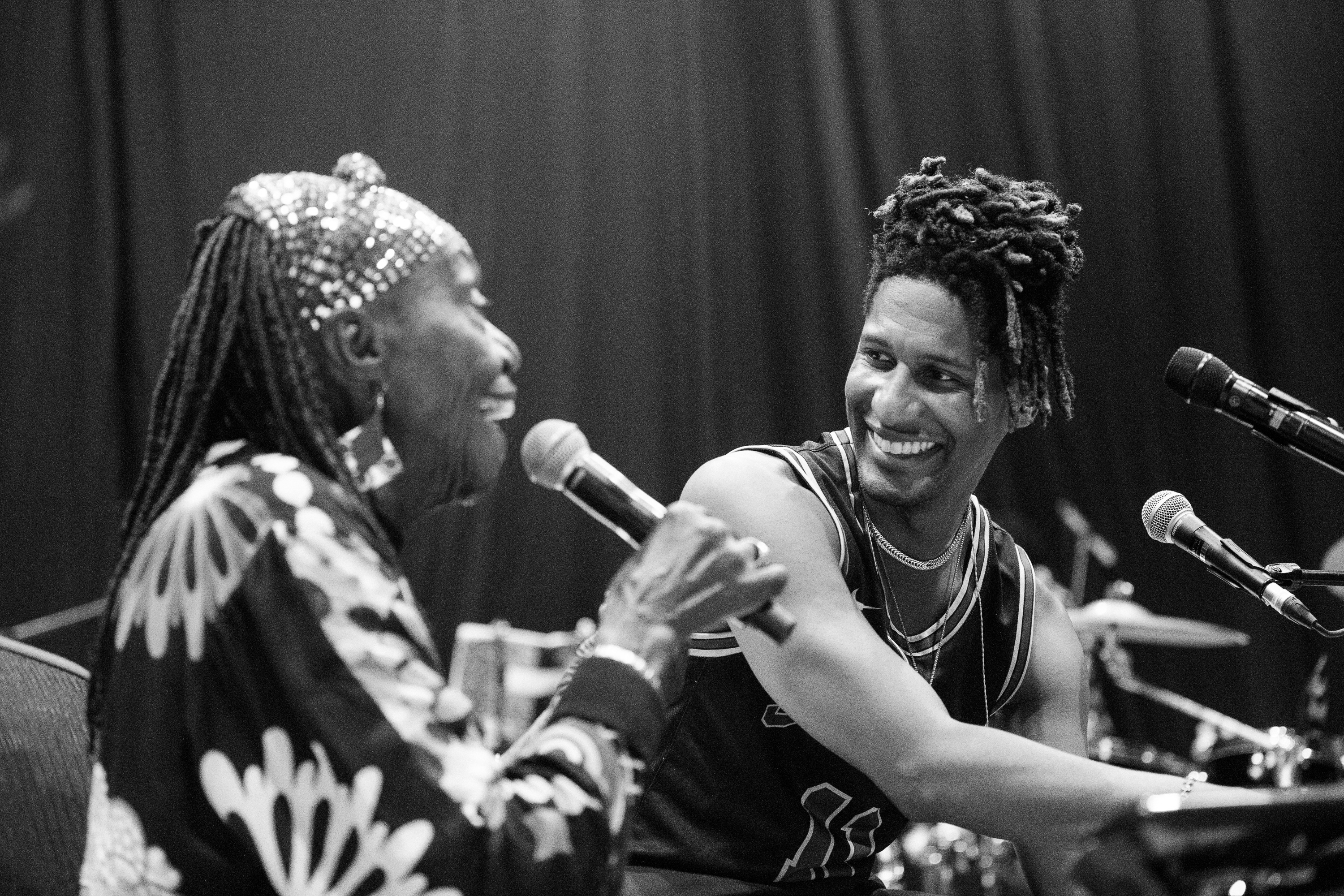
Jon Batiste
American musician and songwriter
19
APPEARANCES
18
PODCASTS
Oct 28, 2026


Jon BatisteGUEST
What you gonna do for us? Man, there's a tune, speaking of some of my early mentors, there's a left hand.
28 MINS LATER


Jon BatisteGUEST
Well, I've been thinking about Monk forever, but the piano and then Monk, I spent a year almost exclusively listening to The Loneliest Monk.
Jon BatisteGUEST
Like, I would listen to it every day, and I would listen to all of the things that I could find, whether it's documentaries, interviews.
Jon BatisteGUEST
You know, when I was 19, I was first touring in Europe, and I'd find all of these, like, bootleg Denmark concert, 1966, The Loneliest Monk.
12 MINS LATER


Jon BatisteGUEST
So you're seeing the physical representation of that on my face, I guess, or my body.
6 MINS LATER

Jon BatisteGUEST
You know, the folks who know James Booker know he's a genius, but he's so unsung.
Jon BatisteGUEST
And he was from New Orleans and he died untimely and really kind of became an obscure figure outside of New Orleans and outside of, you know, music connoisseurs like ourselves.

Jon BatisteGUEST
He's really got such a beautiful melody here that is, is, is going to really connect to that gospel tradition, and it connects to the spirituals and the tradition of that music, as well as the blues.

23:59

Whereas what you've done is shown that there is a direct link between Mozart and Thelonious Munch or Duke Ellington, that some of their compositions, if you break down those compositions, they're as towering as anything that Bach or Mozart ever did.
Jon BatisteGUEST
What we call canon and what we call classical needs to constantly be reevaluated.
Jon BatisteGUEST
And we have to look at it and say, well, the black American classical music, gospel, jazz, soul, blues, and all the expressions that came after that, that's also not classical, that's canon.
Jon BatisteGUEST
That is a part of the greatness of human achievement and the lineage of human creativity.
Jon BatisteGUEST
So let's look at it and assess it and create things that bridge the two worlds, because they're actually not separate worlds.

Nate BurlesonHOST
What is your ideal sort of state of listening to music? Because you spend so much of your life creating it.


Jon BatisteGUEST
The feeling of being a child and being alive, being in your body and being on the earth and moving around and thinking thoughts and realizing things for the first time and that innocence of all that is in Mozart's music.
Jon BatisteGUEST
It's something that immediately is embracing you, and that's a very childlike quality.
Jon BatisteGUEST
There's an innocence to it that almost defies your realizing how complex it is until you start to study it, until you start to take it apart and really understand.


Jon BatisteGUEST
... beat of a drum, in the chord, a, a melody, a lyric, it just brings you to a realization of, wow, this is what we've been through.
Jon BatisteGUEST
It's the universal language, not just because you don't have to speak music to understand it and feel it, but it's universal in that it touches all of the universal human experience in one vibration.


Abby LloricoHOST
The eight-time Grammy Award winner tells St. Louis Public Radio why he's putting his own spin on the work of classical composers.
Jon BatisteGUEST
I really enjoyed making Beethoven Blues because he has so much pathos, so much of his personal pain in the music that there's so many emotions you can draw from to pull out the blues, that you could immediately feel it.
Jon BatisteGUEST
[playing piano] In the first few notes of Fur Elise, I was like, "Oh, that's pain.
Jon BatisteGUEST
[playing piano] You know, I don't even believe in genre terminology to begin with, but I think that the idea of classical music now can extend.
Jon BatisteGUEST
What about Black American classical music like jazz and blues and R&B and funk? [laughs] Why is this music not classical? [playing piano] I think about Black Mozart, and I think about Beethoven, and I think about what they would have done with the color palette of Black American classical music.
Jon BatisteGUEST
What would they have done with those sounds and those conceptions? [playing piano] With Mozart, that is a different spirit.


Linsey DavisHOST
What was it like for you to perform the national anthem in New Orleans at the Super Bowl in 2025?
Jon BatisteGUEST
I love, love performing and the honor of being chosen to do it, not just for the Super Bowl, not just the national anthem, but in my hometown.
Jon BatisteGUEST
Um, and really, an anthem to me is supposed to be a song, a, a theme, a tune that unites and brings people to a sense of pride about our collective identity.
Jon BatisteGUEST
And when that's in a place where there's misalignment and we don't see eye to eye about our identity and about the way that things surrounding our collective function, then I believe you should be in conversation with that theme, that tune, and reflect that in the tune.
12 MINS LATER

Jon BatisteGUEST
Hands like mine, experiences like growing up in New Orleans and learning from the great Alvin Batiste and Ellis Marsalis, and studying the history of things that he wasn't around for.
Jon BatisteGUEST
And not from the perspective of taking anything away, but we're continuing, we're adding to the continuum of human creativity.
Jon BatisteGUEST
He had a lot of philosophical things that he would say that really helped shape my understanding of, of music.
Jon BatisteGUEST
One of the things he would say all the time was, "The genius is the one that's most like themself."


Jon BatisteSOUNDBITE_SPEAKER
[harmonica playing] And it's gonna be a beautiful day, and I'm very excited.
Jon BatisteSOUNDBITE_SPEAKER
[harmonica playing] And I think we pulling up to the house right now.
7 MINS LATER


Jon BatisteGUEST
I can express the depth of humanity of this individual in every choice that she makes, the integrity of every choice, the purity of the intention of every choice, and how it's never forsaking the path to true north of the first intention, the pure intention of the work.
Jon BatisteGUEST
It's never forsaking it for money, for fame, for any sort of accolade or trend that could come and just disrupt the signal.
Jon BatisteGUEST
It's the most pure intention of anyone that I've ever seen create, and I'm talking about from legendary people who I've been in the room with in any genre of creativity.
Jon BatisteGUEST
The toil of, of the craft that it takes to really know exactly what you're saying, exactly what you're doing, to know your stuff to the point where you just know it cold.
14 MINS LATER

speaker_4ADVERTISER
Yeah, it's in the hands of the creator.
Jon BatisteGUEST
The creator, the musician, the creator, the vision of the creative person can take a spoon, you know.


Suleika JaouadGUEST
... um, in, in the school setting that we were in, but for, for future me, and that's gonna be my, my path forward.
Jon BatisteGUEST
Yeah, I remember the, the, the way that you, in that time, when we met, felt like the world was open.
Jon BatisteGUEST
For me, I don't- I love the title of your book, because for me, it, it, it really resonates with coming out of my shell or, or not really having one moment, but a becoming.
8 MINS LATER
Jon BatisteGUEST
I would take drawings to a tailor, and they would be like, "Well, we can't make this, but we can give you the textiles to, to make it." So then I would get...


22 MINS LATER


Jon BatisteGUEST
So y- you, you, you have to think about the aspect of that, not just from a career perspective but from a spiritual one.
Jon BatisteGUEST
And then you have to think about, well, what is the work that only I can do? What is the work in the world that only I can do? And then let me do that to the best of my ability.
Jon BatisteGUEST
And what you'll see is there's a resonance in that, that, that makes whatever success, or lack thereof, in terms of the worldly standard that comes with that...... worth it? So then there's a level of fulfillment within while you balance this fight with the monster.
Jon BatisteGUEST
And then from there, I think it's a question of how much do you give? You know, Biblical principle is 10%.
Jon BatisteGUEST
But what- what is giving? How do you define that? And that's really the thing, and as you grow and as the goalposts move, and as things expand, and your- your- your vision of yourself and what you can contribute to the world, to the community that you're a part of, to society, all that expands, then how you give changes.
21 MINS LATER


Jon BatisteGUEST
We didn't know this for about five years, and we had been talking about everything.
Jon BatisteGUEST
So we got, got to know each other, then we found out we were cousins, and then h- throughout this conversation, he was telling me, you know, I just did Jay-Z's record.
Jon BatisteGUEST
At the time, he finished 444, and with Beyoncé and Jay-Z, and, and, um, he was working on the Beyoncé album, and Cowboy Carter, and he was saying, "I wanna make different music than I've made before." And then I was in the process of thinking about what I wanted to do next, and it organically came together that when Beyoncé was finishing her album, we worked on that album together, and we started Big Money at the same time.
Jon BatisteGUEST
So it was kind of like we, we fell into working with each other after this whole series of events, and it led to the album.
Jon BatisteGUEST
This is before I knew that the album was gonna be a, a Americana album, for lack of a better term.
7 MINS LATER


Jon BatisteGUEST
Well, I had a real lineage of musicians, obviously, as we talked about, but in my immediate family, going to New York and living in New York, that hadn't happened.
Jon BatisteGUEST
I didn't have a winter coat, and the first time [laughs] I went to New York, it was snowing.
Jon BatisteGUEST
My audition was in the snowy morning after landing the night before from Louisiana, and it was the first audition of the year at Juilliard.
Jon BatisteGUEST
And, you know, people have so much pressure over these auditions because the acceptance rate is so low that you gotta come in and it feels like you're going to play a debut at the biggest moment of your life.
39 MINS LATER