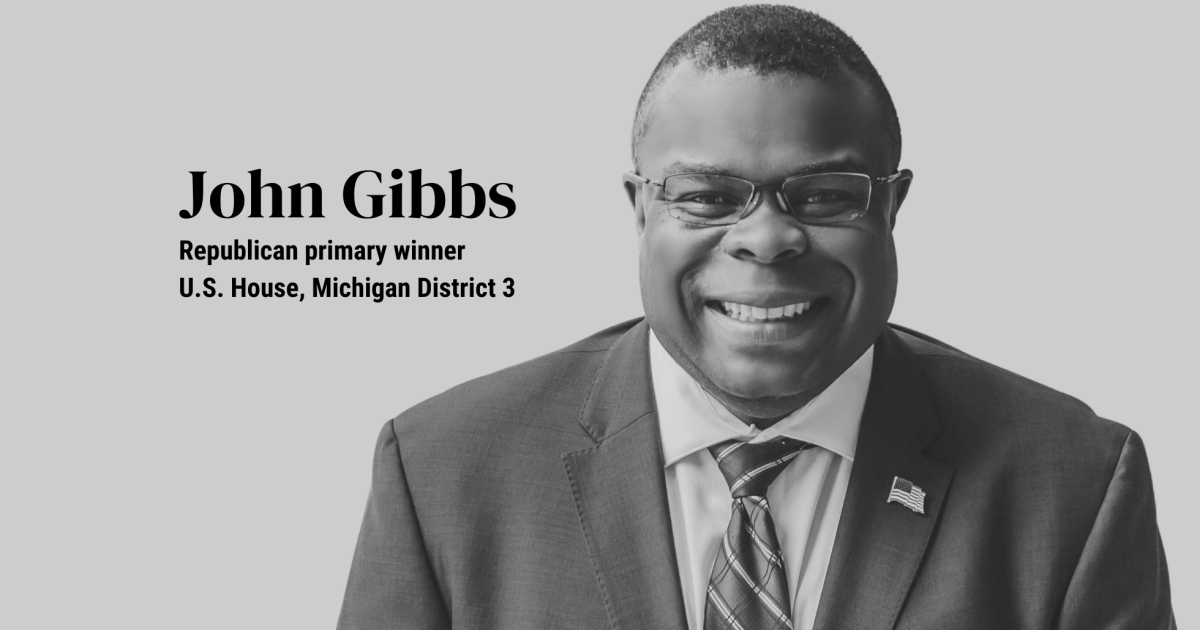
John Gibbs
American Politician
12
APPEARANCES
10
PODCASTS
Nov 18, 2026

Gary HeasleyHOST
It seems to me that we really aren't living in a capitalist system when the government has to come in and run the housing industry.

John GibbsGUEST
He said the American system is finished when the politicians realize they can bribe the people with their own money.
John GibbsGUEST
So you see every industry across the board that is basically going to the government.
8 MINS LATER
Gary HeasleyHOST
Or if there's some crisis, I guess the interest rate and the lower demand because wages are down is the crisis, right?


John GibbsGUEST
Yeah, you know, Spain, unfortunately, right now is a poster child of bad policies.
John GibbsGUEST
You can point to almost anything they're doing and you want to do the exact opposite.
John GibbsGUEST
The first thing they decided to do was to let in record high levels of immigration.
John GibbsGUEST
So there's not enough housing to accommodate all the people they decided to let in.
Jake SmithHOST
He saw the need and built two of the most critically needed developments at that time in the United States for soldiers returning from war, right?
John GibbsGUEST
You know, when you look at the houses the builders are building today, they are much, much larger and more expensive on average than the homes that are being built during the times you're mentioning, you know, 50s and 60s and onward.
John GibbsGUEST
So we're seeing them go straight for the most expensive units because that's what they make the most money on.
John GibbsGUEST
And again, in a free market, if a producer is making something people can't afford, they've got to bring the price down.
John GibbsGUEST
They've got to become more efficient, use more automation, et cetera, to bring that price down.
John GibbsGUEST
But when the government steps in, creates distortions, makes it so that people can keep affording the most expensive thing, they no longer have that incentive to build a more reasonably priced product.


John GibbsGUEST
There is a possibility that many of these newly elected Democrats are going to try to regulate us to death and that they're going to engage in policies and the restrictive regulations that will make it harder to move forward in the AI race.
John GibbsGUEST
We should make sure that things are done at a pace that people are comfortable with.
John GibbsGUEST
But if we simply stop everything, then China is going to get the edge on us here and we've got to be really careful.
John GibbsGUEST
Yes, I think there's a serious concern among investors and among the tech industry that the new Democrats could go overboard in trying to over-regulate AI.

John GibbsGUEST
So what that means is, for example, if you are a mortgage lender and you want your mortgages to be guaranteed by either a private company or the federal government, you've got to pay a price for that.
John GibbsGUEST
But what the federal government does is it actually charges the lenders and investors a far lower amount for the risk that it's taking on.
John GibbsGUEST
This encourages them to take on a little bit more risky loans than they would otherwise.
John GibbsGUEST
It also encourages a much higher amount of mortgage activity, and it encourages mortgages for more expensive homes than what you would see under a free market.
Chris ArpsHOST
John, in these changes that pass with this housing bill, if builders can save money through deregulation, what makes, how do we know that those savings will actually reach buyers?

John GibbsGUEST
Yeah, so, you know, when we talk about housing and the lack of affordability, a lot of people go straight to supply.
John GibbsGUEST
But one thing that people won't talk about as much as all the things that the government does, the federal government, I mean, to make housing more expensive.
John GibbsGUEST
There's not a single European country that has a mortgage market as socialist as that.
6 MINS LATER
John RushHOST
But I think states could help some of what you just said by allowing certain things to happen that wouldn't maybe otherwise.

Vicki McKennaHOST
But what are some things at the macro you could do? And then what are some of the downsides of maybe having the federal government tinker too much?
John GibbsGUEST
So, you know, when we talk about the issues with housing affordability, we talk a lot about the supply issues, which is certainly good to talk about.
John GibbsGUEST
You know, but from the federal government's point of view, that's largely controlled at the state and local level.
John GibbsGUEST
So there's a very limited amount of things that the federal government can do to move the needle there.
John GibbsGUEST
So I like to tell the federal policymakers they should focus on things they control, which is the demand side.
7 MINS LATER
Vicki McKennaHOST
And now everything, the market has been so thoroughly manipulated by government that you can't really point a finger of blame at any one group except regulators.

John GibbsGUEST
Yeah, when you look at Spain and you look at the crisis they're having in their housing, prices are going up like crazy and people can't even afford anything.
7 MINS LATER


Doug BlairHOST
Maybe those Americans, like you were saying, who already have $500,000, a million dollars in the bank, as opposed to the younger Americans who are still building their wealth.
John GibbsGUEST
Yeah, you know, I think we're gonna have to do something because the young people are what, 20, 30% of the population, but 100% of the future.
John GibbsGUEST
So if we're burdening our younger generation with all this student loan debt, you know, they were told to go to college, they did what they were supposed to, but now they got all this debt.
John GibbsGUEST
I mean, it's just is it smart for us for our future to be burdening an entire generation with these kind of debts? I would say it's economically very, very unwise.
John GibbsGUEST
So I think the way we approach this is we can talk to people about their own children.
Doug BlairHOST
Is there any way to square those two circles? Is there a way to make it so that, yes, the products that Americans have grown to know and love are still relatively cheap and we can afford housing and healthcare? Or is this a question of you have to pick one or the other to be more affordable?

Doug BlairHOST
Maybe those Americans, like you were saying, who already have $500,000, a million dollars in the bank, as opposed to the younger Americans who are still building their wealth.
John GibbsGUEST
Yeah, you know, I think we're gonna have to do something because the young people are what, 20, 30% of the population, but 100% of the future.
John GibbsGUEST
So if we're burdening our younger generation with all this student loan debt, you know, they were told to go to college, they did what they were supposed to, but now they got all this debt.
John GibbsGUEST
I mean, it's just is it smart for us for our future to be burdening an entire generation with these kind of debts? I would say it's economically very, very unwise.
John GibbsGUEST
So I think the way we approach this is we can talk to people about their own children.
Doug BlairHOST
Is there any way to square those two circles? Is there a way to make it so that, yes, the products that Americans have grown to know and love are still relatively cheap and we can afford housing and healthcare? Or is this a question of you have to pick one or the other to be more affordable?

Amanda HeadHOST
What would this mean for the housing market? How much would this release into the country for people to purchase?
John GibbsGUEST
So the proposals that are being discussed right now and those that have been talked about by President Trump and the director of the Federal Housing Finance Agency involve kind of what you might consider a partial release from conservatorship.
John GibbsGUEST
However, the GSEs would be opened up to an IPO, so you would have some public investment in there.
John GibbsGUEST
And so the idea is to get some more money in there in order to help, uh, increase liquidity and the mortgage markets, uh, and, uh, you know, make more housing available for the average American.


John GibbsGUEST
Uh, Congress will not want to do, um, something that they consider to be too big of a change from the status quo, but if it can be messaged and talked about as a way to get first-time homebuyers, um, easier access to, uh, housing, I think that is something they might consider.
John GibbsGUEST
Um, there are other data points we have to look at here, which is that if mortgage credit is expanded too rapidly sometimes, what you see is that that expanded credit goes into higher prices, because you increase the buying power of the average person, which means more people looking at the same amount of housing, which means that you have more demand, which means that you have prices going up.
John GibbsGUEST
Uh, so we sometimes we see this, uh, effect of, uh, easing credit going into higher prices.
John GibbsGUEST
The more the government backs student loans, the more college tuition gets expensive, and so we do see some adverse effects here.