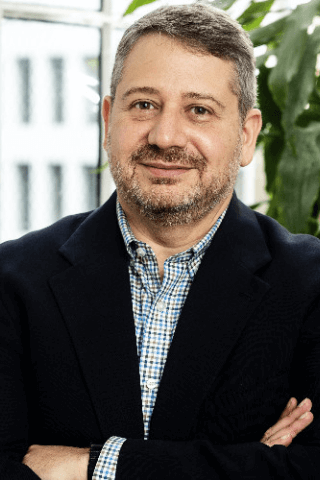
Joe Devon
3
APPEARANCES
3
PODCASTS
Jun 4, 2026


Shannon KempHOST
So as you're growing up, then as you're, you know, starting to select your classes in school, and what are you leaning towards? And where do your passions start to grow?

Joe DevonGUEST
Well, by the time I was 13, I got an Apple IIe at home, and I had no access to books.
Joe DevonGUEST
But at school, we had a bunch of people that had a whole bunch of disks with floppy disks, the five and a quarter inch floppy disks.
12 MINS LATER
Shannon KempHOST
Tell me, you know, what in in this very impressive career, what's been your biggest lesson so far?


Grant HardyCORRESPONDENT
As Joe explained, for him and Jennison, the goal is for accessibility to be top of mind always, not just on one Thursday in May.
Joe DevonGUEST
Over about the first 10 years of GAAD, we really were focused on the day of GAAD, and so many people were saying that this should really be something that we, that we celebrate and pay attention to every day of the year.
Joe DevonGUEST
So for our 10th anniversary, we thought, all right, this is time now to create a foundation, which also will be something that hopefully this GAAD will go on longer than Jennison and I will, kind of want to get the younger generation involved in understanding the ethos of it.
Joe DevonGUEST
One of the, the big things that we wanna do is focus on culture, because you can ask an organization to put money and effort into accessibility.
Joe DevonGUEST
You can have regulation that force them to, to some extent, but what you can't do is require culture.Culture is something that you have to get organizations to volunteer to do, and it's not really organizations, it's individuals.
Joe DevonGUEST
Maybe to put a, a finer point on this, if you're a designer and you're designing a chat app that has an online/offline indicator, and you just use a green or red button to indicate online/offline, you're using color to convey information, which is an accessibility no-no, because people who are blind cannot see the difference.
Joe DevonGUEST
You really need to have something else, let's say a little bit of text that says online/offline.

Joe DevonGUEST
Basically, I wake up every morning and fix everything that went wrong the day before and barely get it to, to really be useful, um, because it's been unstable.
Joe DevonGUEST
It's, it's a whole i- uh, idea, um, that is very important for the accessibility community.
Joe DevonGUEST
And why is that? Because what it is, is you have the ability to attach, um, an input and an output to a central place where you have an AI controlling it.
Joe DevonGUEST
So if you are trying to buy-- look at a mobile app, or you're trying to look at a website, or you're trying to, uh, look at the PDF menu of a restaurant or book your seat and see where the seat is, you don't have to care about what user interface was built on the other side of it.
Joe DevonGUEST
Because the AI, you have a connector, and that connector connects up to, eventually it will be an agent, but for now it works around all of the, um, inaccessible aspects of what you're consuming.
13 MINS LATER