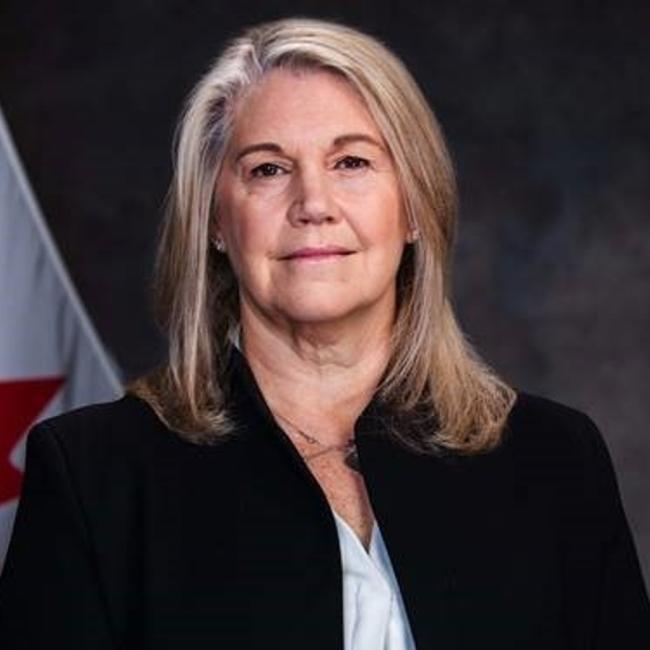
Jody Thomas
Former Deputy Minister of National Defence of Canada
10
APPEARANCES
8
PODCASTS
Nov 5, 2026


Jody ThomasGUEST
Now, whether it's a full service MI5, MI6 model, I don't know, but the capacity has to be developed for a whole bunch of reasons.
Jody ThomasGUEST
I'm not sure that, well, I'm certain we do not have quite the same relationship with the US that we used to.
Jody ThomasGUEST
And while at the operational level, intelligence is still being shared and the Five Eyes is really functioning well, I think it is important that Canada have the ability to collect intelligence for itself.
6 MINS LATER
David BorysHOST
Which parts of the defense supply chain are most important for Canada to control or secure? And where does domestic production make the greatest strategic sense?

Jody ThomasGUEST
I'll start with, for the first time in any of our lives, and this will now continue.
Jody ThomasGUEST
There are kinetic threats that can hit this country, launch from an adversarial landmass.

Allan GreggHOST
By moving this into a crown corporation, one more arm's length away from parliament, isn't this going to create exactly the opposite?
David BorysHOST
Can you give us an understanding of what specific missions these platforms are built to perform?
Jody ThomasGUEST
So Canada is unique in that we use the same fleet for summer icebreaking in the Arctic and for winter icebreaking in Quebec and Atlantic Canada.
Jody ThomasGUEST
And so what they do in the winter is they keep ferries moving between Newfoundland and mainland Canada.
Jody ThomasGUEST
And they keep ships moving in the Great Lakes for, you know, 10 months of the year.
11 MINS LATER
David BorysHOST
What are the trade-offs, in your opinion, between that approach, the bi-Canadian approach, and prioritizing the fastest and most cost-effective way of getting these ships built and into service?

Jody ThomasGUEST
the critical minerals element of this situation that we find ourselves in came to light really during COVID.
Jody ThomasGUEST
Anybody who wanted to buy a car could not because the supply chains for the chips that drive, the automation and the digitization of so much that we do today, so many consumer products, they weren't available.
Jody ThomasGUEST
Suddenly used car prices went through the roof and there was an absolute scarcity of new cars for Canadians to buy.
Jody ThomasGUEST
And I think that was a trigger point, a turning point for an understanding of where we were going to have difficulties.
Jody ThomasGUEST
And most people thought of it in terms of, in sort of geopolitical level, most people thought of it in terms of if there were conflict between China and Taiwan.
Jody ThomasGUEST
and we started to look at other sources of the critical minerals that could be used to make all of those chips and circuit boards that drive cars, but also are critical for weapons, for a number of consumer products, for computers, for cell phones.

Amber MacHOST
As one example, if the Pentagon can identify a Canadian cobalt refinery as strategically important, why is Canada sometimes slower to treat its own assets this way? It's, I guess, the question of

Jody ThomasGUEST
the critical minerals element of this situation that we find ourselves in came to light really during COVID when anybody who wanted to buy a car could not because the supply chains for the chips that drive the automation and the digitization of so much that we do today, so many consumer products, they weren't available.
Jody ThomasGUEST
Suddenly used car prices went through the roof and there was an absolute scarcity of new cars for Canadians to buy.
Jody ThomasGUEST
And I think that was a trigger point, a turning point for an understanding of where we were going to have difficulties.
Jody ThomasGUEST
And most people thought of it in terms of, in sort of geopolitical level, most people thought of it in terms of if there were conflict between China and Taiwan.
Jody ThomasGUEST
and we started to look at other sources of the critical minerals that could be used to make all of those chips and circuit boards that drive cars, but also are critical for weapons, for a number of consumer products, for computers, for cell phones.
Jody ThomasGUEST
And we in Canada realized that, of course, All of those products, all of those minerals, those rare earth minerals, the critical minerals, exist in Canada.
Amber MackHOST
As one example, if the Pentagon can identify a Canadian cobalt refinery as strategically important, why is Canada sometimes slower to treat its own assets this way? it's, I guess the question of

6:55

So how do you balance that desire with taking appropriate, uh, care to avoid bad purchases, overspending and the like?
Jody ThomasGUEST
I think this is where the Defense, uh, Investment Agency and the Department of National Defense are going to have to work very closely together.
Jody ThomasGUEST
Um, I don't think that the slowness in defense procurement previously has been due to, um, intransigent bureaucrats.
Jody ThomasGUEST
So what is going to be really critical is that that rule set is rewritten as we go to ensure that those who have to execute programs on behalf of the government know what's expected of them, uh, what s- steps they can skip, and how, where they can take legitimate and reasonable risk.
Jody ThomasGUEST
I think that, uh, the Defense Investment Agency has, um, moved very quickly to get itself set up.
9 MINS LATER
17:19
Given what you've seen over the last several months, um, in terms of purchases and, and plans a- and potential, how are you assessing where Canada is and, a- and is getting in terms of being a modern military?

Jody ThomasGUEST
Well, uh, is it hel- So, um, is it a local police issue, um, or is it a national police issue, a federal issue? And, and that rapidly it became evident that this was a federal policing issue, and it shouldn't be left to the local police, who did happen to also be RCMP, but it needed the federal focus, I think, to pull all the elements together and look at- Um, trends across the country and where we could see connected events.
Jody ThomasGUEST
Uh, we were hearing from the communities that they were very concerned about the threats, that they thought they were being directed by the government of India.
Jody ThomasGUEST
And so bringing all of that to the federal police force within the RCMP gave a different lens to the investigation than leaving it with a local police force.

Simi SaraHOST
Do you see any evidence of that changing? Are there, like with the RCMP reform, is, is that happening?


Vassy KapelosHOST
What leads you to that conclusion, now that we have two different people in very different roles kind of claiming that that isn't the case, but being careful to say based on what they have in front of them? And how do you distinguish and why should we distinguish between the two things that you mentioned?
Jody ThomasGUEST
Well, foreign interference is ongoing activity by a foreign state, or perhaps a non-state actor to change opinions on things.
Jody ThomasGUEST
That's where we see social media trying to influence how diaspora populations particularly, but not always, think on issues and what, influence their behavior.
Jody ThomasGUEST
Transnational repression is in many ways more nefarious because it involves violence, intimidation, and threats.
Jody ThomasGUEST
Otherwise, it is other kinds of criminal activity, extortion, other violent but criminal activity.
Vassy KapelosHOST
What should we be doing to try and figure out what the truth is? Do you have some, I guess, empathy for people who are, and particularly sick Canadians who are worried that they will be targets?
Mike Le CouteurHOST
What are you hearing, though, of the continued threat level from India when it comes to foreign interference in Canada and even transnational aggression?
Jody ThomasGUEST
Well, if you look at what has gone on, just what's been made available publicly, the CSIS director in his annual report cited India.
Jody ThomasGUEST
During the election, we had weekly tech briefs from officials talking about foreign interference and what they were looking for, and India was raised in that context.
Jody ThomasGUEST
The violence on the streets that was referenced in your last interview is real and it is ongoing.
Mike Le CouteurHOST
So, is that an outright lie to make sure that they have an excuse to go on this mission and essentially put the economic interests of this country over the security interests of this country?

Vassy KapelosHOST
From a security perspective, I'm wondering if you think the same is true, that all the security alliances that they lead, the posture with which they lead on issues around security around the world, are they becoming a rogue actor there?
Jody ThomasGUEST
And I think the actions the president took this week vis-a-vis leaders within the National Security Agency are reason for concern.
Jody ThomasGUEST
Any leader gets to choose who's going to advise them, who's going to lead within their bureaucracy.
Jody ThomasGUEST
But to take the advice of a right-wing extremist to remove established professionals, I think is reason for concern.
Jody ThomasGUEST
It's going to be interesting the impact that the president's actions will have on the BATFORA, on NATO, on the G7, on the G20, because all the other leaders are going to want to talk about what they're doing and what the president is doing vis-a-vis trade rather than the breadth and depth of issues that they should be talking about and that they've traditionally talked about and where the U.S. has been the leader.