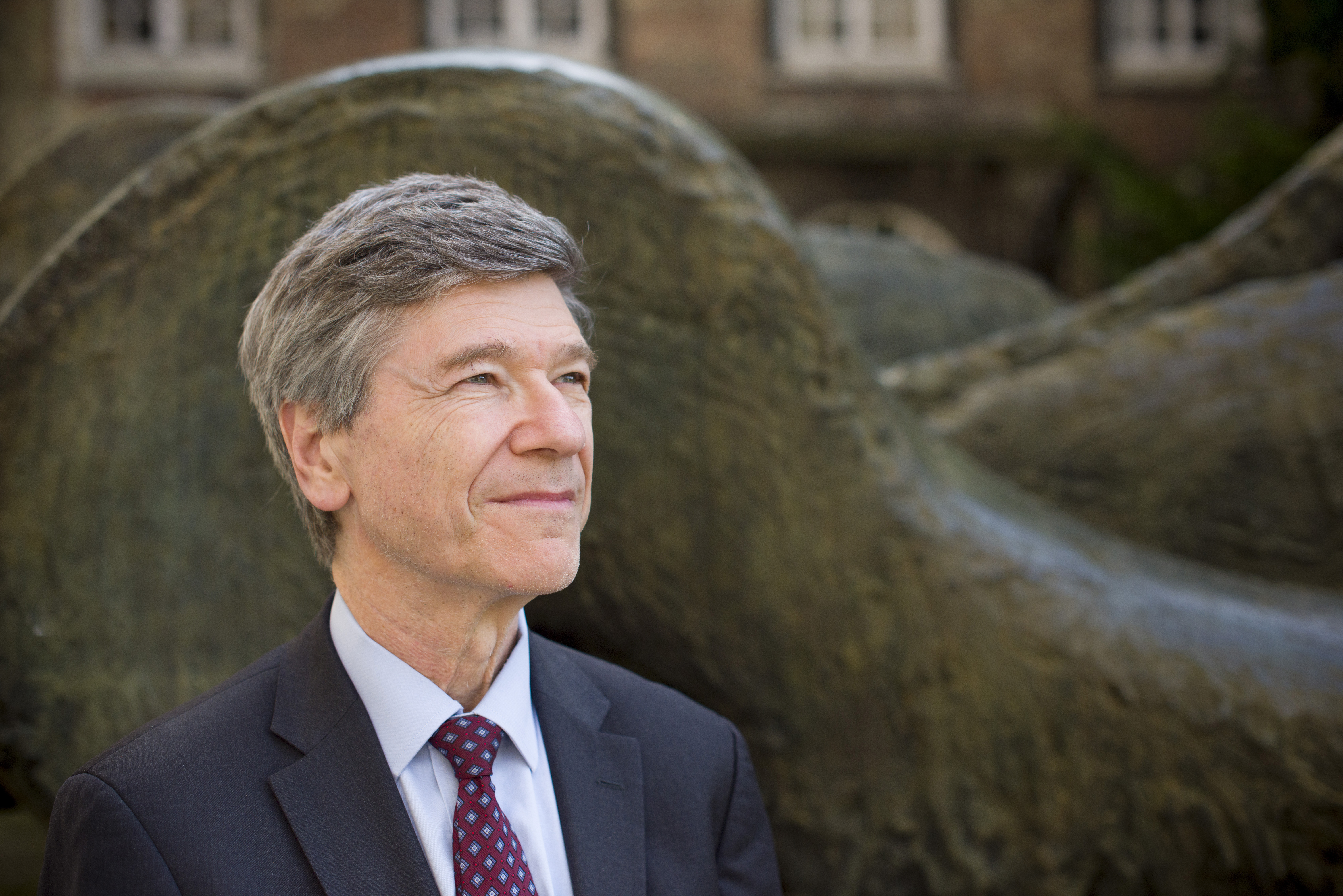
Jeffrey Sachs
American economist
173
APPEARANCES
33
PODCASTS
Nov 7, 2026


Glenn DiesenHOST
How do you assess the election outcome? And to what extent do you see peace being good politics?

Jeffrey SachsGUEST
There's a an electoral issue, a public opinion issue and a deep state issue in the United States.
19 MINS LATER
Glenn DiesenHOST
I mean, do you see something different this time or am I a hopeless optimist here?
1:34

Do you think Trump wants a diplomatic solution in Ukraine? And if you do, why hasn't he restrained the CIA?
Jeffrey SachsGUEST
I think Trump came into office thinking this was Biden's war and not to be burdened with it.
Jeffrey SachsGUEST
Trump did face very strong pressure inside the US military industrial complex, who for a variety of reasons, not the least of which is the war profiteering and the AI companies testing their AI battlefield drone systems and information systems and the normal, if I could call it that, Russophobia and long term CIA anti-Russia strategies and a strong European push to continue the war.
12 MINS LATER
14:50
I guess this is why Netanyahu called Trump over the weekend and begged for an immediate resumption of the war, his theory being that if Israel is actively at war and is being retaliated against by Iran, uh this is no time to throw the government out at least that would probably be his his thinking his sales pitch to uh president herzog and to gadi eisenkot and the arab uh parties


Robert DuncanHOST
What do you think it changes geopolitically that the Pope is an American, given everything you've said? I
Jeffrey SachsGUEST
This is one of the most complicated periods of history of the last centuries, because in my view, and again, many people don't like to hear my view, but in my view, this is the end of the Western dominance, which was a dominance that began an ascendancy around 1500 with the great voyages of discovery and then the beginning of European colonization, both of the Americas and of Asia, and really became ascendant in the 19th and 20th centuries.
Jeffrey SachsGUEST
And the rise of China and the rise of Asia is a kind of natural, in my view, and understandable and analyzable.
11 MINS LATER


Tucker CarlsonHOST
Am I imagining this? Has the general attitude in Israel toward religious extremism changed?
11 MINS LATER
Tucker CarlsonHOST
love that so one last question jeff you mentioned maya kahana and it's who's an american i think from new york um murdered in the end in new york but it it's just another reminder that everything that is happening in israel has been abetted paid for um populated by supporters of israel united states a lot of settlers are from the united states kahana was from the united states the money comes from the united states america as a nation as a political system is clearly going to withdraw is going to change its relationship distance itself from israel what next for israel i mean that that has profound consequences for israel so like what does israel do as that happens

Jeffrey SachsGUEST
Opposition leaders had pledged not to cooperate with Arab parties, even as those parties became pivotal.
Jeffrey SachsGUEST
What takes precedence in Israel? Anti-Arab racism or the chance for the country to stabilize itself? I'd argue Netanyahu's leadership has been disastrous, not just for Israel and the United States, but for the entire region.
Jeffrey SachsGUEST
Look at the devastation in Gaza, the failure to protect Israeli citizens, the international criminal court warrant against him.
Jeffrey SachsGUEST
I believe a presidential candidate who promises not to support Israeli criminality will have a real advantage.
Jeffrey SachsGUEST
The issue is, which makes this very interesting, is that the Palestinian Arab population, the citizens of Israel constitute two million people against the eight million Israeli Jews in a population overall of 10 million people.
Jeffrey SachsGUEST
So the Palestinians account for about 20 percent of the citizenship of Israel.
Jeffrey SachsGUEST
Incidentally, let's remember that if you take Israel and all of the Palestinian territories, Gaza, the West Bank and East Jerusalem, then it's not 20%, it's 50%.
17 MINS LATER

1:29
They've been articulated very eloquently by yourself, but perhaps you can help us by setting them out again in this program.
Jeffrey SachsGUEST
And I view our discussion, as always, but especially now, as brainstorming, actually, because I think ideas can make a difference right now.
Jeffrey SachsGUEST
Of course, not only are we in war, but we are just trapped in the stupidest platitudes imaginable, as everybody knows.
37 MINS LATER

Tim BesleyMODERATOR
Thank you.
Jeffrey D. SachsGUEST
This has been always a high point for me throughout my whole career, and I was just reflecting with Professor Richard Laird, one of my heroes in our profession, that this is the 35th anniversary of the Robbins lectures that I gave about Poland's transformation back in 1991.
Jeffrey D. SachsGUEST
I'm just thrilled to be here and congratulations on this new series and for including me in this new series.
Jeffrey D. SachsGUEST
And as Professor Besley just said, this is the 250th anniversary of The Wealth of Nations.
1 HR 1 MIN LATER
Tim BesleyMODERATOR
Great.


Jeffrey SachsGUEST
This has been always a high point for me throughout my whole career, and I was just reflecting with Professor Richard Laird, one of my heroes in our profession, that this is the 35th anniversary of the Robbins lectures that I gave about Poland's transformation back in 1991.
Jeffrey SachsGUEST
I'm just thrilled to be here and congratulations on this new series and for including me in this new series.
Jeffrey SachsGUEST
And as Professor Besley just said, this is the 250th anniversary of the Wealth of Nations.
1 HR 1 MIN LATER
Jeffrey SachsGUEST
You mentioned one of the prominent words, provoked, which has become part of the lexicon of this war.
Jeffrey SachsGUEST
It launched the invasion on February 24th, 2022, the special military operation, which followed 30 years of war.
9 MINS LATER
Glenn DiesenHOST
Even as we're losing a war, we can't address the Russian security concerns, which means there can't be an end to the war.

FidiasHOST
Okay.
Jeffrey SachsGUEST
There's another side of American politics that which Trump is the cartoonish representative of, but there's a deeper, more evil and less cartoonish part, which just says, we are America, we run the show.
Jeffrey SachsGUEST
And for that part of America, which is the hegemony vision of America, which is very strong.
38 MINS LATER
FidiasHOST
I want to hear, I don't believe it, but I wanted to hear what's your thoughts on this argument that we shouldn't let, as Europeans, Russia win because we can't cock it.
Jeffrey SachsGUEST
Well, this is one of the harder issues, but I don't think it is the hardest issue, though it is the one that is endlessly talked about.
Jeffrey SachsGUEST
The second issue about territory is, is that line a de facto line, meaning that that is how those territories are going to be governed? Or is that a de jure line, meaning that that is how that border will be officially recognized by each other and by the rest of the world? My feeling, Judge, is that at this stage, it is not possible.
Jeffrey SachsGUEST
To draw any line and to have both sides say we renounce all claims other except as that line is drawn.
10 MINS LATER
30:09
What does your gut tell you, that the war will end by a negotiated agreement or the war will end when the Ukrainian military collapses?
FidiasHOST
Cyprus as well.
Jeffrey SachsGUEST
This was not a world of values except values that we wanted to proclaim for ourselves.
Jeffrey SachsGUEST
But one of the main implications of this is that in 1820, at the eve of the Western hegemony, Asia constituted about 60% of world output, as best we can measure it.
Jeffrey SachsGUEST
And by 1950, it constituted 20% of world output, with the same share of population being about 60%.
Jeffrey SachsGUEST
So Asia experienced a calamitous 150 years, roughly from the beginning of the 19th century to the middle of the 20th century.
Jeffrey SachsGUEST
And this was Britain's control of India, this was the Western effective control over much of China.
1 HR 25 MINS LATER
speaker_4UNKNOWN
But isn't it that it will resolve itself because it will become irrelevant towards the real economic forces of the big world, big countries?
Jeffrey SachsGUEST
Uh, and I think this is something that is completely missed in almost all geopolitics.
Jeffrey SachsGUEST
You can make a pretty good projection of where world population will be in a quarter century from now.
Jeffrey SachsGUEST
Uh, if you ask for 75 years from now, it's a little bit harder, but you can make a, a good projection, of course barring the ultimate calamities that we're trying to, uh, prohibit.
8 MINS LATER


Afshin RattansiHOST
I mean, apart from threats of mass killing from Trump and Netanyahu at the UN General Assembly, which we might talk about, what did you detect 12 years on since the coup in Ukraine at the UN General Assembly in New York? Well, these wars continue to
Jeffrey SachsGUEST
rage because it seems nobody wants to speak the truth and nobody wants to acknowledge ground realities.
Jeffrey SachsGUEST
The war in Ukraine is a war that came, as you mentioned, with a coup that overthrew a Ukrainian president so that NATO could enlarge all the way to Russia's border.
Jeffrey SachsGUEST
When the United States pushed the Europeans to agree to commit to Ukraine's membership in NATO.
Jeffrey SachsGUEST
Then German Chancellor Merkel wrote in her diary that this was, as she knew, tantamount to a declaration of war.
Afshin RattansiHOST
So did you manage to see him in New York and ask him why, as many have around the world, why the UN has not taken a more muscular role and convened some kind of conference in a neutral space? Of course, I mean, we're hoping there'll be a conference here in the
7:01
Why is this weak, ragtag group trying to destroy the rich, super rich Saudi Arabia?
Jeffrey SachsGUEST
That's, uh, first of all, the reason that they can destroy airports, grab coastlines, and bomb oil fields.
Jeffrey SachsGUEST
Uh, this is, uh, a, uh, part of a, uh, what is now a complete failed state, uh, Yemen, uh, that, uh, has, uh, hovered between one state, two states, no states, uh, and, uh, incredible, uh, civil, uh, clash for decades, in fact.
Jeffrey SachsGUEST
I went to Yemen just once myself, uh, in, uh, 2009 and came back rather shocked by what looked like a completely explosive situation.
Jeffrey SachsGUEST
There was a major fiscal crisis, debt crisis, uh, ecological crisis, uh, poverty, uh, and so forth.
12 MINS LATER
19:42
What does behavior like this do to the reputation of the United States and its ability to conduct diplomacy? I know you're gonna tell me they don't, that we don't d- conduct diplomacy.

speaker_8UNKNOWN
origin.
Jeffrey SachsGUEST
The world is extremely complicated and disrupted right now, as I think we all know.
Jeffrey SachsGUEST
I'm an economist, but I had worked in public health issues actually for many, many years and had chaired a commission on public health for the World Health Organization.
speaker_15UNKNOWN
They're afraid of the letter Q, you know? The real domestic terrorist, the fake FBI.
Jeffrey SachsGUEST
that because it's our job, we read documents and we read statements and plans.
Jeffrey SachsGUEST
And in this case, it's just absolutely fascinating to read Brzezinski's account of all of this in 1997.
Jeffrey SachsGUEST
The grand chessboard has the subtitle, The Strategic Imperatives of American Primacy.
Jeffrey SachsGUEST
So the idea is spelled out, not in the salami tactics way, but in the definition, the purpose and the results.
Jeffrey SachsGUEST
for as far as we can see in eurasia this is interesting because america is not a eurasian power of course america is in america in the americas but america will have primacy in eurasia primacy over europe primacy over russia primacy over china primacy over india That's the goal.
9 MINS LATER
2:10
Does it appear that Trump and Netanyahu are preparing a ramp up in the war in Iran for after November 3rd, the midterm elections here in the U.S.?
Jeffrey SachsGUEST
The United States, under Trump, launched a war that was illegal, unnecessary, reckless, and both tactically and strategically a failure.
Jeffrey SachsGUEST
The war was launched on February 28th with the very explicit idea that the U.S. and Trump would murder most of the leadership of Iran.
8 MINS LATER
11:28
How has Trump diminished the United States of America in the area of trade?
Jeffrey SachsGUEST
We've been hearing this report from the Israeli newspaper Haaretz for several days.
Jeffrey SachsGUEST
Netanyahu says he's going to sue the reporters, but the reporters know what happened.
Jeffrey SachsGUEST
I think it's becoming increasingly likely that Netanyahu invited an attack so that he could retaliate in the way that Israel did.
8 MINS LATER


Piers MorganHOST
Uh, what is the mood in New York about this? What, what are your thoughts on, on Netanyahu's arrival?
Jeffrey SachsGUEST
Well, the mood right now is, uh, still shock, uh, at, uh, Trump's remarks yesterday.
Jeffrey SachsGUEST
Uh, never before at, uh, the podium of the General Assembly has, certainly not a US president or anyone else, said we're going to annihilate another country, or, "It's a, a choice that I'm going to make.
Jeffrey SachsGUEST
I'm going to make you great or I'm going to annihilate you." Uh, then the Iranian president spoke today saying, um, "Well, I had to put away my speech, uh, after I heard, uh, Trump's, uh, threats," uh, and just to say, "We will never surrender, and we will be as strong as we need to be to protect ourselves." So this was [laughs] quite an, an amazing day from the standards of diplomacy.
Jeffrey SachsGUEST
Maybe not from the standards of, uh, Trump's, uh, true social post, but standing at the podium of the UN General Assembly in a room of global leaders to say, "I have a, I have a hard choice to make.
Jeffrey SachsGUEST
Should I, uh, destroy the civilization and send them to hell?" Which is, uh, what he said, or, or, "Should I make them a great country?" It was a most bizarre moment.
Piers MorganHOST
Can you be entirely sure that they're not, their intentions are not gonna ultimately be bad or dangerous?

Jeffrey SachsGUEST
I shuddered then and I shudder now that a President of the United States can stand at the podium of the UN General Assembly speaking to world leaders in a language of annihilation of other countries and of sending them to hell.
Jeffrey SachsGUEST
It was ghastly, unprecedented, totally disgusting, disgraceful for the United States.
Jeffrey SachsGUEST
But I would also say a measure of how broken the constitutional order of the United States is something that you know, Judge, you lead on with every opening of every segment of your broadcast about undeclared wars, about breaking our constitutional order, about losing our freedom.
Jeffrey SachsGUEST
Trump basically said, like a madman, which I think arguably he is, that he and he alone will decide the survival of Iran.
17 MINS LATER
Glenn DiesenHOST
Um, however, yeah, my question is therefore how, how do you see BRICS organizing international governance? Because BRICS isn't simply a new America that will, um, you know, kind of, uh, or- organize everything, uh, through, you know, centralized command or s- uh, yeah, structures.
Jeffrey SachsGUEST
We're seeing obviously, uh, big shifts, uh, historic scale shifts in, uh, the way the world, uh, is organized and the way that, uh, people view the world.
Jeffrey SachsGUEST
Uh, and I think the, the main, uh, dates, uh, that we should, uh, start with are around 1750 to 1950, uh, and then, uh, around 2000 and today, and let me explain briefly.
Jeffrey SachsGUEST
Uh, starting around 1750, a very unusual thing happened in history, uh, and that is that, uh, Europe, Europe and European imperial powers, uh, started to gain a, a global ascendancy.
Jeffrey SachsGUEST
Uh, it was, uh, just the western, uh, edge of Eurasia, and it was, uh, always a rather modest part of the world population.
44 MINS LATER
Jeffrey SachsGUEST
And, uh, I fear that any replacement of Netanyahu, uh, is also going to be awful, uh, because, uh, Israeli voters and the Israeli political class, uh, have, uh, turned, uh, uh, genocidally, uh, racist, uh, and murderous in their behavior, and it's, uh, shocking to behold.
Jeffrey SachsGUEST
But we're not seeing an election, uh, in which, uh, Netanyahu's vile behavior is being contested on the basis of vile behavior.
Jeffrey SachsGUEST
We're seeing an election in which Netanyahu is being attacked on an individual basis, but from opponents who say they'll do a better job at slaughter or a better job at, uh, repressing, uh, the, uh, Palestinians or a better job at attacking Türkiye, "Who's next?" uh, one of the candidates says, or will finish Iran by the time they come in.
Jeffrey SachsGUEST
The way to solve the crisis is very straightforward, by the way, uh, and that is the United States says, "We don't back you, uh, in this, uh, bloody-minded approach you have." All of our problems, I wanna emphasize once again, are self-inflicted problems.


Tom SwitzerHOST
But at what point did you recognize that the Bush administration's response was clearly an overreaction and a serious misstep?
Jeffrey SachsGUEST
Terror, so-called violence against civilians, is part of politics and part of war.
Jeffrey SachsGUEST
And you don't say a war on war, or you could, but you're not going to get very far.
Jeffrey SachsGUEST
What you can have is a political strategy and insight, a deeper understanding of institutions, of causes, and so forth.
26 MINS LATER
Tom SwitzerHOST
mean, you have to take their argument seriously because it's been four and a half years and their mindset still prevails in Brussels and Washington.
Scroll for more appearances