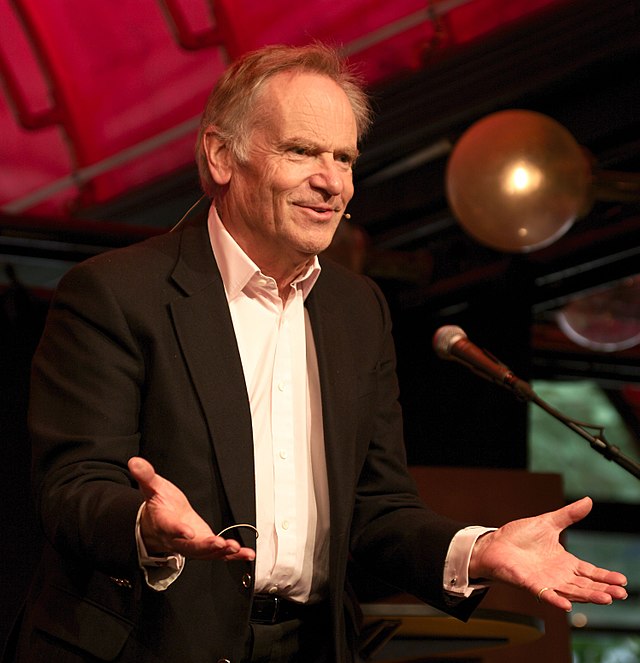
Jeffrey Archer
Novelist
24
APPEARANCES
15
PODCASTS
Nov 22, 2026


6 MINS LATER

Ryan TubridyHOST
And Geoffrey, why did you get so invested in the work that you've been hearing about and the auction process? Charity money and fundraising what why this you had a lot of from my


Jeffrey ArcherGUEST
I didn't think this would come up, but my latest book, and they've sent the line editing to the Americans.
Jeffrey ArcherGUEST
They found one thing they weren't sure about, and they wrote very tentatively, Jeffrey, we wonder if we could change the line at the bottom of page 37.
15 MINS LATER


Jeffrey ArcherGUEST
Well, I first went to Sebastian Coe, who's an old friend in Monaco, spent the day with him and he asked him what went wrong at the 2012 Olympics.
Jeffrey ArcherGUEST
And he said, I can't think of any particular incidents, but the man in charge was Commander Bob Brothost in charge of security.
Jeffrey ArcherGUEST
He felt after 14 years he could say what went wrong, but it was a bit of a shock.
Jeffrey ArcherGUEST
The opening ceremony would never have taken place, and on the fifth day, the stadium would have had to be cleared.
Ryan TubridyHOST
It's funny because, Ian, one of the things that comes up in our conversations with Geoffrey over the last couple of months has been the fact that I think he really was, he kind of would have loved in another life to have been Not necessarily you, but to have had a similar career.
Jeffrey ArcherGUEST
I was then quite well known through Margaret Thatcher and people thought I was quite powerful.
21 MINS LATER


Jeffrey ArcherGUEST
The Glasgow University people had come to hear the argument and they voted against us.
Jeffrey ArcherGUEST
But they appreciated that we'd flown up to Glasgow to the union and spoken and taken it on the nose.
8 MINS LATER
Jeffrey ArcherGUEST
Mary worked with him because he was Secretary of State for Health when Mary was chairman of Addenbrooke.
Jeffrey ArcherGUEST
And I think his first few weeks have been, the first few days, have been outstanding in the sense that He actually makes you believe he's going to be able to do these things.
Jeffrey ArcherGUEST
We're about to find out if he can, because I think we live in an impossible age to govern.
Jeffrey ArcherGUEST
I saw a line in the Times the other day which terrified me in the sense that how can you be prime minister in such circumstances? It said that over 40% of the British people are 67 and above.
8 MINS LATER
Ryan TubridyHOST
When did you in your career think, I've got where I really wanted to be? I mean, I know you'll always fight for it and you'll go to the grave wondering, can I do more and can I be better? But go back a number of decades where you thought, this is it, I can do this now for a living, it's beautiful.
Jeffrey ArcherGUEST
Well, it came in a strange way because I wrote Cain and Abel and I handed it in.
Jeffrey ArcherGUEST
And my agent said, Deborah Owen, said, We're not going to sell this book, we're going to auction it.
Jeffrey ArcherGUEST
And I said, how does that work? She said, you give it to the 12 great American publishers, and they have seven days to make a bid.
Jeffrey ArcherGUEST
And I said, what happens if nobody bids? And she said, we're not worrying too much about that.
10 MINS LATER

Jeffrey ArcherGUEST
Well, it's interesting you say that, because Douglas Heard actually once said to me when he was Foreign Secretary, you actually like her, don't you? LAUGHTER And I thought, it's clear a lot of the cabinet didn't like her.
Jeffrey ArcherGUEST
I was on her team when she stood for leader of the opposition against Willie Whitelaw.
17 MINS LATER


Jeffrey ArcherGUEST
I'm a huge admirer, just in case you two ignoramuses from the United States have missed him, and both you will now shout at me, "Don't be silly, Jeffrey.
Jeffrey ArcherGUEST
We've read him all our lives." I'm a great admirer of Stefan Zweig, the great Austrian writer who, of course, fled from Hitler and went to live in America.
6 MINS LATER
Jeffrey ArcherGUEST
The fear that goes with that is, will anyone else agree? So when I handed it to Kate Alton, my editor...


Jeffrey ArcherGUEST
... and talked him into it, and Grace Kelly came over, and I want to tell you about the professionalism.
Jeffrey ArcherGUEST
The whole orchestra are playing Sinatra-type songs, and Grace Kelly does the introduction of her friend Bob Hope and her friend Frank Sinatra.
Jeffrey ArcherGUEST
She then goes and sits in the royal box, and I'm sitting on the end of about the fifth row watching very carefully.


Jeffrey ArcherGUEST
I never told anybody at the time, but two human beings, a Cain and an Abel, the man who founded Sikorsky Helicopters and Rockefeller, the Vice President of the United States.
Jeffrey ArcherGUEST
And the lady who introduced me, Lady Campbell, you may know her, Victoria Campbell, said, you do realize that the Sikorsky man is a liar and will have made it up.
11 MINS LATER

SunilHOST
What impact do you think she's had in society today, and what was it like in the '80s when you had Margaret Thatcher as the prime minister?
Jeffrey ArcherGUEST
Taking those as two questions, the first one, um, never a day goes by without Margaret Thatcher being mentioned in the press.
Jeffrey ArcherGUEST
Never a day goes by with her attitude to politics, her achievements, her beliefs in, in her economic, uh, s- strategy and schedules.
Jeffrey ArcherGUEST
So the answer to your question, Sunil, is she's had an immense influence on British politics.
Jeffrey ArcherGUEST
On your second question, what was it like working with her? We didn't know at the time quite what a giant she was.
Jeffrey ArcherGUEST
We had to lose her before we found out, and look at the people who are currently governing our country, and so history has been very kind to her.
SunilHOST
What, what do you think one of her best achievements was d- during those, uh, h- her time as, as leader?

David FreemanHOST
So is this the purer form of Jeffrey Archer rather than the full, the full-length novel?
Jeffrey ArcherGUEST
And if you write a hundred and fifty thousand, two hundred thousand word novel, I mean, Kane and Abel is actually two hundred and fifty thousand words.
Jeffrey ArcherGUEST
The joy with the short story is that when you've finished it, you can actually do it in a, in a time.
Jeffrey ArcherGUEST
For example, when I did the proofs for the Cut a Long Story Short, I was able to do a s-- There's 14 of them.
6 MINS LATER

Claire NicholsHOST
Do you look back now and think, yes, a writer was the thing I was always meant to be?
Jeffrey ArcherGUEST
Well, no, because it never crossed my mind, either at school or university, that that's the career I would take.
Jeffrey ArcherGUEST
I went onto the Greater London Council at a young age and into the House of Commons at 29.
Jeffrey ArcherGUEST
So losing everything, I turned to writing the first book, not a penny more, not a penny less, not so much out of mistake as it was quite hard to get a job as someone who had left the House of Commons in debt.
Jeffrey ArcherGUEST
But I confess that I had not thought even for a moment that 50 years later, the book would never have been out of print.


Jeffrey ArcherGUEST
... a very remarkable man, and said, "Did anything go wrong?" And he s- I quite expected him to say, "Nothing I can't speak about," but he told me 14 things that went wrong.
Jeffrey ArcherGUEST
One would've closed the opening ceremony, and one would've had everyone in the stadium having to leave on the fourth day of the athletics.


Michael GoveHOST
What are your memories of her and your reflections on the current dispute between the Spencers and the Windsors?
Jeffrey ArcherGUEST
because I do charity auctions, and we got to know each other quite well then.
17 MINS LATER
Michael GoveHOST
Will you nevertheless offer some predictions? What do you think the next few weeks, months and years hold for Andy Burnham, Kemi Beidenoch and Nigel Farage?

Jeffrey ArcherGUEST
I've got one person who I intensely dislike because he bids the whole time and never pays.
6 MINS LATER


Paddy O'ConnellHOST
But what does it mean to you as someone who's enjoyed writing to, to decide to stop publishing? What does it mean to you?
Jeffrey ArcherGUEST
It means that the agony of, and it's wonderful at one point, fun and, but I won't be doing a hundred and fifty thousand words again.

Jeffrey ArcherGUEST
What you're touching is what should be abolished, and whether the Lords should go, I accept that.
Jeffrey ArcherGUEST
I remember when, when I was in the House, when we voted on how many hereditary peers we would have, because there were 1,000, and I think we voted for 93, and that survived.
Jeffrey ArcherGUEST
And then we had this even stranger thing, where you had an election when a hereditary peer died, an election to get an hereditary, new hereditary p- I thought that was farcical.
Jeffrey ArcherGUEST
My, I, I suggested to the man who was leading this campaign, I said to him, "Look, let all thousand stay, and say none of their children can ever inherit a place in the House of Lords.
13 MINS LATER
Jeffrey ArcherGUEST
I'm fascinated by... clever people, particularly if they're in another field.
Jeffrey ArcherGUEST
I remember last week, Mary said, let's go and hear this lecture on Parkinson's.
Jeffrey ArcherGUEST
And I thought, that's the last thing I want to do is go and hear a lecture on Parkinson's.
Jeffrey ArcherGUEST
I was absolutely glued in to this man who devoted his life to solving the Parkinson's problem.
17 MINS LATER
speaker_5ADVERTISER
Veuillez jouer de manière responsable.


David HeadleyHOST
I'd like you to tell them how, why you became a writer and why you've had multiple professions For me, this is your greatest
Jeffrey ArcherGUEST
Well, I'd always wanted on leaving Oxford to be a politician and assumed I'd be prime minister.
Jeffrey ArcherGUEST
And there's been seven of them in the last five years, so why shouldn't I go on believing? [audience laughing] And it all went wrong.
Jeffrey ArcherGUEST
Most first novels are autobiographical because you write everything you've experienced and you know.


Jeffrey ArcherGUEST
When I traveled over to Monaco to see Seb Coe, I asked him if anything had gone wrong with the London Olympics because my hero in the final book, Endgame, William Warwick, was now a commander and in charge of the Olympic Games.
Jeffrey ArcherGUEST
And he said that he didn't know, but the person I should speak to, Gary, was Commander Bob Broadhurst, who was the commander commander in charge of security at the Olympic Games.
Jeffrey ArcherGUEST
So I flew back to England and met Bob, and he said 14 things happened that the public never found out about.
13 MINS LATER
Sara DiVelloHOST
So what is your sort of method? Is it you get an idea and then, you know, you're, you're, you're in your two-hour chunks? What, what is it?
Jeffrey ArcherGUEST
Well, sometimes I don't know beyond the next page, and I very rarely know beyond the next chapter.
Jeffrey ArcherGUEST
First two hours of the day, 6:00 to 8:00, I pretty well know three pages, if I'm lucky, four, and then I start praying.

Leslie ZemeckisHOST
So when you are pantsing, as they say, not a plotter, do you ever find your organic path leads you down a road that ends up being a dead end, and then you have to delete 10,000 words and find a new way, or it just never leads you wrong?