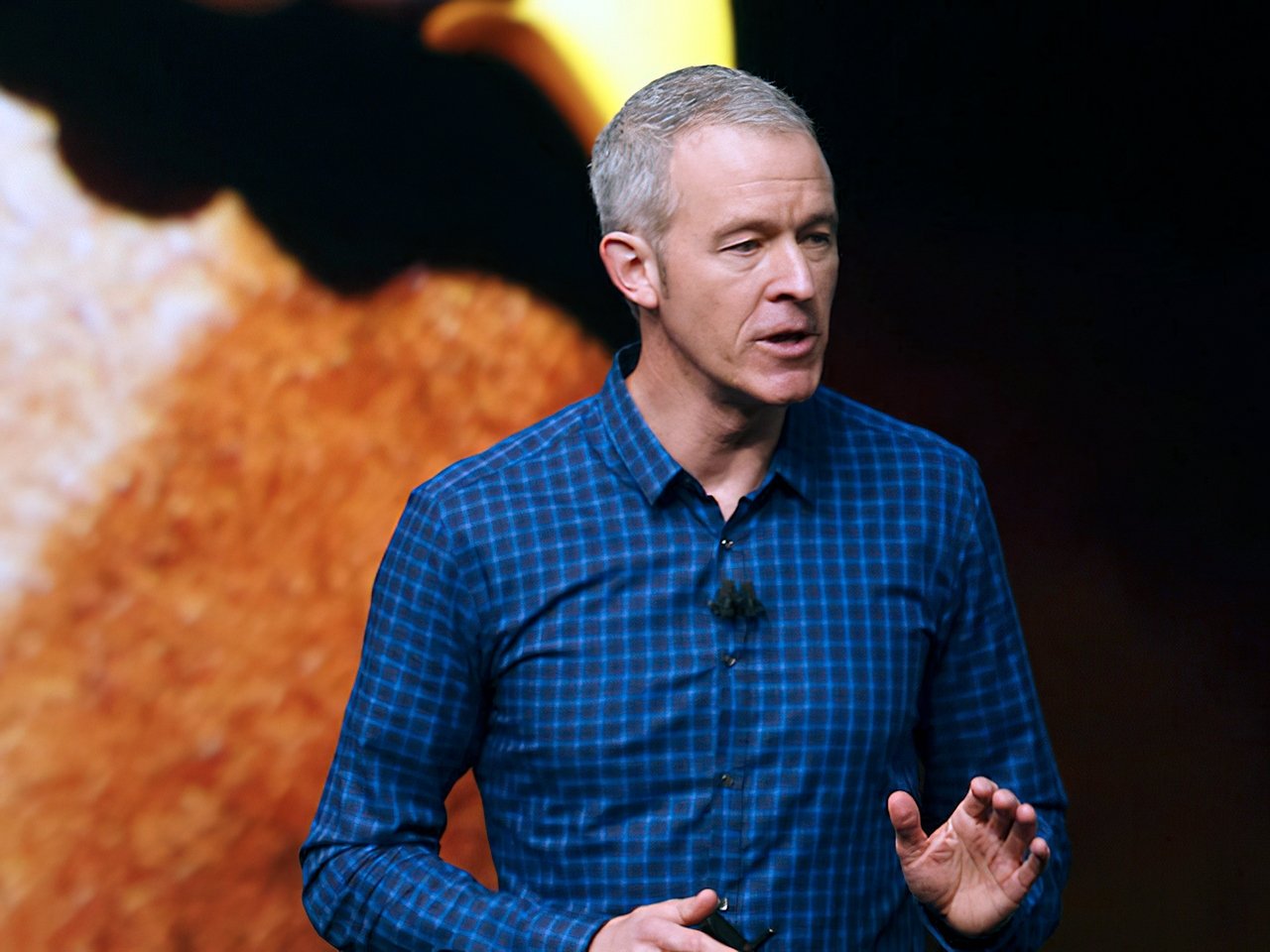
Jeff Williams
American business executive and former chief operating officer of Apple
16
APPEARANCES
10
PODCASTS
Aug 16, 2026


Mo RoccaCORRESPONDENT
Jeff Williams is the author of The Summer of Death, about that great heat wave.
Jeff WilliamsGUEST
I mean, I have thought so many times that if I went back to 1936, that summer I would have been doomed.

Robert ClotworthyNARRATOR
Here is geologist Jeff Williams.
Jeff WilliamsGUEST
When energy's applied from the outside externally, the metal would change shape, but they also noticed that it could also produce its own power supply for about an hour.
Jeff WilliamsGUEST
And of course, most people are considering using it in the field of robotics.
11 MINS LATER
Robert ClotworthyNARRATOR
Considering the difficulties of working with meteoric metal even with today's technology, how did metallurgists 3,300 years ago perform such tasks?
Jeff WilliamsGUEST
This dagger is completely out of place in the fact that unlike simple objects like beads that can be simply hammered out and rolled, this has been perfected to a point where it has no hammer marks on it.

SianHOST
The question I have in terms of flourishing, What have you seen personally from your life and also your tenure in terms of what makes people flourish and the things that make them not flourish?
Jeff WilliamsGUEST
Well, when you're in a diverse area with people from, it doesn't really matter, but it's really critical when you are in a diverse city to put on the minds of your citizens that they need to be kind.
Jeff WilliamsGUEST
And even today, 10 years later, they still have the kindness clubs in the schools.
6 MINS LATER
SianHOST
But I don't know, does it take a type of person or like what was going on in your brain? Were you like, yeah, like, why me? Could I do that?


Dave RamseyHOST
What do you, from your perspective, take away from that? And, and when you sit with some of our clients in our coaching program, uh, what's your advice to them about using debt?
Jeff WilliamsGUEST
A lot of companies that you see, especially small companies, um, that try to use debt, they're...
Jeff WilliamsGUEST
What they're saying is that they, uh, wanna grow faster than maybe their cashflow will allow them to.
Jeff WilliamsGUEST
And so to bridge what they are- have in cash to what they need to grow faster, whether it's another piece of equipment or buying another company or whatever it may be, um, they seek to bridge that gap with debt instead of just paying cash with it.
Jeff WilliamsGUEST
That's what started this, us on this journey that brings you and I here to- uh, today.

Rusty HendricksHOST
I mean, there are some guys that's been stepping up and doing some things for the Cardinals.
Jeff WilliamsGUEST
Jordan Walker, that has to be, for me, the number one success story of the season so far.
Jeff WilliamsGUEST
You look at the last two seasons he had, they were disappointing, just to be honest.
7 MINS LATER
Rusty HendricksHOST
I wanted to know your thoughts on some of these guys that you're really high on and who you think that maybe could – I don't know, either see later on this year or maybe the next couple of years for the Cardinals?
Jeff WilliamsGUEST
And so, uh, they're like, "We need to talk to you." And I'm like, "Okay." So I sat down with them, and they started sharing just the, the, the difficulties that they were going through because they were in a place to where, um, their bookkeeper, the main person with their hands on all of the money, was their mother.
Jeff WilliamsGUEST
Now, their father had passed away, and they were taking over the business from...
John FelkinsHOST
What would you say the main thing you're having them do? You know, around here, what would be their KRA, is how we say-
John FelkinsHOST
What's your advice to get them from there to a full-fledged profit-sharing program?
Jeff WilliamsGUEST
If they've already been doing that Christmas bonus, they've already got the money accounted for in their budget, and so they can repurpose that and rebrand it, if you will, from being just a Christmas bonus to being profit sharing.
Jeff WilliamsGUEST
It gets us on the stage 12 times a year talking about this so people remember it better.


Mark LasterHOST
yeah so anyway we got jeff jeff's gonna give us a little uh story about his dad who i had the pleasure of knowing um years ago and uh jeff uh take it away buddy tell us tell us what you got on your heart
Jeff WilliamsGUEST
well mark there's really there's three guys i've been blessed for a lot of a lot of gentlemen who've poured into me and and taking care of me uh but you know my granddad was probably one of the best man I ever knew, you know, God-fearing, great man, unconditional love kind of guy.
Jeff WilliamsGUEST
He grew up playing sports, fishing, hunting, you know, teaching all those types of things.
Jeff WilliamsGUEST
I remember when he used to – all the gentlemen used to take – their kids to the game at the old Hatline Stadium there in Alexander City to watch Benjamin Russell games.
speaker_5UNKNOWN
JT, you ain't

RustyHOST
Tangy Thangy Bell I'll get the name wrong who's injured at the moment but both came through sevens and also it's interesting my view as well is that and you'll it'd be interesting to get your view on this Jeff but I think it's a pretty good way to develop coaches so when you were talking about the highs when Sedge was talking about the highs and the lows I was thinking about some phone conversations with Jeff Williams in the last year where he's like oh my god Rusty like I am through the ringer
Jeff WilliamsGUEST
On a weekend, you've got six stories to tell, six stories, six meetings, probably more than six actually.
Jeff WilliamsGUEST
And you can win, you can lose, and you've got to adapt so quickly to different circumstances.
Jeff WilliamsGUEST
And I think that's the big thing for coach development and for young coaches to go through that experience is, Well, for me, I've been put in the ring a little bit over the last two years.
Jeff WilliamsGUEST
I mean, just even last month or two months ago, I was on a losing streak of nine games out of 10.
7 MINS LATER
RustyHOST
Kinsale.


Steve BultGUEST
But as you step back, you said, I'm not sure that's going to align with our mission.
Jeff WilliamsGUEST
I mean, the way I think of it... we're trying to expand the kingdom is what our work is about.
Jeff WilliamsGUEST
I mean, if the enemy came down Addison Road in a red cape and a pitchfork, that'd be so much easier to deal with.
13 MINS LATER
speaker_0HOST
Anything come to mind for you, a challenge, a tension that has required courage from you?
Robert ClotworthyNARRATOR
Here is geologist Jeff Williams.
Jeff WilliamsGUEST
It was a prehistoric hammer, if you will, with part of the handle still in place inside some very old rock.
Jeff WilliamsGUEST
And part of the handle actually is starting to go through a process called coalification.
Jeff WilliamsGUEST
It's where, uh, you have inorganic material and organic material changing into coal.Now, how old is this hammer? The hammer itself was found in the Travis Formation.
Jeff WilliamsGUEST
It's a concretion of sandstone, and it usually takes about 140 million years for this to form.
Jeff WilliamsGUEST
Who was here 140 million years ago? Modern-day archeology suggests that we've only been around for about 10,000 years, so this falls into the category of out-of-place artifacts.
Jeff WilliamsGUEST
Anybody who's ever worked with meteorites, even today, will tell you it's very difficult to do this because of the high nickel content.
Jeff WilliamsGUEST
And three, do they love their craft? Do they love what they do? I have a little sheet of paper, uh, on my desk that I go through with each one of them, and I give it to them.
Jeff WilliamsGUEST
On the back is all of our doctrinal statements, so they know where we stand doctrinally.
Jeff WilliamsGUEST
I talk about my vision for TCA, and there's a couple of key terms that I go over with them.
18 MINS LATER

Jeff WilliamsGUEST
So let me share how I think about this, 'cause we keep going in circles a little bit here, and I think it's important to understand that there's levels to this thing, and it's easy to think about the tech parts of it, right? Most of us do that all day.
Jeff WilliamsGUEST
But that operates the, within a market, and there's business reasons why you do things and business reasons why you don't do other things.
Jeff WilliamsGUEST
And I think frankly, cybersecurity, the market isn't great for it because it's not really, it's not part of the market for a variety of reasons.
11 MINS LATER

David ShipleyHOST
Uh, I don't see how we're gonna sustain the marathon of the next couple of years 'cause I think it is gonna be a couple of years.
Jeff WilliamsGUEST
most organizations are not gonna do a wholesale replacement of their existing processes with this 'cause it's just too expensive, and it's a little weird to use it.
Jeff WilliamsGUEST
We've done a bunch of benchmarking, and it's slow, so it's not doing a quick scan on your code after you finish writing it.
Jeff WilliamsGUEST
It's also non-deterministic, so you get different results every time you run it, which is a little confusing.
Jeff WilliamsGUEST
The way you know you've fixed something is you scan it again, and you don't get that finding in the second scan.
10 MINS LATER
Jeff WilliamsGUEST
Yeah, my first experience with OWASP was Chuck Flieger, who wrote the textbook, Security and Computing, was working a couple offices down from me at a consulting company.
Jeff WilliamsGUEST
I think, you know, this new group might be something you might want to follow.
Jeff WilliamsGUEST
So I got on a mailing list and there were like 20 people on there talking about AppSec.
Jeff WilliamsGUEST
And the first thing that I noticed they were doing was they were building an insecure application to help teach people about AppSec problems.
15 MINS LATER
Jim LoveHOST
But what's your impression and opinion of where we're getting to with AI and AI-driven code?


Dave BittnerHOST
Now, is this intended to be something that runs alongside of our own program, or could it potentially replace it?
Jeff WilliamsGUEST
It's intended to run alongside it, and that's some of the challenge here is that instead of having, you know, one major vulnerability authority, now we're gonna have a bunch, and that creates friction for people that wanna use those services.
Jeff WilliamsGUEST
Now, you know, imagine you're a company that just wants to make sure you do your updates.
Jeff WilliamsGUEST
Where do you go for that information? Do you go to the, the old CVE program? Do you go to the new, uh, GNA, uh, uh, driven program, the, the GCVE program in Europe? I, I said GNA because it...
Jeff WilliamsGUEST
they have... their system involves multiple numbering authorities, which is kind of another complication.
Dave BittnerHOST
I, I mean, how, how do they approach this looking at the level of uncertainty that may be ahead of us?
Jeff WilliamsGUEST
us?I think we just got to get used to a world where there's multiple vulnerability authorities, and you're gonna have a lot of duplicates.
Jeff WilliamsGUEST
Hopefully, they have the same numbers, but, you know, it's, it's entirely conceivable that two researchers find a similar vulnerability, report it to their own vulnerability entity, they get different CVE numbers, and they just live as duplicates within this, this world, which is then gonna cause confusion.