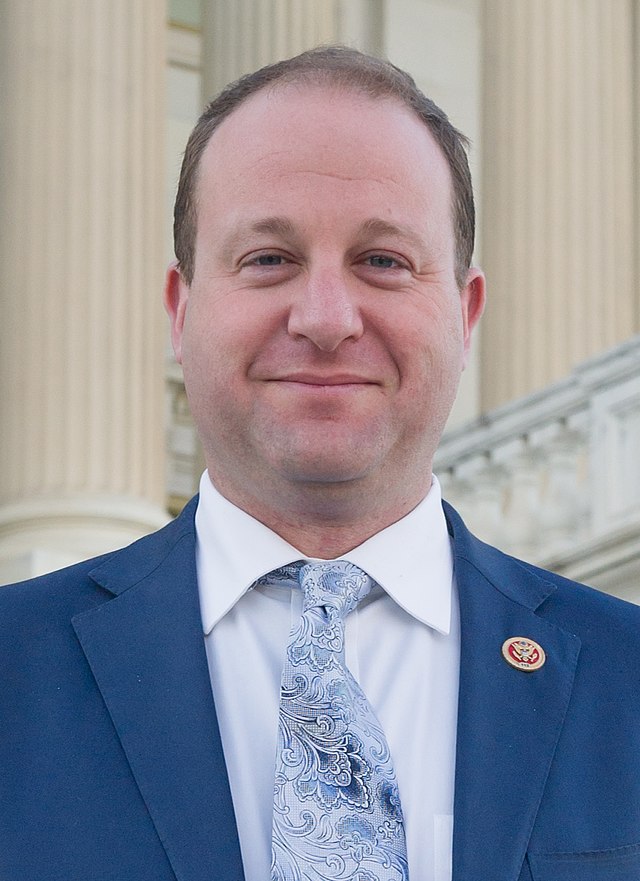
Jared Polis
Governor of Colorado
19
APPEARANCES
17
PODCASTS
Oct 20, 2026

Tanya NathanHOST
You've gotten any criticisms about it? Like have people in politics, pundits, anything like that come back at you and said that is not the government's job? So

Sarah AndrewsHOST
Can you walk us through that decision and what should the state do to protect kids online?


Sarah McCammonHOST
Why are you prioritizing early childhood education, and how are you paying for it?

Jared PolisGUEST
Um, we, uh, Colorado is now the number one state in education, ranked by US News & World Report.
9 MINS LATER

Jared PolisGUEST
Now, number one, I want to briefly describe kind of what we're doing that gets us there.
Jared PolisGUEST
But there's really six things that we're doing that together help propel us there.
6 MINS LATER

Kate AndrewsHOST
Why do you think your party has been so resistant to school choice movements in recent years? And do you think that tide might turn?

Scott WassermanHOST
Why, from a policy perspective, did you believe that focusing so much on education was so important? And were there folks who disagreed with you on that as a policy priority? Sure.
Jared PolisGUEST
It's not something that most members of Congress run on or even most governors run on.
Jared PolisGUEST
I just didn't, you know, I'm sure in response to questions, but it certainly wasn't emphasized by any of the candidates.
Scott WassermanHOST
And so as you look forward, I mean, what are some of the unfinished projects? And, you know, as you think about whomever takes the governor's office next, what do you hope they will focus on as things to do next? There's


Jared PolisGUEST
I, I, I just believe that the teacher is the most important part of that entire education system.
Jared PolisGUEST
I mean, our kids in high school, um, we all knew who the good teachers were, who the bad teachers were.


Ryan WarnerHOST
I don't think you've posted that yet, so I wonder if we might get a preview as to what you have learned and what you have taken from the reaction.
Jared PolisGUEST
The very fact that there seems to be a somewhat partisan reaction to this shows the underpinnings for why it needed to be done.
Jared PolisGUEST
Obviously, as you know, Tina Peters committed a crime and deserves to do the time consistent with what she did.
Jared PolisGUEST
Had she gotten a year or two years in prison or even four years in prison, which is what we commuted it to, I don't think anybody would have batted an eye.
15 MINS LATER

Jared PolisGUEST
Well, look, when I ran in Democratic primaries, I was proud of my business success.
Jared PolisGUEST
That's seen as a plus by Democrats, somebody who's had experience in the real world.
Jared PolisGUEST
I'm concerned by some of the socialism I see, some of the socialism with voices in President Trump's year where they're literally buying government shares of Intel.
Jared PolisGUEST
The military, the Defense Department, actually, the War Department, actually owns 15 percent of a company called MP Materials, Rare Earth Materials.
Jared PolisGUEST
So government ownership of companies, whether it's coming from Democrats or Republicans, is wrong.
Jackie HeinrichHOST
At what point do you say that these are anti-American positions that these candidates are embracing and reject them from your party?


Laura CoatesHOST
Um, explain to me and our audience, what is the danger you see in these DS- DSA candidates that you think voters who support them might be missing?
Jared PolisGUEST
Well, I, look, I'd ra- wanna evaluate each, uh, c- candidate separately, but I can certainly talk about how socialism is a ticket to nowhere.
Jared PolisGUEST
I mean, quite literally, buying 15% of Intel, having Department of Defense buy 10% of a company called MP Materials Government ownership of the economy.
Jared PolisGUEST
How can the government regulate the private sector to ensure competition, to prevent monopolies if they're actually an owner of companies in the private sector and have a vested interest? Number two, I'm a Democrat.
Laura CoatesHOST
What do you say to people who think that based on your actions of granting that clemency, you may not be the best messenger on election integrity in this issue?


Jake TapperHOST
Uh, and second, um, I guess your decision to grant her clemency didn't rely on any sort of repentance as sometimes is required.
Jared PolisGUEST
I would call it a lie, but I think she actually believes it, so I don't think lie is the right word.


Jared PolisGUEST
I think first, Canada should listen to what the American negotiators offer because the American negotiating strategy is completely incoherent.
Jared PolisGUEST
there could very well be some some good things in there that reduce barriers or tariffs I just don't know and I don't think anybody knows exactly what America is seeking so let's hear out what America offers it just may be that there's good things in there I think a consistent pushback from and I hope Canada is also talking to Mexico about how we can reduce hemispheric tariffs I mean let's start with the premise here we are more competitive as a western hemisphere competitive system right we're more competitive against china we're more competitive against europe if we have a free trade zone between u.s mexico and canada and that's the goal here so we get people to agree on that goal how do we then build that by reducing tariffs and encouraging trade between our three countries in the americas
Jared PolisGUEST
I think it's a great question to call them on, saying, what are your goals here? Let's talk about our values and our goals, and then we'll negotiate terms.
Jared PolisGUEST
I think absolutely the president and this administration are feeling pressure to reduce prices and reduce costs.

Kaitlan CollinsHOST
Um, do you believe that's the reason that the president has an issue with you coming to the White House?
Jared PolisGUEST
You know, at times he's said he hates our mail-in ballots and holds me responsible for that.
Jared PolisGUEST
In this case, uh, you know, this, this particular, uh, person got a particularly long sentence that we're examining, and it's probably a too long a sentence.
Jared PolisGUEST
Uh, but she did commit a crime, uh, that had nothing to do with, uh, ballots or elections.
Jared PolisGUEST
It was after a municipal election and had to do with illegal access to a room and, uh, and, and obviously we wanna make sure her sentence is consistent with others.
Kaitlan CollinsHOST
Is that something you're worried about when, uh, whether it comes to that or them trying to get access to, to voter rolls?


Jared PolisGUEST
Uh, we- many bills signed by Republican sponsors in our legislature, they're the minority party, become law.

David DruckerGUEST
This is what he's not gonna do." Um, what's been your approach, and what do you think the result has, has been for you?


Carl QuintanillaHOST
Is any of that affecting the way governors relate to each other, either with their governors' associations or just your own personal dealings?


Andy BeshearHOST
Tell us about the passage of the Affordable Care Act, because I got to watch my dad as governor implement it, and then I got to defend it along with Javier Becerra as the two frontline named defendants.
Jared PolisGUEST
Of course, you never want to know the sausage making, right? That's what they say about lawmaking.
7 MINS LATER


Jacob SoboroffHOST
I, I, I know your, your texts are, are personal between you and the Governor of Utah, but given this initiative, given that you both had shootings on the same day, um, in your home states, I, I'm just curious, w- you know, what type of information, what type of messages are you exchanging with one another?
Jared PolisGUEST
We shared real strong sentiments with one another, uh, m- you know, me, uh, y- about what he was going through in, in Utah, and of course, him with, uh, you know, within hours, the, the, uh, the attack on, on our high school.
Jared PolisGUEST
Uh, I think we, we share the value as the overwhelming majority of Americans do, left, right, and center, that this has to stop.
Jacob SoboroffHOST
After a week like this, do you believe still that it's possible to work on closing that perception gap? How do you work on that?

Chris HayesHOST
Governor, uh, why did you make the decision to essentially, you know, withdraw from the CDC's guidelines here?
Jared PolisGUEST
This was quite a big shock on Friday when it went down, just, as you know, we were gearing up as a state.
Jared PolisGUEST
Uh, and then all of a sudden, out of nowhere, we got this order that you would need a doctor's prescription, if you weren't over 65, to get the COVID vaccine.
Jared PolisGUEST
Now, that's a huge barrier, Chris, right? I mean, uh, you know, the, this is something you get when you're shopping for groceries or you're picking up your prescription for something else, takes five, 10 minutes.
Jared PolisGUEST
If you have to go to a doctor first, you know, you have to pass, go collect $200, all that stuff first, that's probably gonna reduce the vaccination rate by like half.


Jared PolisGUEST
Obviously everywhere in the country people are being, will be thrown off of Medicaid.
Jared PolisGUEST
Um, Colorado won't have the same percentages as some of the, uh, higher poverty states which tend to be red states, they'll have the highest percentage of people that'll be thrown off of Medicaid, but like every state, uh, will be several hundred thousand Coloradans that'll lose their coverage.
Jared PolisGUEST
The loss of the tax credits under the Affordable Care Act means that in the exchange for everybody who buys their own healthcare, doesn't get it from an employer, uh, rates will go up about 28% next year in January.
Jared PolisGUEST
I don't know where that stacks nationally, David, but probably we could be in the middle.
Jared PolisGUEST
A lot of states will be more, uh, it, it just sort of depends, but obviously the loss of those tax credits is devastating.
7 MINS LATER

Jared PolisGUEST
You know, I liked one of your readers, by the way, just said, and we'll move on from tariffs in a moment.
Jared PolisGUEST
That's very important to point out because like the amount of income you spend on clothing is a perfect example.
Jared PolisGUEST
If you make $200,000, you're spending a lower percentage of your income on clothing.
Jared PolisGUEST
But absolutely, it hurts people that are earning $30,000, $40,000, $50,000, $60,000 a year more because a higher percentage of their income is going to buy the goods they need for everyday life, which go up because of tariffs.

Jim AcostaHOST
Why did you do this? Is this something that, I mean, is this something that governors and local elected leaders need to do is just kind of get smarter to spur housing construction, to get this, I mean, because it's a massive problem that it just doesn't get talked about at all.