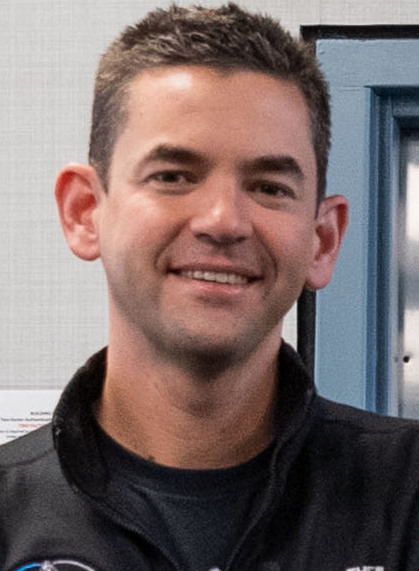
Jared Isaacman
American entrepreneur
39
APPEARANCES
29
PODCASTS
Sep 28, 2026


Jared IsaacmanGUEST
And by the way, it's great to chat with you, especially with such a busy week in space ahead.
Jared IsaacmanGUEST
There's many more exciting milestones later this week, including NASA sending more astronauts to the International Space Station on Crew 13.
Jared IsaacmanGUEST
All that said, when the initial commercial crew program was established, the idea was always to have two providers that would be able to take our astronauts to and from Earth orbit to the International Space Station and maybe future commercial space stations.
Morgan BrennanCORRESPONDENT
What is your expectation around this launch market, especially since NASA is a key customer here and there is demand? in anticipation that you're going to see the Falcon fleet retire at some point from SpaceX and a lot of the capacity that Starship brings online actually going to that own company's own endeavors.


Jared IsaacmanGUEST
We are living through an extraordinary moment in history, aren't we? It took just sixty-five years from Orville and Wilbur's first flight to Neil and Buzz walking on the surface of the Moon.
Jared IsaacmanGUEST
Now, it's been fifty-seven years since Apollo 11, and for a while there, pace of progress hasn't been all that inspiring, but look at what is on the horizon right now.
Jared IsaacmanGUEST
We got artificial intelligence, quantum technologies, robotics, additive manufacturing, the promise of fusion energy, biotech to heal the disabled, autonomous transportation, this whole abundance thing everyone's talking about, all converging in the years ahead is beyond what most people can comprehend.
Jared IsaacmanGUEST
Our world will fundamentally change how we live, how we work, how we fight wars, how we reach out and touch the stars.
10 MINS LATER
speaker_4UNKNOWN
[applause]


Jared IsaacmanGUEST
We are living through an extraordinary moment in history, aren't we? It took just sixty-five years from Orville and Wilbur's first flight to Neil and Buzz walking on the surface of the moon.
Jared IsaacmanGUEST
Now, it's been fifty-seven years since Apollo 11, and for a while there, pace of progress hasn't been all that inspiring, but look at what is on the horizon right now.
Jared IsaacmanGUEST
We got artificial intelligence, quantum technologies, robotics, additive manufacturing, the promise of fusion energy, biotech to heal the disabled, autonomous transportation, this whole abundance thing everyone's talking about, all converging in the years ahead is beyond what most people can comprehend.
Jared IsaacmanGUEST
Our world will fundamentally change how we live, how we work, how we fight wars, how we reach out and touch the stars.
10 MINS LATER
speaker_4UNKNOWN
[applauds]


Nate BurlesonHOST
So what does winning that race actually mean? Is it just a matter of strategic pride, planting a flag on the moon, or is there a strategic importance in establishing a lunar base on the moon before Chinese do?
Jared IsaacmanGUEST
I mean, this is a great power competition with China right now, not just in the ultimate high ground of space, but you see it across infrastructure and energy and AI, military capabilities below the water, on the water, air, and certainly in space.
Jared IsaacmanGUEST
The good news is, with respect to the last frontier, NASA has the playbook for success.
Jared IsaacmanGUEST
You couple it with President Trump's national space policy and the resources in the Working Family Tax Cut Act.
Jared IsaacmanGUEST
We are able to return NASA astronauts to the moon, establish that enduring presence, build the moon base on the South Pole where our astronauts, our robotic capabilities will interact with the water ice.
Nate BurlesonHOST
When you have people here in this country who are struggling to pay for grocery bills, to pay for gas, how do you explain to them the costs involved in that? And what kind of insights do we have into China's capabilities in actually establishing a lunar base on the moon?

Brian SullivanHOST
Why can't we board a plane today, go to the edge of the atmosphere, maybe into the atmosphere, and land in Azerbaijan in two and a half hours? Why isn't that possible in this day and age? Feels like in 50 to 60 years we haven't gotten that far, or am I completely wrong about everything I'm saying right now?
Jared IsaacmanGUEST
I mean, I'm a pilot, uh, an aerospace enthusiast, and I can tell you, yes, for the longest period of time, we have gotten comfortable, right? We, we stretch the plane a little bit.
Jared IsaacmanGUEST
We have gone so far from the breakthrough, you know, radical airframe and propulsion designs of, of decades past, but that is changing.
Jared IsaacmanGUEST
I can tell you, at least within NASA, the first A in aeronautics, we're down to one X plane.
Brian SullivanHOST
What is, what do we anticipate learning and facilitating with, uh, an eventual Moon base?


Jared IsaacmanGUEST
Oh, well, for almost the entirety of the SLS vehicle that successfully launched the Artemis II mission was repurposed hardware from the space shuttle.
Jared IsaacmanGUEST
And now you come to the end of the shuttle program, and you've got this industrial base that wants to know, what should we do next? You could design a whole brand new program from the get-go for what is an optimized vehicle to do the job, or you keep everybody doing what they were doing already, and you just repurpose it together into a new vehicle.
Jared IsaacmanGUEST
Then I'd say you bring in international partners when you're not faced with a global competitor and you try and make things work, and then you get other parts of the vehicle that aren't designed to perform as what you would have initially hoped for in that.
Jared IsaacmanGUEST
So I would say the whole reboot of the Moon program has had varying challenges throughout its existence.
10 MINS LATER


Jared IsaacmanGUEST
When you look at the constraints that you're facing culturally at NASA, you know, there used to be this huge, uh, mantra that, uh, failure is not an option, right? And you're, you're clearly the- your mindset is one of nonstop experimentation and learning.
Jared IsaacmanGUEST
What are the biggest hurdles that you're facing in ch- shifting the culture inside NASA to something like the new model of how we build organizations? Well, I would just say that I, I don't think, uh, the culture of a, uh, a- and I don't wanna even say accepting more risk.
Jared IsaacmanGUEST
It, it really, a lot of what you see, at least I'm- in my opinion, uh, when you see some of the things that SpaceX have done and how they choose to operate, is very similar to how NASA operated, uh, you know, in the 1960s.
Jared IsaacmanGUEST
I mean, we had the same 20-something-year-olds that were, you know, burning themselves [laughs] out, uh, you know, brilliant minds doing incredible things, making tough decisions, extreme ownership, moving with urgency.
Jared IsaacmanGUEST
Uh, and look, how many, you, you know, people talk about NASA doesn't, uh, blow up rockets.
Jared IsaacmanGUEST
Uh, go back into the 19th, uh, late 1950s, early 1960s on YouTube, and you can see plenty examples of, uh, of our iterative design philosophy not working out initially, uh, and then rolling in, uh, what we learned into, um, uh, you know, into, into subsequent versions.
12 MINS LATER


Jared IsaacmanGUEST
Well, I've, I've been lucky to be in space twice and have that perspective and an appreciation for just the scale of it all.
Jared IsaacmanGUEST
I mean, uh, the best way to describe it, like we are understanding, uh, our progress on what I think is the greatest adventure in human history is literally just dipping your toe in the grandest ocean of all.
Jared IsaacmanGUEST
We are lucky that we have been gifted a moon that's four and a half days away as a proving ground to continue to venture out, and we've just begun it all.
Jared IsaacmanGUEST
I mean, all that we stand to learn from a scientific perspective, economic potential.


Newt GingrichHOST
Why did NASA choose that kind of a model where you're beginning to have pretty big companies who are gonna take responsibility for doing this? What's the advantage from America's standpoint to doing it this way?
Jared IsaacmanGUEST
Well, this is a good question, and I think people often forget, too, in the 1960s when NASA set out and achieved the near impossible on July 20th, 1969, when Neil Armstrong and Buzz Aldrin walked on the Moon, we didn't do it alone.
Jared IsaacmanGUEST
Now, many of those companies still help NASA today, and then there's new companies like SpaceX and Blue Origin and Rocket Lab and others.
Jared IsaacmanGUEST
And I acknowledge they bring a different kind of flair to this, right? And it often asks people about why do you even need NASA when you have companies like that? And it's like, no, we do this together.
Jared IsaacmanGUEST
We had a lot of success with the commercial cargo resupply program that SpaceX and Northrop Grumman have done a good job at.
16 MINS LATER
Newt GingrichHOST
[upbeat music] How would you describe how you see the evolution of commercial space over the next ten or twenty years?

ZubyHOST
So for people who wonder about that, what is the reason why it's been so long?
Jared IsaacmanGUEST
You know, it's like Artemis II's first time we've sent humans around into the lunar environment in 53 years.
Jared IsaacmanGUEST
I mean, we did the near impossible on July 20th, 1969, where Neil Armstrong and Buzz Aldrin walked on the moon, and then we brought them home safely.
26 MINS LATER
ZubyHOST
You know, my podcast is Real Talk with Zuby just because I ask the questions that I genuinely want to know the answers to.

speaker_7UNKNOWN
And I was talking to the NASA administrator, Jared Isaacman, about this, and, and he actually said that this mission is actually more complicated than Artemis II going to the moon because you're talking about several different launches that have to happen.
Jared IsaacmanGUEST
In a span of call it a, a couple weeks, three weeks probably at most, you're gonna see the three most powerful rockets in the world, and those, uh, those spacecraft are all gonna converge in low Earth orbit as you get- undertake this multi-spacecraft rendezvous and docking, um, you know, uh, effort.
speaker_7UNKNOWN
Uh, and remember, so we had Artemis II this year, then Artemis III is next year, and then the next one after that is to land on the moon.
Jared IsaacmanGUEST
You know, if you think about 50 years past and what the next 50 years are gonna look like, you're gonna see more people living and working in space.


Caroline HydeHOST
We spoke with the NASA administrator, Jared Isaacman, about the timeline for a Moon base.
Jared IsaacmanGUEST
base.Starting in 2027, you should see a, see a near monthly cadence, uh, of la- uh, robotic landers on the moon, several rovers.
Jared IsaacmanGUEST
In fact, we init- we, we provided an award for the first two, uh, you know, uh, crewed and autonomous, uh, capable rovers for the lunar surface.
Jared IsaacmanGUEST
So when our astronauts arrive on Artemis IV in 2028, they're gonna already have some infrastructure at the moon base waiting for them.
Caroline HydeHOST
And then in that timeframe, it's not just intermittent anymore, it's not just those monthly visits, but when do you think people will be working, humans might even be living in some capacity on the moon there?
Ed LudlowHOST
D- have, has your thinking on that changed, and what, what led you to make those comments? What is it that you see about a future economy in space, indeed on the Moon, um, that, that maybe industry is overstating or the outside world is overstating?
Jared IsaacmanGUEST
I want my kids to grow up in a world where maybe they could go to the Moon, and then we press on, uh, we press on to Mars.
Jared IsaacmanGUEST
Uh, I think it's my job when I, when I take a look at the resources that are entrusted into the agency by Congress, by the taxpayers every single year, to make sure, um, you know, that we maximize the scientific and discovery value out of every, every bit of it.
Caroline HydeHOST
How do you see the Chinese focus on the moon and, and whether it is a real competitive force versus NASA right now?

Caroline HydeHOST
Has your thinking on that changed? And what led you to make those comments? What is it that you see about a future economy in space, indeed on the moon, that maybe industry is overstating or the outside world is overstating?
Jared IsaacmanGUEST
Well, look, just to be clear, I want nothing more than to see an orbital economy.
Jared IsaacmanGUEST
I want my kids to grow up in a world where maybe they could go to the moon and then we press on to Mars.
Jared IsaacmanGUEST
I think it's my job when I take a look at the resources that are entrusted into the agency by Congress, by the taxpayers every single year to make sure that we maximize the scientific and discovery value out of every bit of it.
Jared IsaacmanGUEST
And that results in making kind of a build-buy partner decision on almost every procurement.
Ed LudlowHOST
How do you see the Chinese focus on the moon and whether it is a real competitive force versus NASA right now?

Jared IsaacmanGUEST
Uh, we had 200 and some odd thousand internship applications, uh, this past year.

speaker_2NARRATOR
Recorded at the a16z American Dynamism Summit, Morgan Brennan speaks with NASA administrator Jared Isaacman about what it will take to get there.
Jared IsaacmanGUEST
It's great to be here with so many entrepreneurs, operators, investors, and policymakers who are helping us build the next golden age of space exploration.
Jared IsaacmanGUEST
I love being around the people who not only look up and imagine what is possible, but possess the experiences and the will to bring ideas into reality.
Jared IsaacmanGUEST
There is no organization, I can tell you, that appreciates that kind of determination more than NASA.
Jared IsaacmanGUEST
On that note, in the weeks ahead, America will send the brave Artemis II astronauts potentially farther into space than any humans have ever traveled in generations, flying around the moon on a ten-day mission to test the space launch system rocket and Orion spacecraft before returning home to Earth.
Jared IsaacmanGUEST
Now, President Donald Trump took the decisive steps of establishing the Artemis program during his first term.
Jared IsaacmanGUEST
He recently, in fact, it was the day that I was sworn into this position, reaffirmed America's commitment to space superiority, giving NASA a clear mandate and a focus to return to the moon, build a base, so this time we return to stay.
7 MINS LATER
Morgan BrennanHOST
But first, I have to start with this idea of NASA Force and this idea of bringing talent into NASA and making NASA great again, cool again.
Jonathan FerroHOST
What could this be? What do you tell people? How imaginative do you need to be?

Jared IsaacmanGUEST
I remind folks, you go back to the 1960s, you had Boeing, you had McDonnell, bu- Douglas built the Gemini spacecraft.
Jared IsaacmanGUEST
You had, uh, Grumman that built the lander that put the astronauts on the Moon.
Jared IsaacmanGUEST
Many of those players still exist today, but we have some new ones, SpaceX, Blue Origin.
Jared IsaacmanGUEST
NASA's at its best when we are doing the near impossible, what no other agency, company, nation in the world is capable of accomplishing.
Jared IsaacmanGUEST
And when we figure it out, if NASA can be one customer of many, we hand it off to industry and let competitive dynamics make it better, cost less.
Lisa AbramowiczHOST
There's an argument, why focus on space when we have a lot of problems here on Earth to fix? Can you give us a sense of some of the scientific progress that's coming from some of these programs that has real-world application beyond just necessarily hyperscalers on the Moon?


Joe KernenHOST
Can you tell us i- in terms of, uh, the, the objectives th- that you are looking for in terms of, of science and, and testing out systems for a, uh, for a future, uh, landing on the Moon, what, what did we, what did we find out yesterday?
Jared IsaacmanGUEST
Well, I would say so far, and again, this, this is really from the moment they arrived in Earth orbit, uh, our interest was predominantly with the ECLSS system, uh, the life support system on the Orion spacecraft.
Jared IsaacmanGUEST
This was the first time astronauts have ever been on the actual rocket itself that put them into space.
Jared IsaacmanGUEST
It is, it is extremely hard, you know, to keep human beings alive in the, uh, the harsh environment of space, right? I mean, you, you, you, you've got radiation out there.
Joe KernenHOST
So the, the landers will be in orbit when, when, um, it goes up, and it'll, th- there'll be docking and then a thrust to the Moon, and then the landers go down and it, it, sorta similar to, to LM and, uh, lunar landing module that we had back in, in Apollo?

Chris FosterHOST
What are the plans for the base, the goals for the base? How important is it to have it there before China or anybody else? I mean, for optimal placement, uh, for one thing.
Jared IsaacmanGUEST
It's a great way to motivate your workforce, pull together the great contributions from across industry and international partners.
Unknown podcast
From Washington: Is Busting the Filibuster the Only Way Forward for the SAVE Act?
Apr 5 · 31m
Chris FosterHOST
What are the plans for the base, the goals for the base? How important is it to have it there before China or anybody else? I mean, for optimal placement, uh, for one thing.
Jared IsaacmanGUEST
It's a great way to motivate your workforce, pull together the great contributions from across industry and international partners.


Dasha BurnsHOST
Well, if we went decades ago, why haven't we been able to figure out how to get back?"
Jared IsaacmanGUEST
Let me just be, like, overwhelmingly clear as the head of NASA, an astronaut, and a lifelong space enthusiast, yes, we absolutely went to the Moon.
Jared IsaacmanGUEST
I've spoken directly with the astronauts that have been on the Moon, that have walked on the Moon.
Jared IsaacmanGUEST
I have a moon rock in my office that was picked up by Harrison Schmitt on Apollo 17, and I've spoken to him about it, and he still studies a lot of the samples that we have.
Jared IsaacmanGUEST
In fact, if you went to the ignition event earlier this week, we put a bunch of our moon rocks that we picked up in the 1960s and early 1970s and put them on display.
Dasha BurnsHOST
How do you avoid making some of the same mistakes of the past with this mission?


Buck SextonHOST
Administrator, can you tell us what would this be able to do? And, and, and are we setting up the basic infrastructure here for a whole new generation or new generations of space travel, leveraging space for things here on Earth, including low Earth orbit, uh, uh, things like the data centers that will be able to be put there? I mean, what, what does the future of this look like? I know this amazing launch is coming up, but what's gonna be happening after?
Jared IsaacmanGUEST
We're gonna send four astronauts farther into space than we've ever sent humans before.

Clay TravisHOST
Can you speak to that? And also why, from a national security perspective, space, NASA, what's going on right now with this program is so important?

Dasha BurnsHOST
Well, if we went decades ago, why haven't we been able to figure out how to get back?"
Jared IsaacmanGUEST
Let me just be, like, overwhelmingly clear as the head of NASA, an astronaut, and a lifelong space enthusiast, yes, we absolutely went to the Moon.
Jared IsaacmanGUEST
I've spoken directly with the astronauts that have been on the Moon, that have walked on the Moon.
Jared IsaacmanGUEST
I have a moon rock in my office that was picked up by Harrison Schmitt on Apollo 17, and I've spoken to him about it, and he still studies a lot of the samples that we have.
Jared IsaacmanGUEST
In fact, if you went to the ignition event earlier this week, we put a bunch of our moon rocks that we picked up in the 1960s and early 1970s and put them on display.
Dasha BurnsHOST
How do you avoid making some of the same mistakes of the past with this mission?


Benny JohnsonHOST
All of this exploration of the great beyond and the mysteries that intertwine all of it, how does that affect your relationship with a creator, with God? What is, what, what does the mysteries of the universe unraveled tell you? All great minds have, that have, that have thought of these things or reached for the stars eventually come to this, to some realization about their relationship with the creator.
Jared IsaacmanGUEST
You know, I'll tell you, I mean, I, you know, I've been to space twice, and, uh, I think it's very hard to be there and not be somewhat spiritual, um, because you just have an appreciation for, you know, how small we are in the grand scheme of things, like the enormity of what's around us, um, and, like, it had to have all started, like, somewhere, right? We don't have, you know, uh, an answer for that right now.
Jared IsaacmanGUEST
So the idea that maybe this was all part of some extraordinary grand design is, um, you know, those thoughts have to go through your mind.
Jared IsaacmanGUEST
Like, it, it's, um, it's just, it's too interesting of a perspective not to, not to kind of go down that road, I think.
Jared IsaacmanGUEST
We are gonna learn so much, you know, in the years ahead, and I absolutely believe we were destined to do this, to go out, to explore, and to seek out a lot of those answers, and they're waiting for us.
Scroll for more appearances