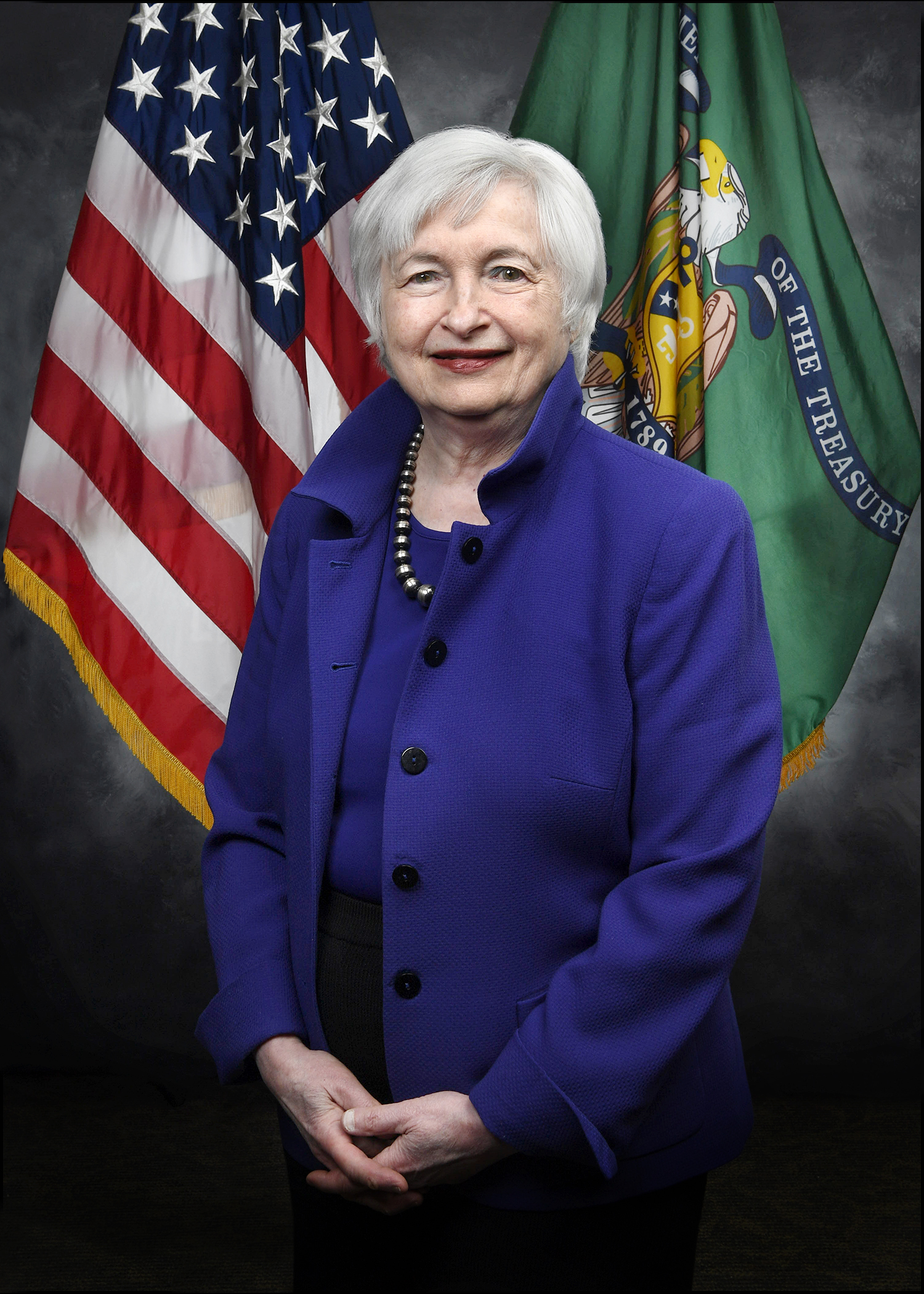
Janet Yellen
Former United States Secretary of the Treasury
12
APPEARANCES
9
PODCASTS
Oct 7, 2026


Janet YellenGUEST
Well, let me start by agreeing with what you said, which is that our openness has been a tremendous contributor to economic growth and the improvement in welfare.
Janet YellenGUEST
You know, economists argue about all kinds of things, but the one thing I've never heard disagreement about is that trade is something that overall enhances economic growth and welfare, which is not to say that it doesn't impose some harm, which is important to address, but overall it's been a big spur for growth.
Janet YellenGUEST
Having open capital markets, welcoming foreign investment to the United States, technology transfer, our investments abroad, very important.
Janet YellenGUEST
And people and talent coming to the United States and starting new businesses and helping business grow.
11 MINS LATER

Janet YellenGUEST
I'm not concerned about the level of the debt, but I am concerned about the trajectory that the debt has been on and where it's headed if we don't take action to deal with deficits.
Janet YellenGUEST
For example, debt that's been issued by one part of the government to another s- whether Social Security or the hospital, uh, Medicare fund.
8 MINS LATER
Dave MartinHOST
I've read a couple of things that you said, and what are your thoughts on political pressure to, you know, manipulate rates or to change rates? Is this good government and, and, uh, or is it dangerous?

Suvir DaswaniHOST
So if you had to grade the US economy today, What letter grade would you give it and why? What's top of mind?
Janet YellenGUEST
You know, in many ways we're doing well and I know many of you here must be focused on AI and this is an incredibly exciting development.
13 MINS LATER


21:24

Where, where do you see the economy right now? You, you wanna grade, grade the economy for us?
Janet YellenGUEST
Um, I'm surprised in many ways that the oil shock and the, um, war in the Middle East hasn't had more of an effect on the economy than it has.
Janet YellenGUEST
I do worry that if it, uh, continues or escalates, um, that we will begin to see a bigger effect.
10 MINS LATER


Janet YellenGUEST
So far, so good in that the Supreme Court has left her for the time being occupying the governorship.
Janet YellenGUEST
And I believe it's next week that the Supreme Court is going to hear oral arguments in that case.
Janet YellenGUEST
Now, if the Supreme Court said, yes, a president can decide if there's cause, now that would be devastating.


Amna NawazHOST
In your words, you said, "To go after somebody that you don't have a valid basis to get rid of..." In your view, what is this investigation really about?
Janet YellenGUEST
Well, it's really about wanting to intimidate Fed leadership to be able to control monetary policy decisions, to bend monetary policy to the president's will.
Janet YellenGUEST
He's been very openly critical, um, really since, um, his second term began, of the Fed's, uh, policy decisions, and he's indicated that he wants far lower interest rates than the Fed has regarded as reasonable to set, given that inflation is, uh, still, uh-... significantly above the Fed's 2% target, uh, and the congressional mandate the Fed's been given to achieve price stability.
Janet YellenGUEST
And the labor market, while it's shown some signs of weakening, is still, uh, the unemployment rate's very low, and it's still in good shape.
Janet YellenGUEST
And President Trump has indicated that one of his goals is to lower the amount of interest that the government has to pay to finance, uh, roughly $38 trillion in outstanding federal debt.
Janet YellenGUEST
Now, that is not one of the goals that Congress has assigned to the Federal Reserve, and that's a very dangerous thing to hear a president say he thinks is an appropriate goal for monetary policy.
Janet YellenGUEST
Because it's when central banks lose their independence and are forced to help governments finance deficits, that's when we see that's always a precondition for high and even hyperinflation.
Janet YellenGUEST
I don't know what his personal circumstances were with these banks, but banks worry about reputational risk.
Janet YellenGUEST
He has had suits that he has lost about misinformation that he's provided about his financial status.
Janet YellenGUEST
But this has been a concern for some time, that groups are being denied access to banking services.
Janet YellenGUEST
I think we got a taste of that when President Trump announced that he had shown a letter to Republicans that would call for Chair Powell's ouster.
Janet YellenGUEST
And while the market reaction was brief, what we saw was The exchange value of the dollar declined, longer-term interest rates moved up, and the stock market declined.
Janet YellenGUEST
Now, President Trump quickly said he had no plan to fire Chair Powell, but I think that gives you directionally a sense of what would happen.
Janet YellenGUEST
Look, importantly, markets rely on the independence of the Fed and the Fed's commitment to achieving its congressionally mandated goals of price stability and maximum employment.
Janet YellenGUEST
in assessing the soundness of the U.S. economy and their security in terms of returns they can expect investing in the United States.
Janet YellenGUEST
And when a president threatens to remove a chair unless he radically lowers interest rates with the stated purpose of helping the government finance its borrowing, not the congressionally mandated goal of price stability, but to ease financing costs on the outstanding federal debt.
14 MINS LATER


Janet YellenGUEST
I think it was totally appropriate that during World War II, the US debt rose to its highest level relative to GDP.
Janet YellenGUEST
The pandemic, we had huge spending, and this occurred even before Biden was elected.
Janet YellenGUEST
And sometimes, the economy is just really weak and we need to create jobs by providing stimulus.

David RemnickHOST
Why is he so abusive toward Jerome Powell? And why is he so desperate to lower interest rates, which is what he's constantly on Powell to do?

David RemnickHOST
Why is he so abusive toward Jerome Powell? And why is he so desperate to lower interest rates, which is what he's constantly on Powell to do?
Janet YellenGUEST
One of his most recent comments about Powell is, He said, look, interest on the federal debt, it is huge.
Janet YellenGUEST
We're spending about a trillion dollars a year on interest on the federal debt.
Janet YellenGUEST
Well, look, if interest rates were lower, the cost of financing the federal debt would be lower.
Janet YellenGUEST
And doesn't that sound like it's a great way to lower budget deficits and help us solve our underlying problem? And that's exactly what Trump said he wants Powell to do, and he can't understand why he's such a numbskull that he won't do that.
Janet YellenGUEST
Well, if I'm allowed to give the answer as to why Powell's not allowed to do it, the words that Trump uttered, are the words one expects from the head of a banana republic that is about to start printing money to fund fiscal deficits when a country, and I can give you lots of examples.
David RemnickHOST
What happens if the Federal Reserve is completely beholden to the president? How does that change the dynamic and the ethics of government?

Janet YellenGUEST
Well, you know, the US Treasury has, for a very long period of time, followed a strategy when it comes to issuance of longer-term Treasury securities of regular, predictable, orderly issuance.
Janet YellenGUEST
We don't try to play the markets, look at what's happening with yields along the curve, but announce, a medium-term program of bond sales that the market understands.
Janet YellenGUEST
So I don't think that moving to bill issuance because you're disturbed that long rates have gone up would be a sensible financing strategy.
Janet YellenGUEST
Bill issuance did surge after the debt ceiling was resolved, and it really spiked.
Janet YellenGUEST
The reason for that is that the Treasury normally holds a cash balance of anywhere between $500 billion to $800 billion.
Janet YellenGUEST
as the debt ceiling became more and more binding, that cash balance was run down to something very close to zero and had to be quickly rebuilt.
6 MINS LATER


Anderson CooperHOST
Secretary Yellen, what's your message tonight for Americans who are rattled by what they've experienced in, in the last days and, and weeks and are concerned about their retirement accounts and nervous about a recession?
Janet YellenGUEST
Well, this is the worst self-inflicted policy wound I've ever, uh, seen in my career inflicted, uh, on our economy.
Janet YellenGUEST
You can see that in the stock market, in the impact, uh, these tariffs are expected, uh, to have on American households, and, um, we're even beginning to see what looks like a flight away from dollar-based assets in the financial markets, which is, um, a r- a really scary development.
Anderson CooperHOST
I mean, the, the, the damage to the reputation of the United States, to the confidence people have or had around the w- the world toward the United States is, I mean, reflected in the dollar and, and investments, uh, how long does that, something like that take to rebuild?
Janet YellenGUEST
Um, dollar assets have long been regarded as the safest in the world, especially US treasury, uh, bonds and bills.
Janet YellenGUEST
Um, they form the core of the whole global financial system, and what we saw this week was a sharp increase, one of the biggest increases on record over the space of a week, in long-term treasury yields, almost 50 basis points, and at the same time, um, a decline in the value of the dollar.