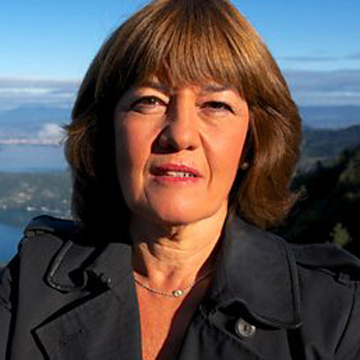
Jane Corbin
British journalist
15
APPEARANCES
2
PODCASTS
Oct 29, 2026

Jane CorbinGUEST
And it's interesting that as it became clear that the Arab parties were going to do really, really well sort of late yesterday, He put out a statement saying that the Arabs had stolen the election.
Jane CorbinGUEST
You know, there was threats made and even that there was manipulation of social media.
Jane CorbinGUEST
But the police and the Shin Bet, that's Israel's internal security service, said, no, there is no evidence of that.

Adam FlemingHOST
But I just wonder, if Netanyahu stays as prime minister, do you expect kind of continuity Netanyahu or a kind of different version of Netanyahu to emerge? And if Gadi Eisenkot takes over, is that sort of, well, continuity Netanyahu, but with just a different person? Yeah.
Jane CorbinGUEST
... two times, that Flydubai, uh, from, uh, Dubai itself to Tel Aviv, and I actually when I, I did it the last time a, a year or so back, I wondered how secure is this? You know, given the geopolitics of the region.
Jane CorbinGUEST
Yes, he was able to greet the Israelis and, and salute them as heroes, uh, when they came back because they obviously stayed in Saudi Arabia on the ground for a little while.
Jane CorbinGUEST
The Israelis offered to send, um, um, aircraft to, to pick them up and bring them back, but Saudi doesn't have ostensibly diplomatic relations with Israel, so the Saudis refused that.
Jane CorbinGUEST
So the, uh, F- Flydubai had to send another plane in to collect them and fly them back to Tel Aviv.
Jane CorbinGUEST
And by the time all of that happened, Benjamin Netanyahu was there to greet, uh, to greet the heroes.
Jane CorbinGUEST
Post October the 7th, 20- uh, 2023, the polls have consistently shown that actually the majority of the Israeli public now do not believe in a, a two-state solution, do not want a Palestinian state.
Jane CorbinGUEST
So when I, suppose the British foreign secretary stands up and says, "This is in, in aid of putting down a marker that we w- we want to still pursue a two-state solution," effectively that is going against the grain of public opinion, uh, in Israel, not just Netanyahu, but public opinion, and that I think explains some of what we've seen and some of the pushback for, in, in public arenas in Israel.
Adam FlemingHOST
And could this be meddling in the Israeli election, which is at the end of next month?
Jane CorbinGUEST
Um, it's definitely a, a key moment, and I think Ed Miliband said, as Lise said, there is no right time to do this, and it is arguable that if you did it after the Israeli election when there was a new government in position or perhaps the same one again, but effectively a new government, that could be seen as meddling as well.
Jane CorbinGUEST
Well, that's the big fire, isn't it? And we've had this negotiation that went on in Pakistan, which seemed to break up, but I never thought it had.
Jane CorbinGUEST
They'd spent twenty odd hours, and it was obvious that it was going to continue behind the scenes, and that's actually what's been happening.
Jane CorbinGUEST
There's still discussions, and, uh, there's optimism, I think, that J.D. Vance, again, will become involved with the Iranians at a, at a high level, and those talks will resume.


Jane CorbinGUEST
And we also know that a week ago, JD Vance was up for twenty-four hours trying to get this thing off the ground.
Jane CorbinGUEST
It was going to be, you know, bombing bridges, bombing power stations." And we know that the Pakistanis with JD Vance really wrestled this thing to the ground, if you like.
Jane CorbinGUEST
And therefore, I think the fact that a week on he is leading the American delegation has got to make us think, as you said, Nick, you know, h-Both sides have lost, both sides have won.


Jane CorbinGUEST
Well, we know that Pakistan is the interlocutor, is the intermediary, and we know also that Donald Trump has a good relationship both with the Pakistani Prime Minister, Shehbaz Sharif, and also with Field Marshal, uh, Munir, Asim Munir, who is the head of the armed forces in Pakistan.
Jane CorbinGUEST
There is a personal relationship, and it's always very important, especially with Donald Trump, those personal relationships.
Jane CorbinGUEST
And so Pakistan offered to try to bring the two sides together, not physically in the same room, but to be the intermediary and to negotiate, uh, in that way.
Jane CorbinGUEST
Um, Iran put, put forward a 10-point plan, and it seemed as if it wasn't going anywhere.
18 MINS LATER
Adam FlemingHOST
And Jane, just to be clear, the reason this was so important is, and, and, and the, the events that led up to all of this turmoil on the markets was Israel striking the natural gas field in the Persian Gulf that, that half of which is in Iranian territory, and then Iran retaliating by hitting Qatar, which is basically the world's largest producer of liquefied natural gas.
Jane CorbinGUEST
Yeah, that oil field straddles under the, the Gulf and south past the, the bit in Iran, huge, and the, uh, the part in Qatar, very significant, and that's exactly what happened.
Jane CorbinGUEST
And Q- you know, Qatar is a really, a real linchpin in this, in, in the Gulf and in what's happened in this war because it's kind of been an intermediary between all sides in the past.

James CookHOST
Jane, it's a decade since Donald Trump won the White House or getting on for it, and I think it is just worth pausing every now and again to remind ourselves that this is not normal action by a president in the context of any other president any of us has known in our lifetime.
Jane CorbinGUEST
Well, those remarks about Keir Starmer were, were really personal, weren't they? And there was a lot of contradictions in what President Trump was saying, but he, he kept coming back to the stance of Britain and the stance of, of Keir Starmer in that very, very personal way.
Jane CorbinGUEST
And we know that in-- when this war against Iran started, there was talk of Britain readying an aircraft carrier to, to join in and help in a very much a defensive role, which Keir Starmer, for reasons of international law and the legality, has always been very careful to, to say that it was only for defensive, not offensive reasons.
Jane CorbinGUEST
And then, of course, the-- we suddenly heard that the aircraft carrier wasn't being got readied.
Jane CorbinGUEST
So obviously behind the scenes, there has been a, a huge amount of toing, toing and froing as to what the Americans want, what the British were prepared to, to provide, and then drawing back from that.
Jane CorbinGUEST
So we've actually got a situation now where there is one, uh, British destroyer still headed, not for the Straits of Hormuz, but for Cyprus, uh, the Dra- HMS Dragon, and that's the only ship that's, that's gone there so far.
Jane CorbinGUEST
And, you know, what, what, what I find quite hard to understand when I listen to what President Trump has been saying is that at one moment, he talks about hammering Iran, uh, i-in the Straits of Hormuz, taking out a hundred ships of those thirtier mine-laying ships.
20 MINS LATER
James CookHOST
What, what do you think the feeling in Tehran will be i-if, if they're focused on this at all, on thinking about the UK or indeed other NATO allies potentially becoming involved here, and this not just being about the US and Israel?
James CookHOST
Jane, because is this the most, the, the big, the, the most, the, the best card in the hand of the Iranians at the moment, and the disruption this is causing to, to the world economy, and the suggestion in here seems to be this is very much going to continue.
Jane CorbinGUEST
Mojtaba says in his speech, the leverage, the leverage, it's an interesting word, of closing the Straits of Hormuz must certainly continue to be used.
Jane CorbinGUEST
And also, he rather threateningly says that, um, there are studies regarding the opening of other fronts where the enemy has little experience and would be highly vulnerable, uh, and activate them.
Jane CorbinGUEST
So you think, yes, he's, he's talking about the Straits of Hormuz, but he's sort of threatening other things, and you have to think that from a Western perspective or the countries around, that could mean terror attacks.
Jane CorbinGUEST
But there are a lot of threats in here, and of course, he understands the economic leverage behind the closing of the Straits of Hormuz.
9 MINS LATER

Alex ForsythHOST
Can you just sort of bring us up to date on where we are with what's currently happening?
Jane CorbinGUEST
Although, as Lyse says, t-tonight or today, um, President Trump has indicated that he wants control over who comes next, and he's been quite firm.
Jane CorbinGUEST
So he's, he's really put his, put his spoke back in again, but less about regime change, and I think that's because the Americans realize that the-The people of Iran are not going to rise up and take to the streets with the risk of, of terrible bloodshed.
Jane CorbinGUEST
So therefore, regime change is not perhaps gonna be the simple thing that it was that we heard right at the beginning of these attacks.
17 MINS LATER
Jane CorbinGUEST
So I think for the Israelis, they wanted to prove that they're, that they're hand in glove with the Americans, and they w-- they said that they, there was such was the level of integration with the US military in the run-up to that first strike on the twenty-eighth of February on the leadership compound, that they actually, um, not only were talking at the highest level, uh, every day, but that they were...
Jane CorbinGUEST
The US and the Israeli war rooms were synchronized in real-time to allow for immediate adjustments based on the Iranian reactions at that point, when that very crucial, from their point of view, from the Israeli and, and American point of view, when that then-- that strike happened.
Jane CorbinGUEST
And I think intriguingly, this official added that, um, that the IDF and the, and the US had deliberately projected an image that the Israeli military was standing down for the weekend.
Adam FlemingHOST
Uh, just as we started recording this episode, they put up a story saying that, that Trump wants to be personally involved in choosing a successor to Ayatollah Khamenei.
Jane CorbinGUEST
Yeah, I think he's, he, he said, "We've got to essentially approve of and who, who is chosen," and he made it very clear that the son of Ayatollah Khamenei would not be acceptable, is, is the phrase he used.
Adam FlemingHOST
the role of the Kurds there and how they felt about what happened afterwards is a very instructive episode for milit- uh, when we think about the history of, of military intervention in this whole region.
Jane CorbinGUEST
Yeah, the 2003 invasion of Iraq, obviously chaos, sectarian conflict, and the empowering of the Kurds in the north, and then effectively there was an abandonment and they felt very, you know, obviously they, they were caught in the middle.
Jane CorbinGUEST
I also think that the 2000, uh, 2011 Arab Spring, the NATO intervention in Libya, where, um, that fragmented the country and it led to, uh, rival governments being set up and militias being set up and, you know, again, descent into chaos that is still going on today.
Jane CorbinGUEST
So within, in, in Iraq, there were, you know, effectively the Americans said, "Mission over," within weeks, and in Libya, they said, "Mission over," within months.
Jane CorbinGUEST
But here we are all these years on and, and, you know, those countries are still, there's still the fallout from these interventions and these attempts to empower ethnic and sectarian groups within those countries has very, very much backfired.
Adam FlemingHOST
Although with all that in mind, Pete Hegseth did say in his press conference on Wednesday that, "None of our objectives are premised on the support or the arming of any particular force." And then he said, "What other entities may be doing, we're aware of, but our objectives aren't centered on that." Um, Jane, there's also moments when you realize that this just ripples out across the whole world, way beyond the Middle East, and that happened today off the coast of Sri Lanka.
Adam FlemingHOST
It sen-seems quite personal and quite visceral, and I mean, comparing Keir Starmer to, to Winston Churchill, that, that's personal, isn't it?
Jane CorbinGUEST
There was real edge in his voice when he said it, and he had preceded this with an attack also on, on Spain and Spain's leaders, and he'd also praised the German chancellor to the skies.
Jane CorbinGUEST
So you, you had three different countries, as it were, in the, in the sights, in Trump's sights, two of which he was very anti and, and obviously not happy with the UK either, is what he said.
Jane CorbinGUEST
He said that it took them three or four days to figure out how to refuel those planes.
11 MINS LATER
Adam FlemingHOST
And in terms of, of US and Israeli military action, Jane, uh, j- a lot more activity today.
Adam FlemingHOST
So I'm just wondering, has Iran thrown everything they've got at its neighbors, and actually the threat is going to recede from now on? Or I mean, it's speculation, I realize, but-
Jane CorbinGUEST
Well, Israel has said today that it, claiming that it's hit underground facilities where ballistic missiles and missiles are being, um, are being built.
Jane CorbinGUEST
We don't know, but the, the general consensus seems to be this will go on for as long as there's ammunition on both sides to throw at each other, and Iran has, we know, large stocks and, of course, of the Shahed drone, which has been a, a game changer in Ukraine and is proving to be so here and that, and, and huge waves of these drones are being used already.
Jane CorbinGUEST
And they have enormous industrial facilities, as I understand, underground to produce these Shahed drones.
Jane CorbinGUEST
So we can only suppose that that is going to carry on for some times, days, if not weeks.
19 MINS LATER
Jane CorbinGUEST
Yeah, I mean, just picking up, as Katrina said, you know, if this goes on to four or five, four or five weeks, we know what happens.
Adam FlemingHOST
And Jane, why are we talking about Hezbollah so much again a-as one of these Iranian regional proxies? 'Cause didn't the, didn't Israel sort of take them out of last year?
Jane CorbinGUEST
To a certain extent, yes, but it's understood that Hezbollah still retains a big arsenal of, of rockets and missiles, largely supplied by Iran or the technology supplied by Iran.
Jane CorbinGUEST
And I think the fear is in Israel, and certainly Benjamin Netanyahu, the prime minister there, has sought to pressurize Trump to come on side with him, not just on nukes and ballistic missiles, but on the proxies, the issue of Hezbollah.
Jane CorbinGUEST
Because Israel is concerned that if, uh, Trump and the Americans strike Iran, they will bear the brunt of it because all those Hezbollah missiles that are still underground will be coming over the border at them.
Jane CorbinGUEST
And again, uh, we haven't really seen, and in the past we've seen Trump and Netanyahu's aims quite closely aligned on Iran, but this time there is a little bit more of a distance, and we're not, we're not seeing quite so much closeness between them.
Jane CorbinGUEST
So, um, Israel, it's very important for Israel whi-what kind of a deal is done, and if it's just about the nuclear issue, it doesn't make the long-term problem go away.
8 MINS LATER
