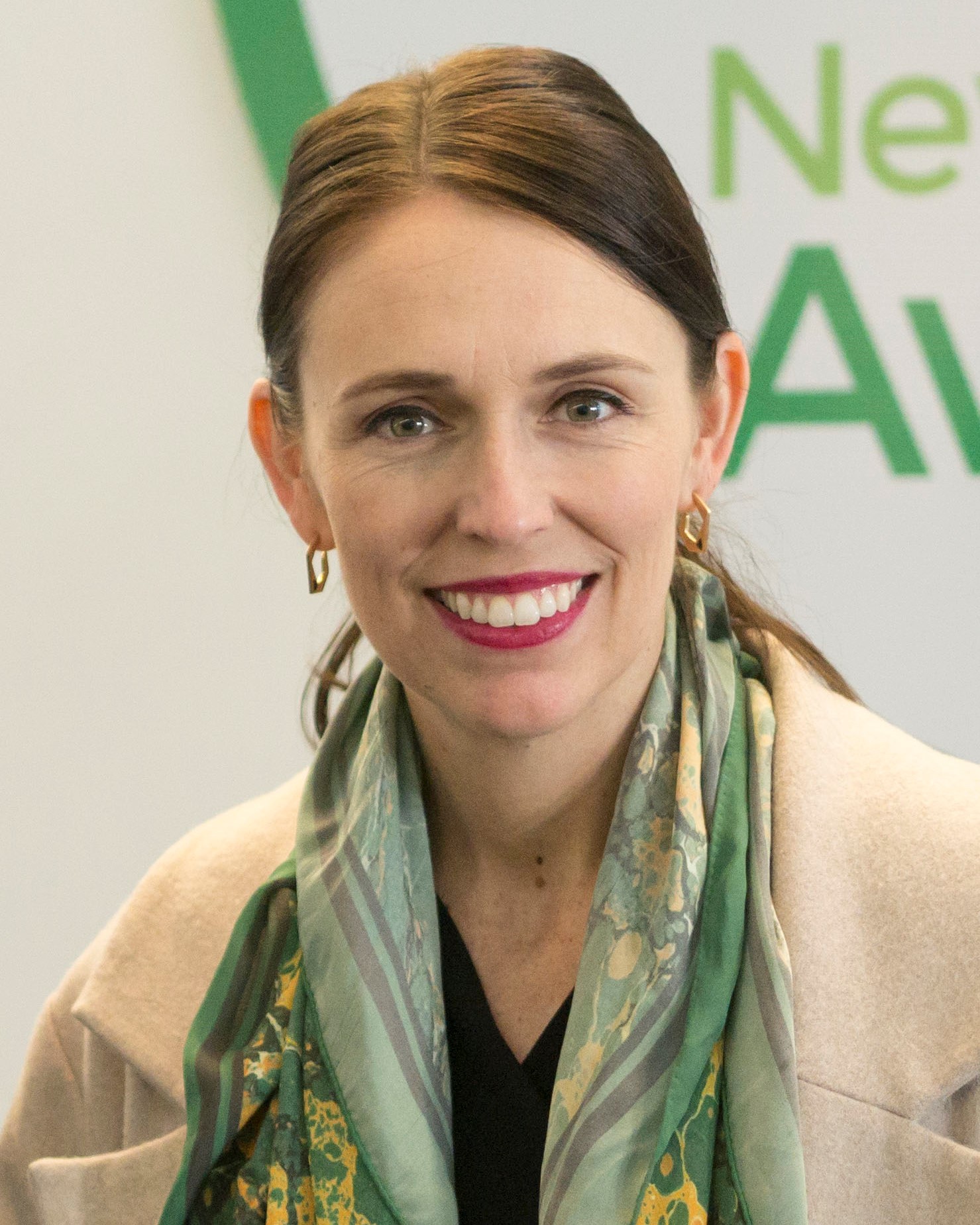
Jacinda Ardern
Former Prime Minister of New Zealand
13
APPEARANCES
13
PODCASTS
Sep 17, 2026


Zan RoweHOST
What was your first reaction when you got the call that there was a mass shooting at two mosques in Christchurch?

Jacinda ArdernGUEST
You know, in, in, in crisis, one of the things that you experience in real time is that you, no one presents to you, uh, you know, immediately the full gravity of a situation.
Jacinda ArdernGUEST
And that in itself can be hugely difficult, because I was at the other end of the country at that time.
Jacinda ArdernGUEST
And so the immediate response from those that I was with was to bundle me off to a police station, because they were worried something else may occur, or that I, I might be targeted.
13 MINS LATER


Ruth RogersHOST
do have to say, I said in my introduction how you were heroic, you are heroic, and the world was watching you.
Jacinda ArdernGUEST
And, you know, at times thinking, you know, everyone's just doing the best they can.
Jacinda ArdernGUEST
And yet I remember thinking, how could things that are meant to be based on science, how do they become political science? I feel the same way about climate change, you know, these issues where actually we have an evidence base around the problem that exists and ensure, you know, there might be different interpretations around what the best thing is to do.


Jacinda ArdernGUEST
So my sister was a avid photographer, and so we repurposed part of the old packing shed on the orchard, uh, with old secondhand photography equipment that we found in garage sales.
Jacinda ArdernGUEST
And I remember this kind of, you know, smelly, musty shed where we would develop photos together.
Jacinda ArdernGUEST
And we'd found some old, after my nana had passed away, we found some old slides, and my sister said, "Oh, we can develop these and take a little look at them." And one of them was this picture of my grandfather holding a swan.

Jacinda ArdernGUEST
So my sister was a avid photographer, and so we repurposed part of the old packing shed on the orchard, uh, with old secondhand photography equipment that we found in garage sales.
Jacinda ArdernGUEST
And I remember this kind of, you know, smelly, musty shed where we would develop photos together.
Jacinda ArdernGUEST
And we'd found some old, after my nana had passed away, we found some old slides, and my sister said, "Oh, we can develop these and take a little look at them." And one of them was this picture of my grandfather holding a swan.


Jacinda ArdernGUEST
Uh, and, you know, the bits that are in there, uh, it's fair to say don't include the number of times I told him to leave me alone (laughs)-
16 MINS LATER
Jacinda ArdernGUEST
I think that it's really interesting that on two recent election nights, prime ministers who won office used their election night victory speeches to talk about kindness.


Jacinda ArdernGUEST
My dad was not a tall man either and so I was amazed that he was okay, whatever had happened.
Jacinda ArdernGUEST
He was really disappointed, I could tell, by the line of questioning I had, and he just said to me, "Jacinda, the words will be the greatest tool I ever have." And what a- what a lesson, um, for someone, but that was kind of the way that he was.
Jacinda ArdernGUEST
And it was a few years later when I was a little older, a little more able to understand his job, he was a detective by this point, so he was, uh, particularly spent a lot of time on homicide cases and I remember our-... trip away for summer holidays was, uh, ended abruptly when there was a homicide in, in our local city.
Jacinda ArdernGUEST
And we came back, and after a few weeks, I remember him making an arrest 'cause I saw his picture on the front page of the paper, and I remember his face.
Jacinda ArdernGUEST
And he was taking in the, the suspect into court, and he just looked so sad.
17 MINS LATER


Jacinda ArdernGUEST
In my mind, all of the questions that you have as a leader, you can assume are going to generally be the questions that others will have as well.
Jacinda ArdernGUEST
We falsely make the assumption that if... we're only going to build confidence in leaders if we demonstrate absolute knowledge absolutely, but actually no human expects that.
Jacinda ArdernGUEST
In fact, I think if you try and portray that or imply that, people immediately are like, "How do you know? How do you know?" And COVID was such a good example.
7 MINS LATER

Jacinda ArdernGUEST
In my mind, all of the questions that you have as a leader, you can assume are going to generally be the questions that others will have as well.
Jacinda ArdernGUEST
We falsely make the assumption that if we're only going to build confidence in leaders if we demonstrate absolute knowledge absolutely, but actually, no human expects that.
Jacinda ArdernGUEST
In fact, I think if you try and portray that or imply that, people immediately are like, "How do you know? How do you know?" And then COVID was such a good example.
7 MINS LATER


Jane CoastonHOST
How were you able to do so? And what can we learn from your trials and tribulations doing so to talk about climate more broadly?
Jacinda ArdernGUEST
And- and I think probably increasingly, at least in the New Zealand example, we have a history of a parliament where from time to time you have seen consensus between opposition and government of the day on certain issues.
Jacinda ArdernGUEST
And I think people in the past have really valued that, but you- you see less of it publicly, and yet the issue where we need consensus is on our response to climate change because it requires a long-term set of policy interventions and solutions.
Jacinda ArdernGUEST
We can't afford to yo-yo every three years in New Zealand's case when we need a 30-year plan.And so, I'd watched from opposition, where I was for a long period of time before becoming prime minister, the issue of how we dealt with agricultural emissions.
Jacinda ArdernGUEST
And the reason this is really important in New Zealand is when you look at our profile, our contribution to climate change, almost 50% comes from food production for us.
Jane CoastonHOST
Looking back on that work now, what do you think of it, and where do you think that work needs to go?

speaker_5ADVERTISER
(instrumental music) What is your advice to business leaders about how they handle their positions on political issues like tariffs and climate change, but then also, how they can work with governments to help solve these sort of big existential challenges?
Jacinda ArdernGUEST
One of the things I heard the most from business leaders during my time in office was how much they valued certainty.
Jacinda ArdernGUEST
How can you give us the most certainty where we can around climate policy, environmental regulation, and so on? And my message always back to them was that if you're seeking certainty in an environment where from time to time you'll see political parties taking different positions, if you operate at the highest bar that you can anticipate being set, then actually you're creating a level of certainty for yourself.
Jacinda ArdernGUEST
Because if the expectation drops lower, then you're already operating at a place where you're insulated against that.
Jacinda ArdernGUEST
If someone raises the bar, then they'll simply meet you at the point that you're already operating.
Jacinda ArdernGUEST
And some might say, "Well, there's an economic cost to that," but policies that are highly variable or creating uncertainty in the way that you're operating comes at a cost as well.
7 MINS LATER

Jacinda ArdernGUEST
You know, in part because I- I think those are all of the things that took me into politics in the first place, and I think unfortunately over time, and this is something that I notice is a bit of a universal theme, we've built up an expectation about, uh, the way that politicians need to behave in order to survive the political environment.
Jacinda ArdernGUEST
But I don't believe that necessarily means that that is what people are expecting of us, that idea that there's- you have to be devoid of kindness because that would equate to weakness, uh, or the idea that it's a compassion-free zone.
Jacinda ArdernGUEST
I actually do think voters seek that, uh, and, uh, hopefully my time in politics demonstrated that you can lead in that way, and you can successfully lead, uh, in that way.

Amna NawazHOST
So I wonder what you think the difference is between the two nations that kept similar changes from being enforced here?
Jacinda ArdernGUEST
And- and look, I- I comment as an observer and also acknowledging there's significant differences in our political systems.
Jacinda ArdernGUEST
Yes, we changed our gun laws and the ban on military-style semi-automatic weapons after that, uh, horrific event in New Zealand.


Jacinda ArdernGUEST
I, you know, I gave her a version of what I'd kind of said at the time because it was, you know, my honest view and it was as I've already explained.
Jacinda ArdernGUEST
And then she just said to me, "But Mummy, we never give up." And suddenly I was mortified at the idea that that might have been what she thought.
Jacinda ArdernGUEST
You know, for me, politics is an incredible place to be useful, to make change, to address injustice, but it's not the only place.
16:11
However, I am gonna ask, do you have any advice for your counterparts here, for America's political leaders who are horrified when they see gun violence here and yet have sworn an oath to uphold our Constitution?


Jacinda ArdernGUEST
... and I, you know, I knew enough to know that it looked like a pretty bad situation.
Jacinda ArdernGUEST
Uh, and my dad clocked me and he told me to just keep walking, and, you know, so o- off I went but then worrying the entire time about how my dad got out of that situation.
Jacinda ArdernGUEST
That night I asked him about it, thinking that because he was so outnumbered that he must have had to have used force in some way, and he looked so disappointed at my assumption.
Jacinda ArdernGUEST
And I remember him saying to me, "The greatest tool that I have will always be my words." You know, and so he, he was someone who modeled, role modeled I think to me, as did my mother, uh, the importance of communication, the importance of empathy, the importance of kindness, even in such a difficult job like policing.
Jacinda ArdernGUEST
And so I think that was probably some of the earliest examples for me of how there can be a strength and a power...to kindness and empathy, uh, which we often forget in leadership.
39 MINS LATER