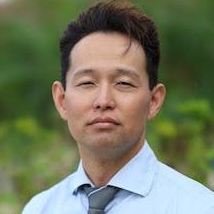
J.S. Park
Hospital chaplain and author specializing in grief, family trauma, and end-of-life care; works at Tampa General Hospital.
5
APPEARANCES
5
PODCASTS
Sep 3, 2026


J.S. ParkGUEST
in order to sit with someone who is suffering yeah And that's such a wild concept, I think, because we are taught, we're led to believe that here is sort of the a to b to c program that we can do to solve almost anything right at any sphere any any area any field yeah we're given that formula those schematics yeah that blueprint and sometimes it works you know we have that repeatable uh scientific method right to be able to get to them then you have these key performance indicators and outcomes and those are all important things right um but grief doesn't have a measurable metric right it doesn't fit a natural timeline yeah even when you watch a movie about grief you know you're always coming to the end of that person's grief because there's a montage they get back to training and they finally take a shower all right you know and they're eating the muffins and you know getting back to work you know and uh is life a montage

JulieHOST
But we do, I will get to other topics.
J.S. ParkGUEST
Yeah, you know, no, I love this theological angle because like, I mean, I have two minds about it.
J.S. ParkGUEST
Like, hell is kind of a, it's condemnation for everyone who doesn't believe in like a particular religious, moral ascent to like this dogma, right? Yes.
J.S. ParkGUEST
And one of the things I've found a lot is that Like, so much about how people at the end, they realize, my religion, my faith, it never spoke to my suffering.
J.S. ParkGUEST
And we conflate the two so often, like I'm suffering because I did this wrong thing, or I'm being punished.
27 MINS LATER
JulieHOST
yeah, it's, Yeah,


J.S. ParkGUEST
And so at least at the hospital that I'm at, chaplains, they kind of train us to assist people with a lot of that heavy burdensome decision-making that goes into it.
J.S. ParkGUEST
So I get to see, I think, people, in some sense, entering a completely new world that they've never experienced before because so many people don't experience, regularly experience death and dying, mortality, injury, or illness until it happens to them or to a loved one.
J.S. ParkGUEST
So when you mentioned death doula earlier, those are incredibly helpful people who, sometimes on a volunteer basis, will assist people with guiding them almost through this very new experience.
30 MINS LATER
37:43
So going back to you, like I- curious if you have any thoughts as a, a chaplain, as a grief doula, of how you interpret this moment we're in.

Todd ZwillichHOST
Does what Greg is saying about his work resonate with you and how is your work different?
J.S. ParkGUEST
You may have seen a level one trauma center very accurately depicted on the show, The Pit.
J.S. ParkGUEST
So I am with many people very often in the worst day, even in the worst moment of their lives.
J.S. ParkGUEST
And the thing that I'm seeing that I absolutely agree with Greg about, I see patients who have faith would identify with not having any faith at all.
16 MINS LATER
Todd ZwillichHOST
How do you counsel people who find themselves in situations like this where they had faith and lost it or they pray and nothing comes back to help them feel a little more certain?


Lisa KeefauverHOST
How would you explain to people what intergenerational trauma or how you see it showing up?
J.S. ParkGUEST
So, you know, the very clinical, I guess, definition of trauma, trauma is not necessarily the event that occurs or happens to you, but it's the imprint left by a negative or harmful event, which outweighs the resources that we have to deal with it.
J.S. ParkGUEST
And so for many of us, it's difficult to cognitively rearrange and just change our minds to get out of the effects of trauma, quote unquote, because trauma is so imprinted in a way that it can get down to our cells, our DNA, our bone marrow.
7 MINS LATER
speaker_2UNKNOWN
Yeah.