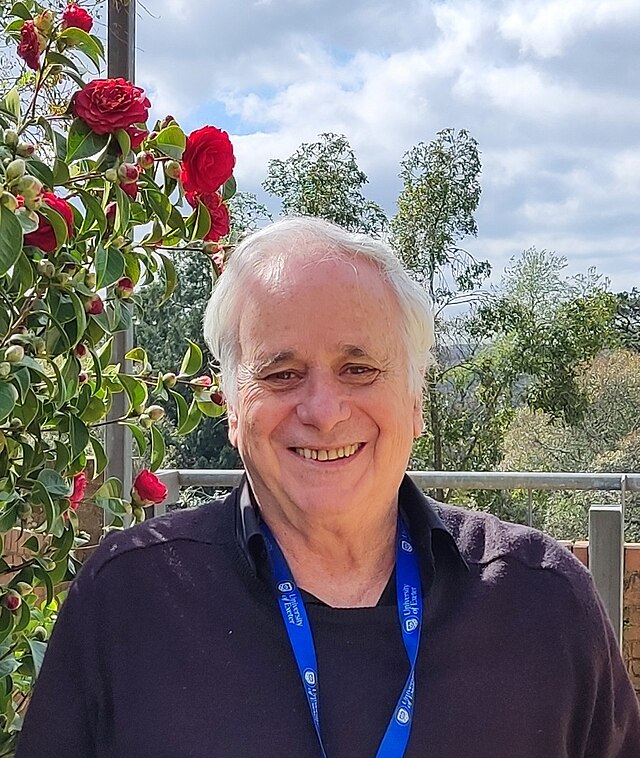
Ilan Pappé
Israeli historian and political scientist
12
APPEARANCES
11
PODCASTS
Nov 5, 2026

Chuck MertzHOST
So Elon, does all warfare serve ruling class interests? Is warfare the violence necessary to keep the ruling class in power, just like you have the violence that is necessary to keep an apartheid state in power?

Ilan PappéGUEST
I think one of the things that the scientific contribution that Joab brings to the book shows that the propensity for war is part of culture rather than nature in many respects.
Ilan PappéGUEST
a means of interaction between human beings that can be intensified, it can be tamed, it can be eliminated.
Ilan PappéGUEST
Now, I would hesitate to generalize as probably pacifists who were facing Hitler in the Second World War would hesitate to say pacifism at any price.
12 MINS LATER
Chuck MertzHOST
Elon, is any threat to colonialism, should that be perceived by capitalists as a threat to capitalism?


Hamza HarrakHOST
Why did that not happen? Why did we then get the Declaration of Independence, the United Nations recognizing Israel, the United States being one of the first countries to recognize, along with a host of others, including the Soviet Union?
Ilan PappéGUEST
Secondly, the Jewish military forces until 1945 that were really fighting the Palestinians more than anything else began to direct their attention to the British, trying to force the British to evict through terrorist acts.

JermHOST
Is that correct?
Ilan PappéGUEST
Uh, and like most Israeli Jews, at the age of 18, I, I was conscripted, uh, to the army.
Ilan PappéGUEST
Uh, and then, um, I went to the university, which was, uh, you know, an ordinary trajectory.
Ilan PappéGUEST
Uh, um, and, uh, did my bachelor, uh, degree and my BA, uh, which still was very conventional in many ways.
Ilan PappéGUEST
Uh, things have began to change, uh, in the early 1980s, actually around 1980 or so, when I decided that I wanted to continue my academic studies as an historian outside of Israel.
46 MINS LATER
JermHOST
Can you please explain Hamas to me?

Ilan PappeGUEST
They would first, as you mentioned, they would say, all right, you know, one state has boycotted us.
Ilan PappeGUEST
And they would only, I think, panic more when it will be, if it will be, an accumulative process.
Ilan PappeGUEST
I also think that they would, of course, go to UEFA and ask for that organization to take action against Ireland.

Ilan PappeGUEST
They would first, as you mentioned, they would say, all right, you know, one state has boycotted us.
Ilan PappeGUEST
And they would only, I think, panic more when it will be, if it will be, an accumulative process.
Ilan PappeGUEST
I also think that they would, of course, go to UEFA and ask for that organization to take action against Ireland.


Ilan PappéGUEST
... is, uh, uh, overseeing, uh, a group of unruly and wild, uh, uh, y- y- y you know, gang members, so to speak.
Ilan PappéGUEST
I mean, the Messianic Zionist, uh, component of his alliance that are pushing for annexation of the Gaza Strip, annexation of South Lebanon, annexation of parts of, uh, South Syria, and of course, total Judaization of the West Bank.
Ilan PappéGUEST
Uh, the other direction or, or the other kind of gang members he doesn't always control are the Orthodox Jews and, and their insistence that their young, uh, uh, young members of their society would be con- continue to be exempted from military, uh, service, uh, which, uh, e- even among his own voters is not a very popular policy.
14 MINS LATER

OllieHOST
Exactly.
Ilan PappéGUEST
So I think that this needs a... a total transformation in the way we perceive the reality and we understand it.
Ilan PappéGUEST
For genuine reasons, people thought that, and they took it from the American business school, that you can divide things, you can partition things, because that's what you do in business, right? But it ignored justice.
7 MINS LATER
LukasHOST
They need to first, they need to stop the genocide, right?
Haim BresheethGUEST
It's a jingoistic society, and jingoistic societies, first of all, get excited by war.
Ilan PappéGUEST
war.Uh, it creates, uh, a false sense of unity in a society which is, uh, not very, uh, uh, united and diversified.
Ilan PappéGUEST
Uh, it creates, uh, a d- a detraction, a- a- and re- a deflection, uh, for politicians and sections of society from, from other problem.
Ilan PappéGUEST
Uh, uh, so part of it is, is even mass psychology, uh, that we have, uh, e- encountered in the past in, uh, societies such as, uh, in Prussia and later in Germany and Italy, and to a certain extent in Britain in, uh, cer- certain periods of Britain's history.
Ilan PappéGUEST
What is, uh, uh, unique in a sense is that, uh, a- among the people who should provide a more profound analysis, whether it's a journalist, of course, Gideon is not the, uh, the example for that, whether it's journalists, uh, uh, academics, uh, people who should provide the more profound analysis, you hardly hear the connection between the ideology of the state, the, uh, history, the historical context, and the f- a- and the, uh, continued, uh, violence that Israelis find themselves again and again in one cycle after the other.
6 MINS LATER
Tom McRaeHOST
Does that show the kind of status and currency the Israeli military has in Israeli society?

James BaysHOST
In fact, we've seen it in the war in Iran, there are civilians dying each time, too.
Ilan PappéGUEST
There is a long history of this policy of assassination going back to, uh, the 1940s.
Ilan PappéGUEST
The, the first, uh, time that officially, uh, the Zionist leadership, that is in the pre-state, uh, period, uh, was authorizing i-its, uh, agents, its, its troops to target Palestinian leadership, not just military leadership, uh, journalists, political leaders, was already then in 1946, believing then as they believe now, that if you target the elite, whether it's a political or cultural, social elite, you subjugate more easily the society as a whole to your plans of, uh, occupation, colonization, and so on.
Ilan PappéGUEST
What is, of course, incredible is that since 1946, again and again, this, uh, assassination policy proved to be a total failure.
Ilan PappéGUEST
Uh, and, uh, and yet there seems to be no process of learning in the Israeli policymakers, which makes you think that it's not anymore about really believing that it achieves anything in terms of, uh, defeating the enemy, so to speak.
14 MINS LATER
James BaysHOST
How are you going to find an Iranian Delcy if you keep taking out all of the Iranian leadership one by one?

Ilan PappéGUEST
The division is mainly the result of a major contradiction that was inbuilt into the Zionist project from its very beginning.
Ilan PappéGUEST
And that is the idea that you can define Judaism, which is a religion, as nationalism.
Ilan PappéGUEST
If you would have tried the same to do for Christianity or Islam or Buddhism, you will run into similar problems.
Ilan PappéGUEST
So there are two camps that are now much more clearly defined than maybe before in Israel of how to define Judaism.
Ilan PappéGUEST
This has huge implication on the public sphere on the content of the educational system, on the freedom of speech, of liberties, not to mention, probably more important than anything else, on the treatment of non-Jews, particularly the Palestinians.

David MarrHOST
Ilan, why has this state of Judea, as you call it, grown up? Why has it come to dominate the politics of Israel? These things don't happen by accident.

Ilan PappéGUEST
First of all, there is some joy in knowing that the bombing of the people in Gaza has stopped for a while.
Ilan PappéGUEST
And there is joy knowing that Palestinian political prisoners have been reunited with their families.
Ilan PappéGUEST
I But except from that, I don't think we are in such an historical moment as President Trump claimed in his speech in the Knesset and beforehand.
Ilan PappéGUEST
We are not at the end of the terrible chapter that we have been in it for the last two years.

Amy GoodmanHOST
Others are saying the possibility of his arrest, not on corruption charges, but on crimes against humanity, the whole case before the International Criminal

Ilan PappéGUEST
Uh, first of all, uh, there is, uh, some joy in knowing that, uh, the bombing, uh, of the people in Gaza has stopped, uh, for a while, and there is joy knowing that Palestinian political prisoners have been reunited with their families, and similarly that Israeli hostages were reunited, uh, with their families.
Ilan PappéGUEST
Uh, but ex- except from that, I don't think we are in such an historical moment as President Trump, uh, claimed in his speech in the Knesset and beforehand.
Ilan PappéGUEST
Uh, we are not at the end of the terrible chapter that we have been in it for the last two years, and that chapter is an Israeli attempt by a particularly fanatic, extreme y- uh, uh, right-wing Israeli government to try and use ethnic cleansing in the West Bank and genocide in Gaza to downsize the number of Palestinians in Palestine and impose Israel's will, uh, in a way that they hope would be at least endorsed by some Arab governments in the world, and so far they have an alliance of Trump and some extreme right-wing, uh, uh, parties in, in, in Europe.
Ilan PappéGUEST
And now, I hope that the world will not be misled that Israel is now ready to open a different kind of page in its relationship with the Palestinians.
Ilan PappéGUEST
And what you told us about the way that the celebration were dealt with in the West Bank and the incineration of the sanitation center shows you that nothing has changed in the dehumanization and the attitude of this particular Israeli government and its belief that it has the power to wipe out Palestine as a nation, as a people, and as a country.
Amy GoodmanHOST
Others are saying the possibility of his arrest, uh, not on corruption charges, but on crimes against humanity, the whole case before the International Criminal Court.