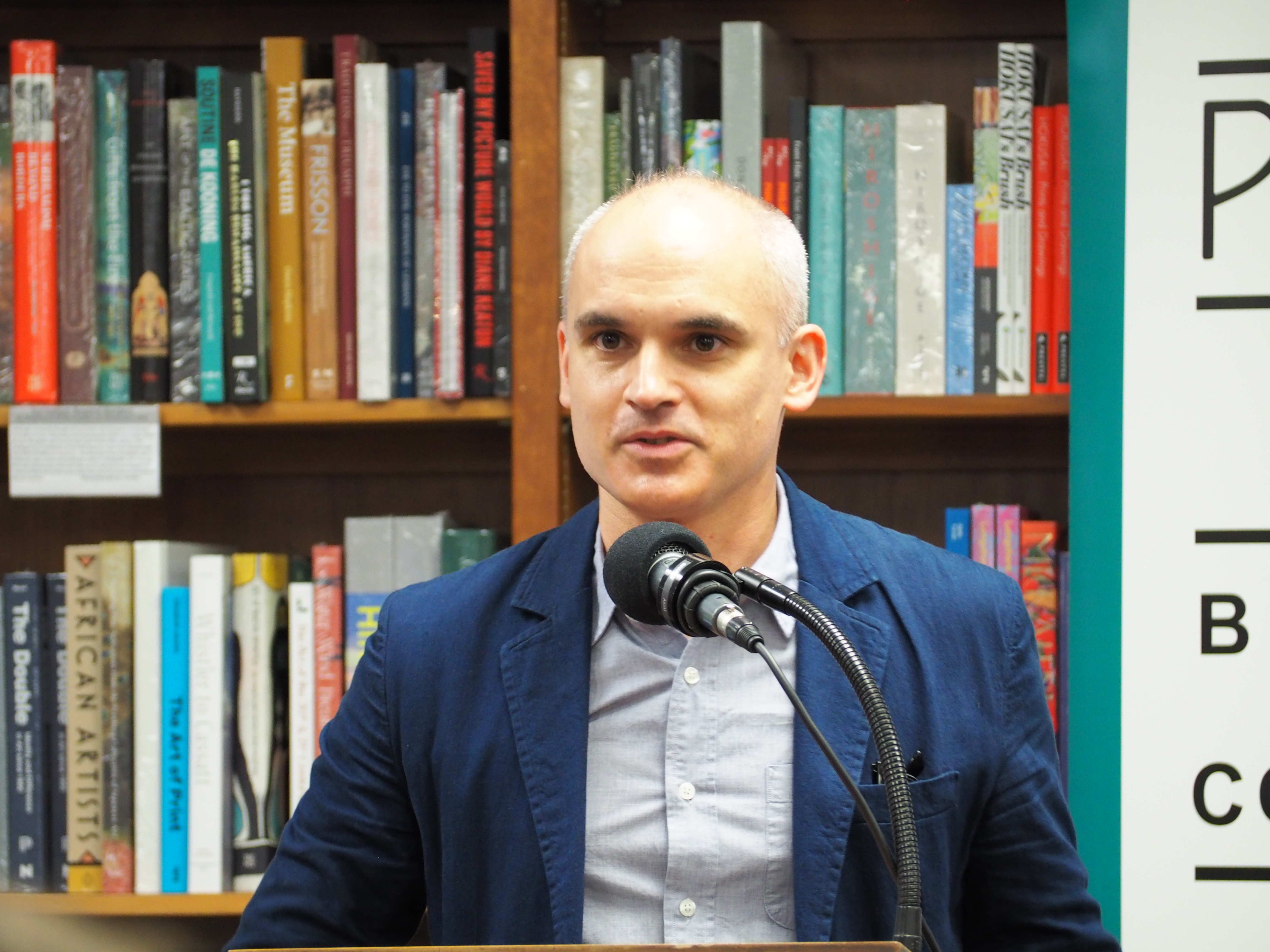
Hernan Diaz
Argentine-American writer
11
APPEARANCES
11
PODCASTS
Nov 6, 2026


Joe SkinnerHOST
Does your process change from book to book? And how do you go about balancing those two sides of the story
24 MINS LATER
Joe SkinnerHOST
As a writer, just on the craft side of this, how do you wrap your head around piecing all these different ideas together? How would you describe that process for Ply?


Kirsty WarkHOST
Hernán Díaz, please describe the setting and how far in the future the book is set.

Hernan DiazGUEST
I left it a little bit unmoored and untethered to give readers enough space to roam in their imaginations.
Hernan DiazGUEST
And a new historical epoch is trying to be born among the debris that remains of the previous historical period.
Hernan DiazGUEST
So it's very much a transitional moment in history, but it's not about sort of the end of an electoral cycle or something like that or a regime.
6 MINS LATER


Elissa NadwornyHOST
I spoke with Hernan Diaz here in the studio and asked him to start by telling us about the book's main protagonist.
Hernan DiazGUEST
The protagonist is a young woman who lives in this city sometime in the future, vaguely shaped after New York.
Hernan DiazGUEST
She's very intuitive as a sort of proto engineer, what in this world is known as a tinker, someone who fiddles.
Hernan DiazGUEST
Very, very few things are made from scratch, new industrially, so people get by fiddling and tinkering with objects and technology, and she's very adept at it.
Hernan DiazGUEST
Gradually, she becomes a pincher who's someone who siphons electricity for the grid.
9 MINS LATER

TomHOST
Mm-hmm.
Hernan DiazGUEST
Because, uh, apocalypse implies sort of, uh, um, a scatological, teleological notion of history like- Everything has ended.
Hernan DiazGUEST
In terms of dystopian, I think for sure, as I was saying in my, in my previous answer, for sure, uh, in this world, many things have been lost.
Hernan DiazGUEST
Uh, mostly those that are associated with, uh, the institution of the modern state, the rule of law, uh, public services, most importantly public health, education, safety, uh, uh, sort of a regulated currency, which is also a tremendously important, uh, uh, event in human history to have regulated currencies.
TomHOST
What did you want the disagreement to establish about the competing visions of humanity in the novel?

Sarah Jenks-DalyHOST
I think family specifically, because I think that was a really interesting part to me, was the relationships that the pincher is involved in as we follow her over the course of these few years.
Hernán DíazGUEST
I'm very interested in the family as a unit and as our first experience as humans of intimacy.
Hernán DíazGUEST
Like that is our first connection or approach to that, what it means to be extremely close to someone both physically and emotionally involved.
Hernán DíazGUEST
I think this notion of sort of the bourgeois patriarchal family wasn't always such a stable institution at all.
Hernán DíazGUEST
I was trying to think of these units that are still sort of brimming with emotion and where one goes to find safety and comfort and shelter in physical and emotional ways, but that were sort of unmoored from the family structures as we know them.
Sarah Jenks-DalyHOST
The second part would be, did you feel as though you had to understand it to write it?


Hernán DíazGUEST
Well, a few things, I think, and entire, not volumes, but libraries have been written about this, how age is a little bit of a construct.
Hernán DíazGUEST
Of course, there were always pubescent humans who were undergoing all these hormonal changes.
16 MINS LATER

Hernan DiazGUEST
So the order that we currently live in, all of us globally I would dare to say, which is an order that is centered mostly around a few notions.
Hernan DiazGUEST
The notion of the institution of the state, which is kind of omnipresent, which can be both oppressive but also Boy, will we ever miss it when it's gone, you know? And we see the signs of it cracking now.
39 MINS LATER

Miwa MesserHOST
And there's a point where the pincher says, are these actually my memories of my life or are these my mother's interpretations?

10:02

And what made you think, do you know what, this would be a great fit for the book that I'm working on?
Hernán DíazGUEST
And in Frankenstein, obviously, this is creating life out of dead tissue, right? Which completely alters our very definition of life itself.
14 MINS LATER
24:02
astronauts and when they were flying around the moon this year ahead of time they said they spent a lot of time working with poets in terms of working out ways to describe what they saw because potentially like many scientists they're quite analytical and maybe didn't have the background in this kind of freer form of writing and you've been on both sides of it now you've worked with the scientists in cern and obviously you've been writing your book what do you think the kind of through line is between the two what can one learn from the other do you think

Hernan DiazGUEST
Yeah, so this, this independent publisher had, uh, one day a year of open submissions.
Hernan DiazGUEST
Uh, but I was ready, and I think they capped it at 600 or 800 submissions, which only took a matter of hours-

Peter SagalHOST
met."I wonder, though, since, since you were able to pursue your art with such passion for what you were doing in isolation just for yourself, is it actually harder now that you're an award-winning acclaimed novelist who everybody expects great things from?
Hernan DiazGUEST
Uh, but I also know the other side of this, of writing in complete solitude, in this kind of solipsistic, uh, uh, madness of, of, of, and keeping going despite the world telling you to please stop.


Loren MossHOST
Now, now are there this year? Tell me about the are there any speakers or keynotes that you wish to highlight? Who are some of the the interesting speakers that you're going to have this year?
Hernan DiazGUEST
Well, on Wednesday, September the second, we're going to have the official opening ceremony.
Hernan DiazGUEST
Well, bringing together key national and international authorities from the European Union and others, well, some other countries, to launch the 41st edition of Andycom.
Hernan DiazGUEST
And during this morning, well, attendees will hear the vision of the national government, so we expect the participation of the Minister of Information and Communications Technology, Mrs. Alexandra Falla, and also with other representatives of the European Union.
Hernan DiazGUEST
Also this day, on September 2nd, we're going to have some keynote speakers from different companies, big tech companies such as Google AI, Microsoft, and also, well, Oracle.
Hernan DiazGUEST
To highlight some of the speakers we're going to have this day, I can highlight Pilar Manchón.
7 MINS LATER
Loren MossHOST
Is there anything that you wanted to mention that I neglected to ask you that you wanted to bring up or let the listeners or readers know? Yeah, well,

Hernan DiazGUEST
And it was very important for me that my character or characters, that their fortune not be rooted in any sort of tangible goods, right? It had to be abstract finance because I think it's so weird.
Hernan DiazGUEST
The more removed these financial instruments are from our daily lives, paradoxically, the more influential they are.
Hernan DiazGUEST
And also this high level of abstraction made me think of math, which also made me think of music again, which is a big part of the book.
10 MINS LATER