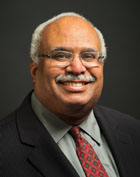
Georges C. Benjamin
American physician
6
APPEARANCES
6
PODCASTS
Sep 15, 2026

8:00

Do you remember a time or the moment when you first learned about public health or thought about public health as a career?

Georges C. BenjaminGUEST
Yeah, you know, interestingly, I never really thought of public health as a career.
Georges C. BenjaminGUEST
Many of my colleagues in University of Illinois were getting MPHs because they saw the MPH as kind of the MBA for medicine.
Georges C. BenjaminGUEST
Because if you think about it, public health is a five core competency that you just didn't get a lot of in medical school training, health administration, believe it or not, statistics, epidemiology, mental health.
Georges C. BenjaminGUEST
was unless you're going to go into psychiatry or behavioral health, that wasn't really emphasized a lot in most people's medical school training.
14 MINS LATER
23:08
How have we been winning in this last year? You can pick whichever one you want to start with.


Ken CookHOST
Now, when I think of military medicine, to me, it seems like, isn't it always a goddamn emergency?

Georges BenjaminGUEST
What's left? No, military medical training programs are no different than the civilian.
Georges BenjaminGUEST
You see military members and their families, and they have heart attacks and asthma, and they need high blood pressure taken care of.
Georges BenjaminGUEST
So no, my training was no different than anybody else, except The fact that when the military regionalizes stuff, that means that you take care of everybody who needs specialty care in that region.
Georges BenjaminGUEST
So just to give you an example, if you're a specialist in gastroenterology, One of the things that you learn to do is a procedure called endoscopy, where you take a tube and you go through the mouth into the stomach to look at the stomach.
Georges BenjaminGUEST
If you have a bleed or any kind of tumor or anything like that, that's usually reserved for people who are specialists in gastroenterology.
Georges BenjaminGUEST
Now, as a resident, you do get to do a few of those procedures because they want you to learn to do the procedure as an internal medicine resident.
16 MINS LATER

Georges BenjaminGUEST
And what the problem is what used to happen is you would have someone from out of the country who would come in, um, and they would go into a community that was under-vaccinated or unvaccinated.
Georges BenjaminGUEST
And, and then you would spend hours because what a health department officer has to do is they have to go and chase every single case, um, just like Sherlock Holmes.
McGraw MilhavenHOST
A lot of people say, I hear a lot of parents say, "I, I, I'm not against the vaccines, I just don't want them, uh, all at once," or, "I'd like to spread them out," or, "My pediatrician wants to give them all at once and I, I, I think, uh, they should be spread out." What do you say to somebody who, who, who asks about that?

Kim MillsHOST
And Dr. Benjamin, from your vantage point, what are these factors like housing instability and food insecurity and, and the economy, how are they affecting people's physical health?
Georges C. BenjaminGUEST
You know, Kim, I think the big issue here is the fact that people have never really had any rest.
Georges C. BenjaminGUEST
When people go into combat in the military, we take them out of circulation so they can get what we call crew rest.
Georges C. BenjaminGUEST
When I used to run the EMS system here in Washington, DC, we would put our EMS workers and our firefighters, giving them some downtime.
Georges C. BenjaminGUEST
For the last twenty years, we've had a pandemic, we've had economic disruptions, at least two of them.
Georges C. BenjaminGUEST
We've had social unrest, we have political polarization, and what's happening right now, it's on steroids.
9 MINS LATER


Rebecca AlvaniaHOST
How do we talk about prevention in a way that really connects with communities today?
Georges BenjaminGUEST
We often talk about the fact that we're talking about prevention, but I'm not quite sure that we are really selling prevention as the best buy that it is in the best way possible.
Georges BenjaminGUEST
First of all, of course, when we do our best work, nothing happens, or the less severe things happen.
Georges BenjaminGUEST
And if you think about what we did during COVID, for a variety of reasons, we were counting ER visits, hospitalizations, and deaths.
Georges BenjaminGUEST
when we probably should have been talking about lives saved, lives improved, number of people vaccinated, and helping people connect the dots to our prevention efforts versus, frankly, being on the frightening side of the equation, which they were already afraid of the disease.
Georges BenjaminGUEST
Now, it was important for us to tell people what we knew and what we didn't know.
Georges BenjaminGUEST
But we often did not celebrate the successes on an ongoing basis, which I think would have been much more hopeful.
Rebecca AlvaniaHOST
When you think about where public health is today, what are some areas where you think we could achieve important wins in the next five to 10 years?


Jen PsakiHOST
What kind of impact could that have on the work that they do that impacts people who are watching?
Georges BenjaminGUEST
Well, this is an example on the part of the secretary of failed leadership and administrative incompetence.
Georges BenjaminGUEST
You know, he has created a toxic work environment, um, and then, of course, after them bringing on board a highly competent expert in infectious diseases who told the secretary that his ideas around COVID vaccination, um, were not scientifically valid, he decides he wants to fire her.
Georges BenjaminGUEST
You know, they're pushing out some of the world's top experts in disease: infectious disease, chronic disease, injury, climate disease, environmental health.
Georges BenjaminGUEST
And what this means is that, again, um, the air will not be safe to breathe, the water not safe to, to drink, and the food not safe to eat.
Georges BenjaminGUEST
We can't assure you of that because the federal oversight of those activities won't be there with the experts that are necessary to get the job done.