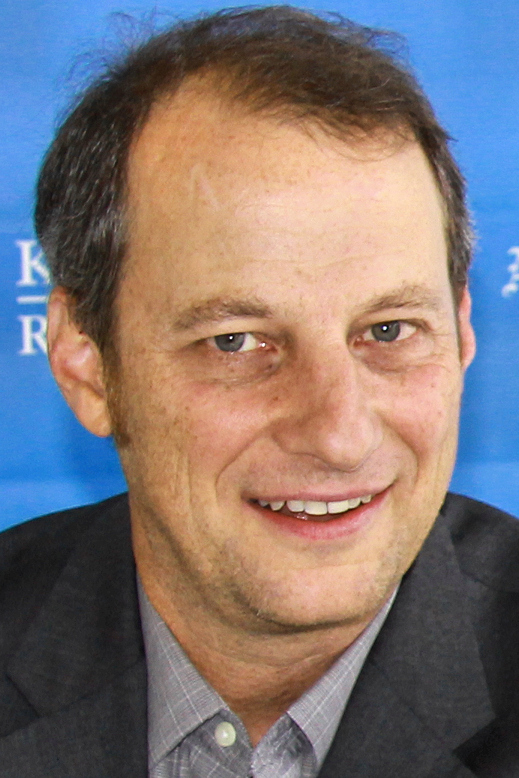
George Packer
American journalist and novelist
16
APPEARANCES
12
PODCASTS
May 14, 2026


George PackerGUEST
One that will be in the June issue of The Atlantic and that was just published on the web last week is really about corruption.
George PackerGUEST
It's about a guy named David Sacks, who is a Silicon Valley venture capitalist, entrepreneur, Peter Thiel friend, sidekick, former PayPal alumnus, who Trump appointed as his, uh, AI and crypto czar.
George PackerGUEST
And so Sacks spent a year, half-time, because he did not quit his job as a venture capitalist.
George PackerGUEST
He got a sort of special, uh, benefit of clergy and was allowed to continue to invest money while making policy about technology and ultimately about money.
George PackerGUEST
Sacks pushed the Trump administration, which didn't need much pushing, into a position of sort of a radical anti-regulatory stance on AI.
5 MINS LATER

Preet BhararaHOST
And why, if that is corruption of the kind you describe, why is that the thing that broke through to the MAGA base and not the Qatari plane? Although I do think, and I have not seen polls, that nobody is a big fan of the billion-dollar ballroom.

George PackerGUEST
Yeah, we had a nice chat, Steve Bannon and I, and he said some typically incendiary things, and one of them was that David Sachs, whom he is on record as really disliking, if not hating, has been g- the best thing that could have happened to MAGA because as Bannon sees it, Sachs' maneuvering in favor of the tech industry has been so blatant and clumsy and incompetent that he's made, uh, what Bannon calls the AI supremacists look bad, that he's defeating his own cause.
George PackerGUEST
He's got-- kept Washington's hands off AI, but he's losing the war because he's actually alienating some important parts of the MAGA coalition," including members of Congress who Sachs sort of pushed hard to prevent bills or amendments that would have put American companies ahead of China for those valuable AI chips, an amendment called the Gain AI Bill that was defeated, um, because Sachs and Trump, uh, decided to tell the congressional Republicans that they didn't want it.
George PackerGUEST
Well, this was a very popular idea to have American companies ahead in line of China, but no, that's not what NVIDIA wanted.
12 MINS LATER


Chris HayesHOST
And Donald Trump is coming to office just as they want to make these trillions of dollars, and Sacks is the kind of nexus between these two interests.
George PackerGUEST
He's Silicon Valley's man in Washington, which is interesting because Silicon Valley for decades wanted nothing to do with Washington.
George PackerGUEST
It had kind of a contempt for bureaucrats, for the creaky workings of representative government.
George PackerGUEST
We might contribute money every now and then, but we'll go our separate ways, and it'll be good for everyone, and it will change the world." But in the last decade, I think Silicon Valley realized it could not afford to keep its distance on Washington.


George PackerGUEST
There's an, an empire has collapsed from boredom, distraction, loss of faith in itself.
George PackerGUEST
The main drama is about a family that lives in that empire, in a ci- in a city, unnamed.
George PackerGUEST
It's a doctor, a surgeon, who's a very accomplished, respected pillar of the community, uh, his wife, and their two children.
George PackerGUEST
And the main relationship of the whole novel is between the doctor and his 14-year-old daughter, Selva.
32 MINS LATER


George PackerGUEST
... uh, ominous, ominous billionaire, has many big ideas about American decline and the failure of democracy that kinda point toward a more authoritarian system, and he's a brilliant investor, made his money at PayPal, Facebook, Palantir, and becomes a big influence on Vance.
George PackerGUEST
He gives a talk at Yale that Vance goes to as a law student, and the talk is about how while you're here cutting each other's throatsTo get the best jobs that you will then find meaningless and unfulfilling in corporate law.
George PackerGUEST
America is declining in a decadent phase, technology is stuck, and no one seems to be aware of it.
George PackerGUEST
We're just fighting each other for these elite jobs that are dwindling because we're stagnant.
George PackerGUEST
All of this speaks very deeply to Vance, because I think at that point he had also begun to feel, "What am I here for? Why am I trying so hard to make it in this world when it doesn't really seem to have a whole lot of value other than just credentials?" He continues to make it in that world and to do all the right things, but I think Thiel planted a seed of doubt that paid off when Vance got out of law school, did a couple years of law, and then went out to Silicon Valley to work for Thiel.
speaker_8HOST
Yep.
George PackerGUEST
And not only is it more than 5%, it's 100%, because even the talk about jobs and making America great is all about making America great without them, because they have made it bad.


George PackerGUEST
I mean, a, a president who perhaps made the final decision to, uh, capture and, and bring out Nicolas Maduro because he was pissed off that Maduro was dancing on TV in a way that seemed to be taunting Trump's threats, is gonna make decisions based on a sense of loss of face or of, uh, a personal grudge.
George PackerGUEST
"Let's send 3,000 federal officers there, uh, and provoke and see, uh, see how they react." So I, yeah, I don't think this is part of a, a, a particularly thought-out strategy of how to get to, uh, Stephen Miller's million-per-year deportations, but, "Why not try Minneapolis? 'Cause we don't like them, and they don't like us."
27 MINS LATER

George PackerGUEST
Um, because I think as far as (clears throat) we can tell from reports that the Trump administration did not go through the usual sort of policymaking process in arriving at, at this action.
George PackerGUEST
It, it seems to have been maybe something that was in the, in the works for a long time, but, uh, absolutely no consultation with Congress, no preparation of the American people, um-... you, I, I lived through the Iraq War and I remember a, really a year-long public relations campaign by the Bush administration to prepare Americans for a, for an invasion that was still quite confusing because the rationale for it was confusing.
George PackerGUEST
In this case, the rationale is utterly baffling (clears throat) because there's so many contradictory justifications being given by top people in the administration.
George PackerGUEST
There was a, a long, uh, campaign of bombing of alleged drug boats off the coast of Venezuela, uh, threats, um, a, a large American military presence, uh, in the region, in the Caribbean, but no explanation.
35 MINS LATER


George PackerGUEST
I wrote a book in 2013 called The Unwinding that it was kind of a big panoramic narrative rather than, um, an, a polemic or an analysis.
George PackerGUEST
But it, it essentially showed a landscape on which someone like Trump was very thinkable, and a couple of years later, there he was.
George PackerGUEST
Because of the level of alienation, the cynicism about the elites, about business elites, government elites, media elites, the loneliness, the fact that Americans seem to be cut off from one another, the lack of any institutional, uh, sort of foundation for people's lives for, to support or maintain a, a, a middle-class life.
George PackerGUEST
Um, I was in kind of left-behind parts of the country and was s- seeing that everywhere.
George PackerGUEST
So it was Obama's first term, and while Obama w- as you know, [laughs] John, was struggling to pass legislation that could address these things, it just didn't seem to be reaching people and making them feel as if, "Yeah, this is gonna change my life, and he cares." Instead, it felt very far away, uh, and slow.
13 MINS LATER
George PackerGUEST
By 2021 or '22, Tim, I had begun to have a crisis of my faith in facts in my, in my profession, because they seemed to be unable to establish any kind of shared consensus about what's real.
George PackerGUEST
For example, what happened on January 6th, 2021? For about three news cycles, people agreed what happened, and that it was terrible.
George PackerGUEST
And then, it just began to fall apart almost immediately because we are not that country anymore that can come to any basic agreement about what is real and what is true.
27 MINS LATER

Tim MillerHOST
I couldn't even watch it because just of my conflicting feelings about it, but, like, that scene in Arizona with of his, of his memorial.


George PackerGUEST
And a, a grand jury had originally refused to as well, and finally, President Trump found the prosecutor who would do his bidding, and she, in a kind of shambolic way, assembled a, a case very quickly, uh, and got a grand jury to go along with it.
George PackerGUEST
And since then, other enemies of the president, political enemies, have also been indicted.
George PackerGUEST
And that, the rule of law is such a powerful tool, and the s- pressure of the state weighing down on an individual is so crushing that it almost doesn't matter.
George PackerGUEST
Of course it matters, but they will suffer irrevocably whether or not they're convicted because of the amount of time and money and energy and just sheer anxiety and stress that is involved in having the federal government coming after you.
George PackerGUEST
Trump can spend or not spend if it's been appropriated and he decides he doesn't like it.
George PackerGUEST
Trump can eliminate programs that Congress legislated, beginning with, uh, USAID.
George PackerGUEST
I mean, I wrote The Unwinding, a nonfiction book, to try to describe it, to some degree explain it, mostly describe it.
George PackerGUEST
I did not anticipate the coming of Trump, but the, the book describes a landscape in which a figure like Trump is quite thinkable.
George PackerGUEST
And yet even that book, um, doesn't answer fundamentally the question, why is this successful, prosperous, uh, relatively united, um, militarily immensely powerful democracy, um, in the process of, of if not destroying itself, at least weakening itself, hurting itself? And so in a way, I've avoided answering that question in The Emergency by simply saying boredom and loss of faith.
George PackerGUEST
And I think there is an element of that in our country, a loss of faith in our country.
7 MINS LATER

Yascha MounkHOST
Would it be too simple to say that this is a bizarro world, a, a, a emergency land world, a pecker land, uh, pecker world version of the MAGA movement?


George PackerGUEST
I'm not a historian so it's not my profession to do it but as a writer and a journalist, I find myself thinking about the Declaration, the Constitution, the figures that, uh, Jeff Rosen has been talking about and the, um, conflicting, clashing ideas that he outlined because for the first time in my life, I sense that it is in danger of fading, that we're in danger of losing the best of those ideas, uh, of the documents that, um, that became the founding documents.
George PackerGUEST
And th- this is something new for me and I think for a lot of Americans that, for example, there is a tendency, uh, on the MAGA side to welcome the idea of a Caesar, not to warn about it, but to say we need a Caesar.
George PackerGUEST
To welcome the idea even of a monarch, um, to question, as Vice President Vance has done repeatedly, whether the founding ideas really are the definition of Americanism or whether it's something closer to European blood and soil and nationalism.
George PackerGUEST
These are all, for me, shockingly new and disturbing, uh, earthquakes in, in our history.
6 MINS LATER


George PackerGUEST
You get rid of all the independent offices, whether it's inspectors general, uh, prosecutors who are independent, federal commissioners, for example, on the FCC, central bankers, Federal Reserve, and you replace them with loyalists.
George PackerGUEST
I'm a little worried that the Supreme Court has become a kind of firewall for the administration when- whenever there is a real, a direct legal threat to its power.
9 MINS LATER
George PackerGUEST
... uh, ominous, ominous billionaire, has many big ideas about American decline and the failure of democracy that kinda point toward a more authoritarian system, and he's a brilliant investor.
George PackerGUEST
Made his money at PayPal, Facebook, Palantir, and becomes a big influence on Vance.
George PackerGUEST
He gives a talk at Yale that Vance goes to as a law student, and the talk is about how while you're h- here cutting each other's throats to get the best jobs that you will then find meaningless and unfulfilling in corporate law, America is declining, in a decadent phase, technology is stuck, and no one seems to be aware of it.
George PackerGUEST
We're just fighting each other for these elite jobs that are dwindling, because we're stagnant.
George PackerGUEST
All of this speaks very deeply to Vance, because I think at that point, he had also begun to feel, "What am I here for? Why am I trying so hard to make it in this world when it doesn't really seem to have a whole lot of value other than just credentials?" He continues to make it in that world and to do all the right things, but I think Thiel planted a seed of doubt that paid off when Vance got out of law school, did a couple years of law, and then went out to Silicon Valley to work for Thiel.
George PackerGUEST
And not only is it more than 5%, it's 100% because even the talk about jobs and making America great is all about making America great without them, because they have made it bad.

Tim MillerHOST
the people he grew up with are victims, that they, you know, were abused by the globalist society, and they've no chance in the meritocracy, and these elites have been out to get them." Um, and sure, what you make of that, you know, arc.
George PackerGUEST
Yeah, at one point when he was out selling the book, he said, "There's a..." In fact, I think this was a, an interview with Rod Dreher of The American Conservative, he said, "There's a, a tendency in the white working class to blame society and government for all of their ills, and that's a very dangerous tendency." I'm paraphrasing.
George PackerGUEST
It's a, it's a lacerating self-portrait, portrait of his family, portrait of his people.
George PackerGUEST
But that honesty requires him to say, "We've brought a lot of this on ourselves.
31 MINS LATER


Tonya MosleyHOST
What did he witness or experience during that tour, which was, it was around 2006, that kind of shifted his perspective about war?
George PackerGUEST
war?Well, his friend in the Marines told me that on their way in, um, passed through Kuwait where there's a major American base.
George PackerGUEST
And there were these guys, these officers, on their way out who had just served a tour.
31 MINS LATER