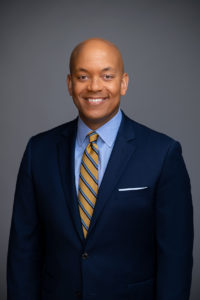
Geoff Bennett
Broadcaster
5
APPEARANCES
5
PODCASTS
Aug 28, 2026

speaker_14UNKNOWN
If they had just

Geoffrey BennettGUEST
So you're, yeah, you're sharing an experience that people have had throughout history, ever since people have been able to observe this, uh, have been on this planet, we've observed the sky and been able to watch phenomena like this.

Geoffrey BennettGUEST
You know, I'm personally very curious to see how much of the redness we'll see.
Geoffrey BennettGUEST
The redness comes from light that's coming from Earth's atmosphere and that sort of ring around the Earth that would be visible from the moon, and it's very, very dim compared to the sun's light that you see in the part of the moon that's still fully sunlit.
Geoffrey BennettGUEST
So it's that full sunlit part is going to be bright enough to overwhelm part of that redness that we would see during a total lunar eclipse.

Geoff BennettGUEST
And what's so interesting about the origins of black comedic expression is that black comedy in America didn't begin with black people controlling the joke.
Geoff BennettGUEST
And it was built on caricatures of black life that were meant to reassure white audiences about the country's racial order.
Geoff BennettGUEST
And so you had black people portrayed as lazy and ignorant and childlike and hypersexual and really just content in their oppression.
Geoff BennettGUEST
And these performances, they really reduced black humanity to a collection of stereotypes that could be laughed at without empathy.
13 MINS LATER
26:57
I'd love for you to say more about what was in the air, in the culture and in comedy that primed the pump for a show like this.

Geoff BennettGUEST
So the, the title is a play on laugh out loud, but the other side of this is exactly the point that you're picking up on.
Geoff BennettGUEST
For, for, for decades, for generations really, Black comedians had to perform inside other people's expectations of them.
Geoff BennettGUEST
That was true certainly of, of minstrelsy and vaudeville and even I would say some of the early sitcoms.
Geoff BennettGUEST
Um, and over time, what became true was that as you had Black showrunners, Black writers, Black creators behind these different shows and, and, and sitcoms, you... what you had was Black life, different versions of Black life in full color and fully out loud.
Geoff BennettGUEST
And the, the, the frame for the storytelling wasn't that it was, you know, Black comedians or Black performers trying to translate Black life for other audiences.
Geoff BennettGUEST
These were very specific, very authentic [laughs] depictions of Black life, primarily for Black people.
17 MINS LATER

Tiffany HansenHOST
I really do attribute our increasing othering intolerance and open racism to the disappearance of these shows, and even the absence of The Oprah Winfrey Show," Jeff.
Geoff BennettGUEST
So the business decision that led to the flourishing of those shows, there was a business decision that led to the unwinding of it.
Geoff BennettGUEST
So whereas Barry Diller says, "I want to find new demographics and a new viewer base," and at the time, Black and urban viewers were over-represented in their TV watching.
Geoff BennettGUEST
Toward the end of the '90s, what you get is the beginnings of reality TV, so it's much cheaper than scripted television, and you also have a decision by the networks and by advertisers to effectively pivot.
Geoff BennettGUEST
We've built these networks, and this wasn't necessarily explicitly stated, but we've built these networks, uh, primarily on, you know, based on Black viewers and urban viewership, but we believe that there is a, a more affluent, a more loyal consumer base, and we are go- going to basically shift our programming to reach those audiences.
9 MINS LATER
Tiffany HansenHOST
I wonder, I wanna get back though, Jeff, to this notion that, um, that the fracturing of media is somehow diluting, um, the experience because, a- and I alluded to streaming before, but I think if you talk about streaming, and we're seeing shows now that are, um, I think of, I'm thinking of, like, Madea, let's say, that is exclusively pretty much streamed, right? There are, you know, some theatrical performances, but what has streaming done to fracture the audience in a way that we're not coming together, not just in a shared experience, but in an experience where, as you say, we're learning to understand an experience that isn't our own, someone who has a life that is completely different than mine, who is still funny, uh, and I'm able to laugh at it? And we're kind of losing that even more.

Stephen DubnerHOST
The more multidisciplinary journalism can get, the better.
Geoff BennettGUEST
One more question about process that's not specific to journalism, because I am really interested in how the data guy and the storyteller find a shared voice.
Geoff BennettGUEST
There are a million reasons why a collaboration like that should not work, but yours did work.
26 MINS LATER
Stephen DubnerHOST
(laughs)
Geoff BennettGUEST
I want to talk about the business of what you do and the medium, because you had the book then you launched a blog, then the podcast.
Geoff BennettGUEST
And the blog and the podcast existed long before blogs and podcasts were even a thing.