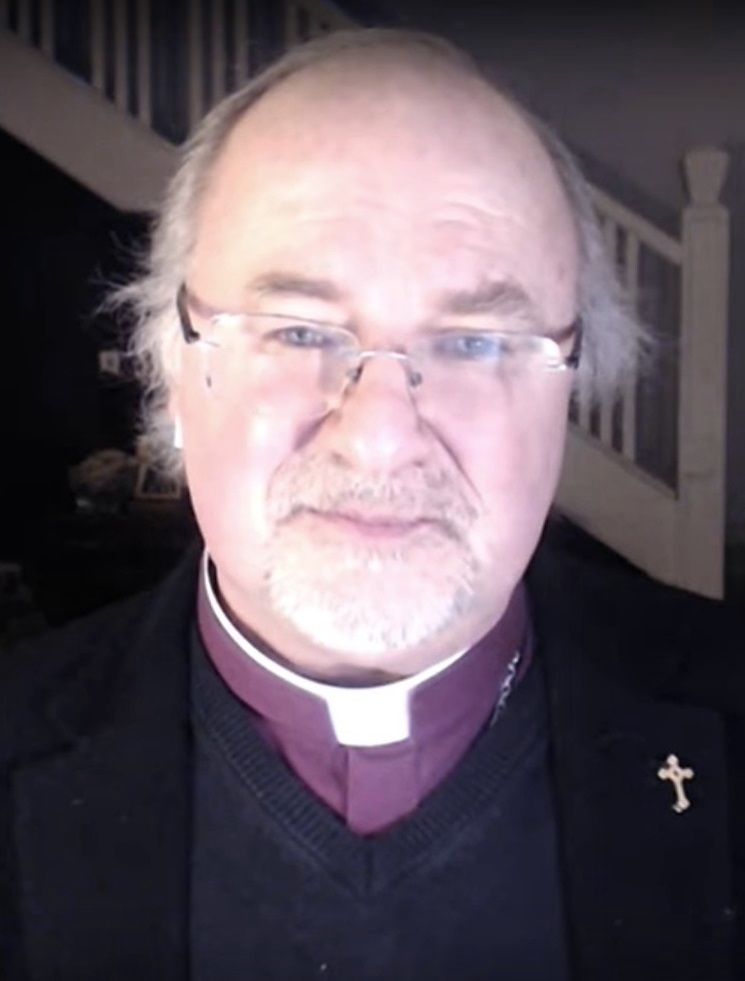
Gavin Ashenden
Author
14
APPEARANCES
11
PODCASTS
Nov 18, 2026

LaurenHOST
I've never, you know, you've never been wrong.

Gavin AshendenGUEST
Well, one of the reasons I say this, and again, I apologise to people if this sounds too much to believe.
Gavin AshendenGUEST
And it is secondhand in the sense that I'm reporting what my Muslim colleagues said to me.
Gavin AshendenGUEST
But in about 2005, I was talking to the particular academic who treated me to the inside story because he thought I was absolutely on their side and could be relied on to be sympathetic.
Gavin AshendenGUEST
And so one of the things that he talked about was, I mean, what happened was we had a, I planned a big symposium at the university.
9 MINS LATER
LaurenHOST
I mean, it's just unbelievable when we also go back and we think we are in this position and largely King Charles has played a pivotal role in this.

Gavin AshendenGUEST
Well, it's all part of the long, slow, inexorable Islamization of our culture.
Gavin AshendenGUEST
It starts off with worse elements, given the fact we've got effectively an Islamic blasphemy law.
Gavin AshendenGUEST
There's been a tweet going around of a video of a political commentator, a nice commentator, A black lady saying, I can say anything I like about Jesus, no one blushes or does anything.
Gavin AshendenGUEST
This is part of the process of Islamicization, and it's intended to make Islamic culture normative in our society.
Gavin AshendenGUEST
But one of the things that we need to keep on saying is there are some very good things about our culture, including the fact that genetically, the way we mate and the way we actually reproduce ourselves, it's healthier than if you allow cousin marriage, which is unhealthy and problematic.
Gavin AshendenGUEST
... that hatred has got smuggled in in any kind of, you know, through any of the defenses we have.
Gavin AshendenGUEST
And so he had an angel that come to him, and he said to the Jews, "Hey, I'm your latest prophet." And the Jews listened to him, and they said, "We think you've got it dreadfully wrong.
13 MINS LATER

Kevin O'SullivanHOST
Uh, and, uh, do you think this debate is worth having? Where do you stand on it, Gavin?
Gavin AshendenGUEST
But the thing is, I'd been listening to some survivor stories from the Twin Towers, people climbing down burning staircases and losing their friends and remembering that the lives lost was over 2000 innocent Americans in New York.
Gavin AshendenGUEST
And so when I saw this, I retweeted it saying, you know, silly Archbishop, this is ridiculous.


Gavin AshendenGUEST
The problem, I think, is that he's bringing Harry into his camp to take vengeance against his father.
Gavin AshendenGUEST
And so I'm afraid that what we're going to see is an ongoing guerrilla or civil war at the top of society between the Spencers and the Windsors in which some very nasty things are said and imputed.
Gavin AshendenGUEST
Harry and Meghan began it by... suggesting that somewhere in the Windsors there was a racist and we all wondered was it Prince Philip was it Princess Anne it set the question going in a really horrible again malicious way and the struggle between these two families is going to catch us all up and we could do without it it's very I'm very sorry I'm sorry for everyone involved particularly as it opens the wounds again that that were so fresh when Diana died, and divided society against itself.


Marcus PeterHOST
Might I prevail upon you to share that... arduous, painful story? And you can give us the SparkNotes version as the young people are seeing it today.
Gavin AshendenGUEST
One of the things that lies behind this is that in the early 1980s, I used to do, I got involved in Bible smuggling behind the Soviet Union.
Gavin AshendenGUEST
And I don't say that to present a cool profile, but because it gave me an experience of totalitarianism, Marxist totalitarianism, that has marked me forever, partly because I got arrested and interrogated and in trouble with the authorities, but I'd read enough of what was going on to know what the reality was, and that was why I was there in the first place.
Gavin AshendenGUEST
And I assumed in 1989, for those who remember these years, that along with a Japanese historian, Fukuyama, that this was indeed the end of history.
Gavin AshendenGUEST
Liberal democracy and capitalism had won out over its major foe, marxist leninism and and it was just a matter of building a consumer paradise with as much christianity built in to get people to heaven at the same time what i didn't realize was that there was a plan b um and that that was going to come at us as cultural marxism or the wokery or progressive um values and that the revolution that had been attempted in terms of the bourgeois being overturned by the proletariat, was going to happen in a different framework.
Gavin AshendenGUEST
It was going to be the redistribution of power from the framework that Christendom had left and was in place.
Gavin AshendenGUEST
One of the people who the commentators was very helpful was Jordan Peterson, and he framed it in terms of a challenge between uh forced equity the equality of outcome which is not the same as equality of opportunity versus competence competence knows no barriers i mean inevitably there are going to be cultural constraints um but the fact is that in in the arts and in sport and in in the academy um although there might be some genetic factors basically competence doesn't belong to any group It's the way you're made most of the time.
8 MINS LATER
Marcus PeterHOST
And so to dive deeper into this life of being stalwart and your Marian devotion and this piece about the Proto-Evangelium of James.

Peter McIlvennaHOST
Um, tell us a little bit about how that kind of structural unity is, is actually achieved, and is it actually true, or is there actually unity there?
18 MINS LATER

Gavin AshendenGUEST
So your readers probably know that Lewis thought that he could argue people into the kingdom of heaven until he came across a very clever Catholic woman theologian whose name begins with A. Wasn't Arbuthnot, but it'll come to me in a moment, and she trounced him in the Socratic, in a public debate in Oxford [laughs].
Gavin AshendenGUEST
And he was so demoralized by this, um, Anstruthers maybe, um, that he, he withdrew from public debate for a year, having had a huge, terrible crisis, and at that point, demoralized and depressed, began to write Narnia stories.
Gavin AshendenGUEST
Now, his Narnia stories were much more, a much more powerful vehicle of the Christian mind than his in, extremely sophisticated intellectual debates in the Socratic Club.
Gavin AshendenGUEST
And so if we look at the Narnia stories, uh, or, or the, the, the great myths that Tolkien wrote, what we find there is a retelling of the drama of the human being in relation to God and good and evil that anyone can get.
Gavin AshendenGUEST
And so people who are not terribly educated and have used their artisan skills get it at a, at a, at a straightforward level, and people who've been playing international gymnastics with their mind all years long, uh, get it in a more abstruse level, but everyone gets it.
Gavin AshendenGUEST
And, and my problem with, with doing very clever theology and philosophy is it's, it's a game for some very sophisticated people, and I've never seen it make people holier.

Gavin AshendenGUEST
But, um, as Christians, what we need to be doing is doing the kind of theology, uh, that makes us holier, and that's why I think this, the pursuit of the Christian mind.


Gavin AshendenGUEST
Well, it may go back to a very strange experience I had when I was 19 and I drunk myself to death.
Gavin AshendenGUEST
I'd had a fight the night before because I was with some musicians and the man employing us was stealing our money.
Gavin AshendenGUEST
And he said, would you persuade him with your honeyed words to give him the money we need to go to conservatoire and i ended up by using all my arts of persuasion by picking him up by his lapels and banging him against the wall until he said i'll give it back to you however they didn't i i didn't react very well to this show and i i drunk a liter of vodka and i had one of those classic near-death experiences later on i became a professor of the psychology of religion for 25 years and i interested myself professionally into intellectually in this phenomena They're really quite common.
Gavin AshendenGUEST
But in my case, what matters most is I went to the light and I went to judgment.
23 MINS LATER
Gavin AshendenGUEST
well we're cooked the end is not in an eye the end has come i mean there isn't any way out of this in any in any in any sensible but but in a sense you know humanity's been here before i think of the black death this was wretched this terrible tickle rat born plague which killed 30 of people and destroyed the country for a very long time.
Gavin AshendenGUEST
There was a point when the Vikings came and invaded us and just ravaged, burned, raped and killed in the name of a very violent Teutonic god.
Gavin AshendenGUEST
I think one of the things I'm clear about is that the moments of of safety and of clarity are rare.
Gavin AshendenGUEST
This idea of the kind of democratic safe space is a very rare and fragile thing.
Gavin AshendenGUEST
Another reason for using it while we have and not be surprised that we're going to lose it.
Gavin AshendenGUEST
Effectively, we have, so we need to distinguish between process and content, I suppose.
17 MINS LATER


Karl StefanovicHOST
together.So, so why do you think, um, what the King did, and it was somewhat surreptitiously, I'm sure you'll agree, but why was it oath breaking?
Gavin AshendenGUEST
You can either say, um, [clears throat] look, it's a, it's a creative extension of some rather dull historic words that he was required to make.
Gavin AshendenGUEST
I mean, they're an oath that was put together by the English Parliament after a civil war, uh, several hundred years ago.


Veronica DudoHOST
While he grew up a Catholic, what more can you tell us about his current relationship with the church?
Gavin AshendenGUEST
Well, he's like a lot of people who've grown up a Catholic and then decided that they don't want to be Catholic.
Gavin AshendenGUEST
He has talked very fondly about the social teaching of the Catholic Church, but he essentially turned his back on it once he chose a secular agenda of egalitarianism, the DEI, woke agenda.
Gavin AshendenGUEST
particularly because it runs contrary to the Catholic faith, especially over any sense of anthropology and sexual ethics.
Gavin AshendenGUEST
So he's got a residual respect for his past and he speaks well of the Catholic Church and fondly.
Gavin AshendenGUEST
He was an altar boy, but it doesn't play any part in changing or shaping his political morality.
Gavin AshendenGUEST
There are lots of people who are socialists and who hold the same beliefs as he do who are atheists.
Veronica DudoHOST
What kind of politics does he favor? And also, what direction do you think he will take the United Kingdom, including its relationship with Europe?


Iain DaleHOST
Um, i-is he just talking motherhood and apple pie, or do you think there is a meaning behind his message?
Gavin AshendenGUEST
Um, but, but the problem is, I think, that, uh, um, what he's written in the Easter message isn't borne out in the actions of the government, so they, they don't represent what he's doing.
Gavin AshendenGUEST
And so we're, you know, one's grateful for the wishes, but they, they-- there's no cash value in them.
Gavin AshendenGUEST
I, I think you were quite right when you highlight the issue, what does division mean? Because the word gets used in two different contexts.
Gavin AshendenGUEST
Um, i-it's perfectly acceptable, as you say, when people are com-- uh, are sharing different political visions, then obviously we're divided between different worldviews.
Iain DaleHOST
sphere.Can you think of a single politician or a single prime minister in this country who's actually brought the country together rather than divided them?


Gavin AshendenGUEST
So if we start, I mean, this could be tedious to our listeners, but I'll try and make it interesting.
7 MINS LATER

Tim StanleyHOST
And that quiet faith, one thinks of David Cameron's Like Magic at Home, It Comes and Goes in the Chilterns, that quiet faith is actually where England